Navaratri: The Festival's Significance and the Journey of Inner Transformation
"Exploring the historical, spiritual, and symbolic significance of Navaratri, and how its nine days offer a framework for personal growth, self-mastery, and the evolution of human consciousness."
1. Introduction: The Deeper Meaning of Navaratri
Ancient traditions, scriptures, and cultural practices offer valuable insights into the accumulated wisdom of human civilization. Exploring their historical origins and symbolic meanings is not only an intellectual journey of discovery but also an opportunity to learn from the experiences, observations, and philosophical reflections of our ancestors. Although societies, technologies, and lifestyles have evolved dramatically over time, the fundamental aspects of human psychology have remained remarkably consistent throughout our species' history. Our fears, desires, ambitions, attachments, internal conflicts, and search for meaning continue to shape human behavior much as they did thousands of years ago. This continuity makes ancestral wisdom worth exploring, not as unquestionable truth, but as a valuable source of knowledge and perspectives that can deepen our understanding of ourselves and the world around us.
Navaratri (also called Navratri), meaning nine nights in Sanskrit (nava meaning nine and rātri meaning night), is one of Hinduism's most significant festivals, dedicated to the worship of the Divine Feminine, or Shakti - the fundamental cosmic power associated with creation, preservation, transformation, and the dynamic expression of existence.
While Navaratri is widely celebrated through rituals, fasting, music, dance, and devotion, its philosophical significance extends beyond religious observance. It can also be understood as an allegory for the struggles and transformations that characterize human existence.

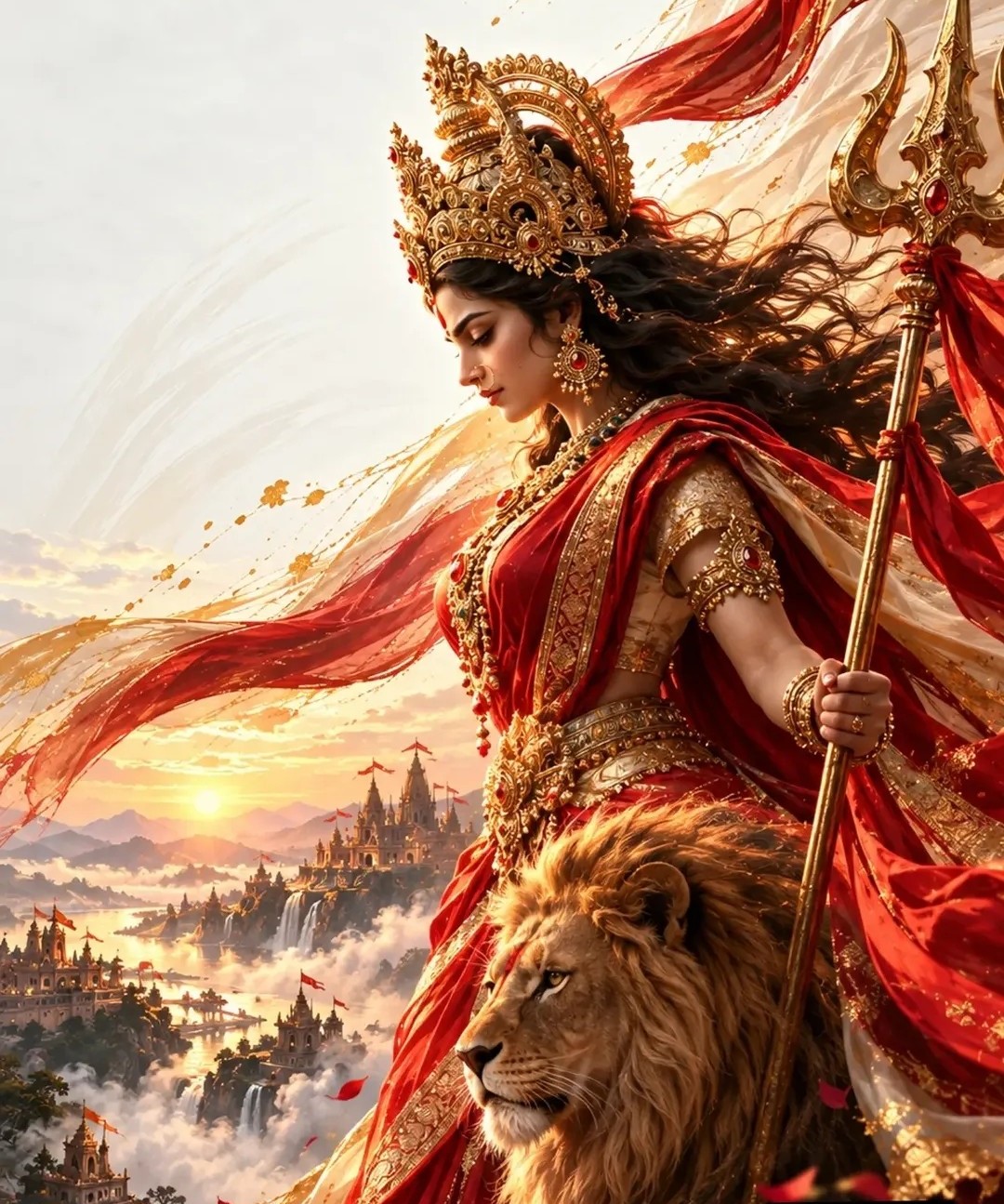
The lion represents instinctive power, while Durga represents the higher consciousness capable of directing that power. In Hindu iconography, a deity's vahana often expresses aspects of the deity's nature, powers, or relationship with the natural world. Durga riding a lion conveys that she possesses and directs extraordinary power.
The festival celebrates the triumph of Goddess Durga over Mahishasura, the buffalo demon, symbolizing the victory of dharma over adharma, knowledge over ignorance, and disciplined consciousness over destructive tendencies. Navaratri draws upon the rich philosophical and mythological traditions of Shaktism, particularly those found in two important Hindu scriptures - Markandeya Purana - The Triumph of Divine Power and Devi Bhagavata Purana - The Philosophy and Rituals of Divine Energy.
At a deeper level, the nine nights can be interpreted as a progressive journey of inner transformation - from developing stability and self-discipline to cultivating wisdom, courage, compassion, and ultimately self-realization.
In the widely observed Navadurga tradition, each day honors a different manifestation of Goddess Durga. Each form represents particular divine qualities, which can also serve as inspiration for developing human character.
Importantly, this psychological interpretation is a contemporary philosophical reading of the symbolism, not a claim that every ritual or goddess was historically intended to represent a specific stage of psychological development.
2. Historical and Scriptural Foundations
2.1 The Origins of Shakti Worship
The worship of female divinities in the Indian subcontinent has a long and complex history, encompassing local goddess traditions, Vedic references, Purāṇic narratives, and later Śākta philosophical and Tantric developments.
One important early expression of divine feminine power appears in the Devī Sūkta (Ṛgveda 10.125), in which the goddess Vāk speaks as a cosmic power operating through gods, nature, and living beings.
The Devī Māhātmya, composed approximately between the fifth and sixth centuries CE and incorporated into the Mārkaṇḍeya Purāṇa, became one of the foundational scriptures of goddess worship. It describes the Goddess defeating forces such as Madhu-Kaiṭabha, Mahiṣāsura, and Śumbha-Niśumbha.
The Navadurga tradition identifies nine forms of Durga, while other Navaratri traditions emphasize different goddesses, narratives, and ritual sequences.
2.2 Why Nine Nights?
Nine has symbolic importance in several Hindu traditions, but there is no single universally accepted explanation for why Navaratri lasts nine nights.
Within a spiritual interpretation, nighttime can represent introspection, withdrawal from external distractions, and confrontation with aspects of ourselves that remain hidden during ordinary activity.
The progression through nine nights can therefore be understood as a metaphorical movement from inner uncertainty toward clarity.
2.3 Regional Diversity
Navaratri is not celebrated identically throughout India. In Bengal, Durga Puja prominently celebrates the Goddess's victory over Mahishasura. In Gujarat, Garba and Dandiya Raas express communal devotion through dance. In parts of South India, Golu displays, Saraswati Puja, and Ayudha Puja emphasize knowledge, creativity, and reverence for the instruments of work.
These traditions share a broad reverence for divine power while preserving distinctive histories and meanings.
3. The Nine Days: Symbolism and Modern Application
Day 1: Shailaputri - Stability and Grounding
Traditional significance - Shailaputri, the daughter of the mountains, is associated with Parvati's birth as the daughter of Himavan. She is commonly depicted riding a bull, holding a trident and lotus.
Symbolic interpretation - The mountain represents firmness, endurance, and a stable foundation.
Modern application - Before pursuing ambitious goals, individuals need stability in their principles, habits, health, and judgment. Progress without a stable foundation can become fragile.
Reflection - What are the foundational values upon which I build my decisions?
Day 2: Brahmacharini - Discipline and Perseverance
Traditional significance - Brahmacharini represents Parvati's austere spiritual practice undertaken in pursuit of union with Shiva. She carries a rosary and water vessel.
Symbolic interpretation - Her austerity represents the ability to pursue meaningful objectives despite discomfort and delayed rewards.
Modern application - In an environment dominated by instant gratification, sustained attention and deliberate practice are increasingly valuable. Expertise, physical fitness, and intellectual growth require consistent effort.
Reflection - Am I choosing immediate comfort over long-term development?
Day 3: Chandraghanta - Courage and Composure
Traditional significance - Chandraghanta is depicted with a crescent-shaped ornament resembling a bell on her forehead. Her iconography combines a warrior's readiness with divine grace.
Symbolic interpretation - Courage is not merely the absence of fear, but the capacity to act responsibly despite fear.
Modern application - Effective leadership requires the ability to confront difficult situations while maintaining emotional balance. Aggression without composure is destructive; composure without courage can become passivity.
Reflection - Can I confront difficult truths without losing my inner balance?
Day 4: Kushmanda - Creation and Possibility
Traditional significance - Kushmanda is associated in devotional traditions with the creation of the cosmic egg and the emergence of the universe through her divine energy.
Symbolic interpretation - She represents the creative potential through which possibilities become realities.
Modern application - Human progress depends not only on solving existing problems but also on imagining possibilities that do not yet exist. Scientific discoveries, inventions, and social transformations begin with creative thought followed by sustained action.
Reflection - Am I merely reacting to circumstances, or actively creating something meaningful?
Day 5: Skandamata - Compassion and Responsibility
Traditional significance - Skandamata is revered as the mother of Skanda, also known as Kartikeya. She is commonly depicted holding her child.
Symbolic interpretation - Her maternal aspect symbolizes nurturing, protection, and responsibility for the well-being of others.
Modern application - Individual achievement acquires greater meaning when combined with concern for others. Parenthood, mentorship, leadership, and community service require the ability to place collective well-being alongside personal ambition.
Reflection - Does my progress contribute to the growth and well-being of others?
Day 6: Katyayani - Justice and Decisive Action
Traditional significance - Katyayani is a warrior manifestation of the Goddess, associated with the sage Katyayana and, in several traditions, the defeat of Mahishasura.
Symbolic interpretation - She represents the courage to oppose injustice and the determination to translate conviction into action.
Modern application - Knowledge of what is right has limited value unless it influences behavior. Ethical leadership requires confronting misconduct, defending principles, and making difficult decisions even when doing so carries personal costs.
Reflection - Do I act upon my principles when they are challenged?
Day 7: Kalaratri - Confronting Darkness and Ignorance
Traditional significance - Kalaratri is a fierce form of Durga, associated with the destruction of destructive forces and the removal of fear.
Symbolic interpretation - Darkness can represent ignorance, attachment, destructive habits, and the uncomfortable realities that people avoid confronting.
Modern application - Personal transformation often requires examining one's biases, limitations, fears, and mistaken beliefs. Critical thinking and self-awareness demand intellectual courage - the willingness to discover that one's assumptions may be wrong.
Reflection - Which uncomfortable truths am I avoiding because they challenge my identity or beliefs?
Day 8: Mahagauri - Purification and Inner Clarity
Traditional significance - Mahagauri is associated with purity, serenity, and the transformative power of spiritual austerity.
Symbolic interpretation - Purification can be understood as the gradual removal of ignorance, harmful tendencies, and unnecessary mental attachments.
Modern application - Mental clarity develops when individuals learn to distinguish meaningful concerns from distractions, facts from assumptions, and genuine needs from manufactured desires.
Reflection - What unnecessary attachments or mental habits prevent me from seeing reality clearly?
Day 9: Siddhidatri - Wisdom and Self-Realization
Traditional significance - Siddhidatri is regarded as the bestower of siddhis, or extraordinary spiritual attainments. She represents the culmination of the Navadurga sequence.
Symbolic interpretation - Rather than interpreting spiritual attainment merely as supernatural power, a philosophical reading emphasizes mastery over one's impulses, understanding of the self, and freedom from limiting attachments.
Modern application - The highest expression of personal growth may not be wealth, influence, or technical capability, but the wisdom to use one's abilities responsibly.
Reflection - Am I becoming merely more capable, or also more conscious of how I use my capabilities?
4. The Nine Days as a Framework for Human Development
The Navadurga sequence can be interpreted as a coherent progression of human development. The following is a modern philosophical synthesis rather than a fixed scriptural classification.
| Day | Goddess | Inner quality | Contemporary relevance |
|---|---|---|---|
| 1 | Shailaputri | Stability | Strong values and foundations |
| 2 | Brahmacharini | Discipline | Consistency and perseverance |
| 3 | Chandraghanta | Courage | Emotional resilience |
| 4 | Kushmanda | Creativity | Innovation and constructive thinking |
| 5 | Skandamata | Compassion | Responsibility and empathy |
| 6 | Katyayani | Righteous action | Ethics and accountability |
| 7 | Kalaratri | Confronting ignorance | Self-examination and critical thinking |
| 8 | Mahagauri | Clarity | Mental refinement and detachment |
| 9 | Siddhidatri | Wisdom | Self-mastery and responsible capability |
This progression suggests that human development is multidimensional. Discipline without compassion can become rigidity. Courage without wisdom can become recklessness. Creativity without ethics can become destructive.
True development involves integrating these qualities rather than pursuing them independently.
5. The Symbolism of Durga and Mahishasura
One of the central narratives associated with Navaratri is the battle between Durga and Mahishasura.
In the Devī Māhātmya, Mahishasura is a powerful asura who threatens the cosmic order. The gods' combined energies manifest as the Goddess, who ultimately defeats him.
5.1 Mahishasura as a Symbol of the Uncontrolled Ego
Within a philosophical interpretation, Mahishasura can represent the ego when it becomes dominated by arrogance, attachment, aggression, and the desire for power without responsibility.
His ability to change forms offers a compelling metaphor for the adaptability of destructive tendencies.
Human ignorance rarely appears in only one form. It may manifest as anger in one situation, pride in another, and self-deception in yet another.
5.2 Durga as the Integration of Higher Human Qualities
Durga's many arms, each carrying different weapons or symbols, can be interpreted as representing the integration of multiple capabilities.
A sword may symbolize discernment, a shield protection, and a trident the power to overcome obstacles, although these associations vary across traditions.
The larger philosophical insight is that complex challenges rarely yield to a single virtue.
Overcoming ignorance may require knowledge, discipline, courage, compassion, and persistence acting together.
5.3 The Battle Within
The struggle between Durga and Mahishasura can therefore be interpreted not only as a cosmic confrontation between divine and demonic forces but also as a metaphor for the internal conflict between our higher aspirations and destructive tendencies.
The objective is not to eliminate individuality or suppress all desires. It is to develop sufficient awareness and self-mastery that our desires no longer govern us unconsciously.
6. Vijayadashami: The Victory of Conscious Action
The festival culminates in Vijayadashami, also known as Dussehra, celebrated on the tenth day.
Different traditions associate Vijayadashami with Durga's victory over Mahishasura, Rama's victory over Ravana, or the auspicious beginning of learning and new endeavors.
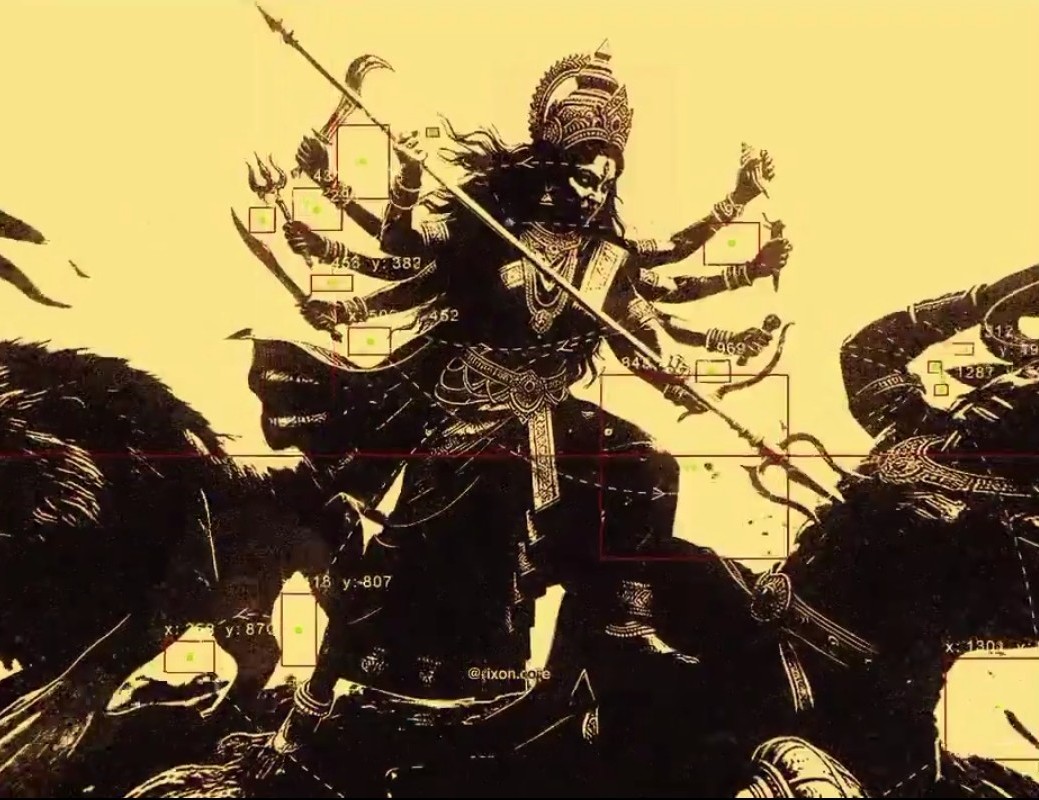
In the Devi Mahatmya, Durga battles Mahishasura's armies with terrifying intensity. Her lion attacks the demonic forces, her weapons destroy their ranks, and her divine power overwhelms the battlefield. When Mahishasura repeatedly changes forms to evade defeat, Durga remains relentless. Finally, she pins him down and strikes him with her trident as he emerges from his buffalo form, bringing his tyranny to an end.
The symbolism extends beyond the destruction of an external enemy.
The deeper victory is the transformation of the individual who confronts ignorance, cultivates wisdom, and learns to act in accordance with higher principles.
In contemporary life, this victory may take less dramatic forms - overcoming an unhealthy habit, correcting a deeply held misconception, resolving a conflict without hostility, or choosing ethical action over immediate personal advantage.
These victories may be invisible to others, yet they can fundamentally transform the direction of a person's life.
7. Navaratri in the Modern World: From Ritual to Conscious Practice
Religious rituals often function as recurring reminders of values that are difficult to sustain amid everyday responsibilities.
The symbolic significance of Navaratri becomes particularly relevant in a world characterized by accelerating technological development, constant information exposure, competitive pressures, and increasingly fragmented attention.
Ayigiri Nandini is also one of the most famous devotional songs associated with Goddess Durga. You can explore it on the shloka page here - Mahishasura Mardini Stotram (Ayigiri Nandini).
We have developed extraordinary capabilities to manipulate the external environment. Yet technological progress does not automatically produce emotional maturity, ethical judgment, or self-understanding.
The nine qualities associated with the Navadurga tradition offer a useful framework for addressing this imbalance.
For example, an engineer may possess the technical ability to create a powerful AI system, but discipline, ethical courage, compassion, and wisdom are necessary to determine how that system should be developed and used.
Similarly, a leader may possess authority and strategic intelligence but still fail without humility, emotional stability, and concern for others.
From this perspective, Navaratri becomes an invitation to examine whether our internal development is keeping pace with our external capabilities.
8. Conclusion: The Evolution of Inner Consciousness
Navaratri can be appreciated simultaneously as a religious celebration, a continuation of ancient cultural traditions, and a philosophical framework for personal transformation.
Its nine manifestations of the Divine Feminine offer distinct but complementary ideals - stability, discipline, courage, creativity, compassion, righteous action, confrontation with ignorance, clarity, and wisdom.
These qualities are not confined to a particular historical period. They remain relevant to human relationships, professional life, scientific inquiry, leadership, and the ethical challenges of modern civilization.
The enduring significance of Navaratri lies in the recognition that the greatest obstacles to human progress are not always external. They also emerge from within - through ignorance, unchecked desires, fear, arrogance, and the inability to examine our own assumptions.
The victory celebrated at the end of Navaratri can therefore be understood as more than the defeat of evil. It represents the possibility of elevating human consciousness through knowledge, self-discipline, compassion, and wisdom.
9. References and Further Reading
Primary scriptures
- Ṛgveda 10.125 - Devī Sūkta - An early Vedic expression of the divine feminine as cosmic power.
- Devī Māhātmya - Foundational scripture for the Goddess's battles against demonic forces.
- Devī Bhāgavata Purāṇa - An important Śākta Purāṇa exploring the Goddess as supreme reality.
Historical and philosophical studies
- The Triumph of the Goddess - C. Mackenzie Brown; a study of the theological development of Goddess traditions.
- Encountering the Goddess - Thomas B. Coburn; explores the religious and textual significance of the Devī Māhātmya.
- The Devī Gītā - The Song of the Goddess - C. Mackenzie Brown; an introduction to Śākta philosophy and the nature of divine consciousness.
Further philosophical exploration
For a broader interpretation of Shakti, consciousness, and the relationship between divine power and human transformation, the Devī Gītā, the Upanishads, and the Bhagavad Gītā offer complementary perspectives, although they emerge from different philosophical and theological contexts.