Ramayana Interpretation - Part 1
Overview
The Ramayana is one of the foundational Itihasas of the Hindu tradition - a sacred account of dharma, character, sacrifice, and divine purpose. Through the life of Rama, it explores how a person should respond when duty conflicts with desire, when righteousness demands sacrifice, and when personal suffering becomes part of a larger moral order. Its enduring power lies in the depth of its characters and in the timeless questions their choices continue to raise.
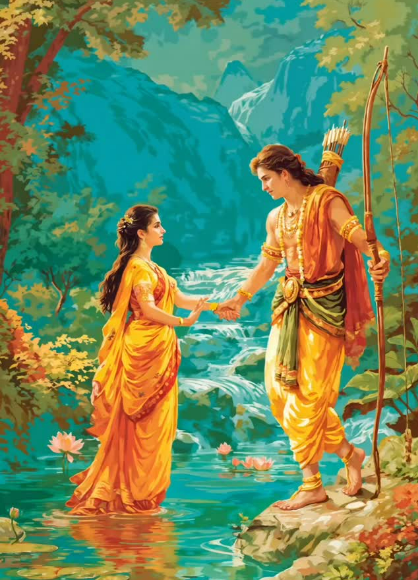
Source: ai.artera
The Ramayana is not only the story of Rama, Sita, Ravana, Hanuman, exile, devotion, and the victory of dharma. It is also an inner map of the human being. Traditionally attributed to Maharishi Valmiki, the Ramayana is one of the two great Sanskrit epics of ancient India, along with the Mahabharata. It is commonly divided into seven kandas: Bala, Ayodhya, Aranya, Kishkindha, Sundara, Yuddha, and Uttara Kanda. The epic narrates Rama’s life, his exile, Sita’s abduction by Ravana, the alliance with Hanuman and Sugriva, the war in Lanka, and the restoration of dharma.
But like the Mahabharata, the Ramayana can also be read as a psychological and spiritual allegory. Ayodhya is the inner kingdom. Rama is the divine order within consciousness. Sita is the pure heart, the soul’s sacred energy. Lakshmana is disciplined awareness. Hanuman is devotion in action. Ravana is the ego-intellect that has great power but is ruled by desire. Lanka is the golden fortress of material brilliance without inner surrender.
In this reading, the Ramayana is the story of how the soul loses contact with purity, searches for it through devotion and courage, defeats the egoic forces that have captured it, and restores divine order.
Source Lens: A Deeper Decoding of the Ramayana’s Psychological Forces
- Ayodhya is the kingdom of harmony.
- The forest is the field of testing.
- Lanka is the fortress of ego.
- The bridge to Lanka is disciplined spiritual effort.
- Hanuman is the power of devotion that can cross the impossible.
- Rama is dharma.
- Sita is purity.
- Ravana is desire crowned as intellect.
The Ramayana therefore asks:
- What rules my inner kingdom?
- Where has my purity been captured?
- Which force inside me is Rama?
- Which force is Ravana?
- And where is my Hanuman — the devotion strong enough to cross the ocean?
1. Rama: The Divine Self and the Principle of Dharma
Rama is the central figure of the Ramayana. He is the prince of Ayodhya, the son of Dasharatha and Kausalya, the husband of Sita, and the embodiment of dharma. In the traditional story, Rama accepts exile for fourteen years to honor his father’s promise, later searches for Sita after her abduction, defeats Ravana, and returns to Ayodhya.
Symbolically, Rama represents the divine Self within the human being. He is not merely a heroic prince. He is order, restraint, truth, courage, duty, compassion, and spiritual kingship.
Rama’s greatness lies in his alignment. He does not act according to personal convenience. He acts according to dharma. He accepts exile not because he is weak, but because he is inwardly sovereign. A person who can give up a kingdom without losing inner dignity is already a king.
| Aspect | Interpretation |
|---|---|
| Human or divine nature represented | dharma, divine order, self-mastery, moral clarity, inner kingship. |
| Distortion avoided by Rama | egoic reaction, selfish entitlement, emotional impulsiveness. |
| Why Rama acts as he does | Rama acts from alignment with dharma, not from personal preference. His life shows that true greatness is not doing whatever one wants; it is doing what is right even when it costs comfort. |
| Purpose in the epic | Rama is the standard by which all other characters are measured. His presence reveals who is loyal, who is selfish, who is devoted, who is jealous, who is wise, and who is ruled by ego. |
| Inner lesson | The divine Self does not panic when life sends it into the forest. It remains Rama even in exile. |
| Inner question | When life takes away comfort, status, or certainty, do I remain aligned with dharma? |
2. Sita: The Pure Heart and Sacred Inner Energy
Sita is the daughter of Janaka, wife of Rama, and one of the most revered figures in the Ramayana. In the outer story, she follows Rama into exile, is abducted by Ravana, remains in Lanka, and becomes the central reason for Rama’s war against Ravana.
Symbolically, Sita represents purity, inner beauty, devotion, sacred feminine energy, and the heart’s uncorrupted essence. She is not weak. Her strength is not loud like a warrior’s. Her strength is endurance, clarity, refusal to submit to Ravana, and unwavering inner loyalty to Rama.
Ravana can physically take Sita to Lanka, but he cannot possess her heart. This is one of the deepest symbolic points of the Ramayana. The ego may capture the outer life, but it cannot truly own purity unless purity consents. Sita remains inwardly free.
| Aspect | Interpretation |
|---|---|
| Human or divine nature represented | purity, devotion, sacred dignity, inner feminine strength, soul-energy. |
| Distortion | emotional vulnerability when separated from wisdom; innocence exposed to deception. |
| Why Sita acts as she does | Sita follows Rama because love and dharma are inseparable for her. She refuses Ravana because purity cannot unite with ego, no matter how powerful or wealthy ego appears. |
| Purpose in the epic | Sita is the soul’s sacred treasure. The entire epic becomes a journey to recover her — meaning, to recover purity, devotion, and the heart’s original alignment with dharma. |
| Inner lesson | The pure heart may be surrounded by darkness, but it does not have to surrender to darkness. |
| Inner question | What part of my inner purity has been taken into the Lanka of ego, distraction, or desire? |
3. Lakshmana: Disciplined Awareness and Protective Devotion
Lakshmana is Rama’s brother and constant companion during exile. He leaves royal comfort to serve Rama and Sita in the forest. He represents intense loyalty, vigilance, discipline, and protective awareness.
Symbolically, Lakshmana is the focused mind that guards dharma. If Rama is the divine Self and Sita is the pure heart, Lakshmana is the disciplined awareness that protects both.
He is alert, sharp, and uncompromising. His strength lies in service. He does not seek the throne, recognition, or personal comfort. He wants only to be near Rama and serve the cause of dharma.
| Aspect | Interpretation |
|---|---|
| Human nature represented | discipline, alertness, loyalty, self-control, protective intelligence. |
| Distortion | intensity, anger, harshness, overprotectiveness. |
| Why Lakshmana acts as he does | He acts from brotherly devotion and spiritual loyalty. He cannot imagine a life separate from Rama because disciplined awareness cannot be separate from the divine Self. |
| Purpose in the epic | Lakshmana protects the sacred order around Rama and Sita. He is the boundary, the watchfulness, the strength that keeps the inner forest-life from collapsing. |
| Inner lesson | Devotion needs discipline. Love without vigilance can be deceived. |
| Inner question | Do I have a Lakshmana within me — a disciplined awareness that protects my higher values? |
4. Hanuman: Devotion, Prana, and Impossible Courage
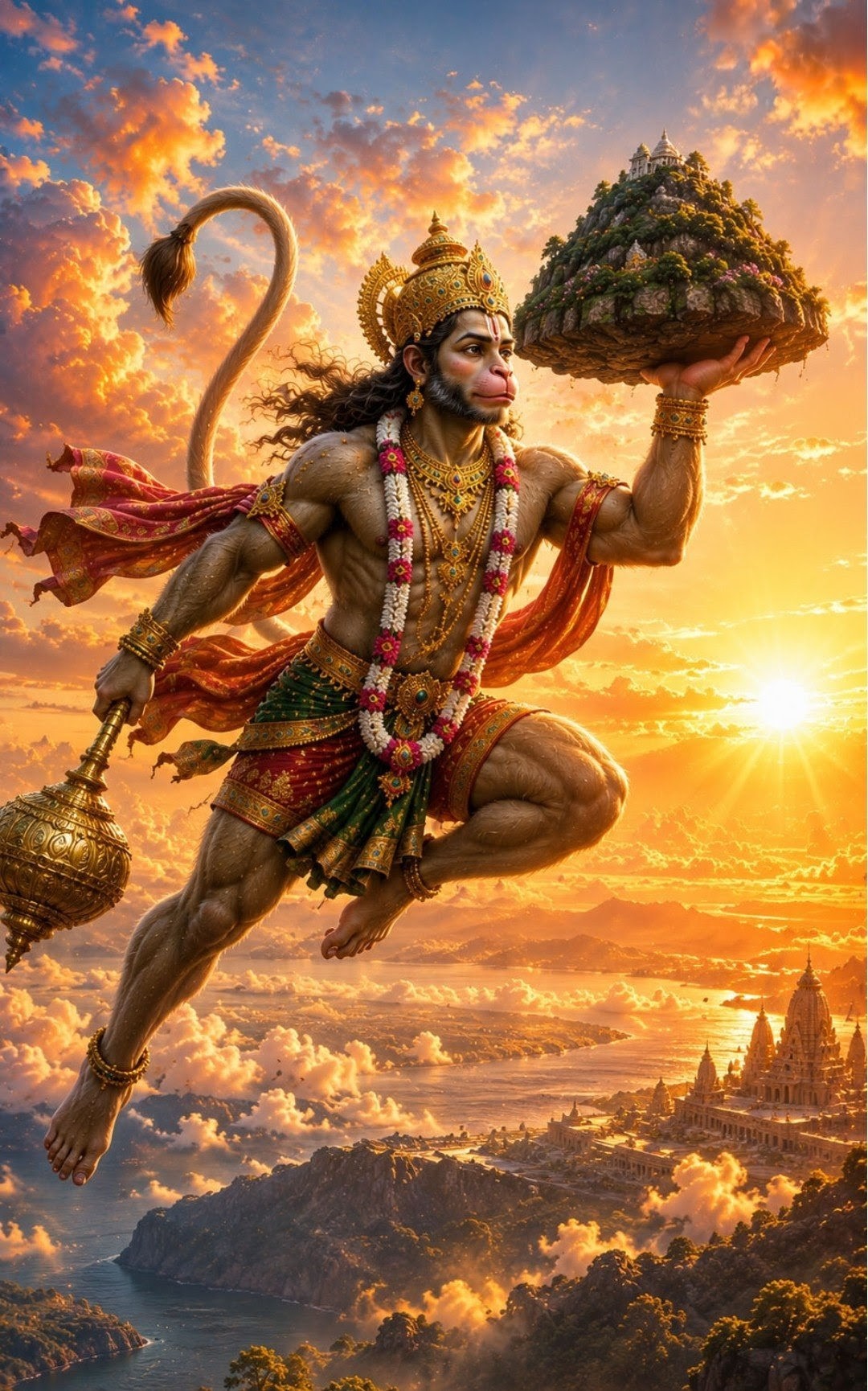
Hanuman is one of the greatest figures in the Ramayana. He is the servant of Rama, the messenger to Sita, the hero of Sundara Kanda, and the embodiment of devotion, strength, humility, and fearless service. The traditional story describes Hanuman crossing to Lanka, finding Sita, giving her Rama’s message, and later helping in the war. ([Maxwell School][2])
Symbolically, Hanuman represents bhakti in action. He is devotion that does not remain emotional; it becomes strength, intelligence, courage, humility, and service.
Hanuman can become small or vast. This is spiritually significant. True devotion is flexible. It becomes humble when humility is needed, powerful when strength is needed, subtle when intelligence is needed, and fearless when action is needed.
He crosses the ocean because devotion can cross what the ordinary mind thinks is impossible.
| Aspect | Interpretation |
|---|---|
| Human or divine nature represented | devotion, prana, courage, humility, service, spiritual strength. |
| Distortion avoided by Hanuman | pride in power, self-importance, laziness, doubt. |
| Why Hanuman acts as he does | He has no separate agenda. His strength belongs to Rama. That is why it becomes limitless. |
| Purpose in the epic | Hanuman reconnects Rama and Sita. Symbolically, devotion reconnects the divine Self and the pure heart. |
| Inner lesson | When devotion is pure, impossible distances become crossable. |
| Inner question | Is my strength serving my ego, or is it serving Rama? |
5. Bharata: Renunciation of Power and Loyalty to Truth
Bharata is Rama’s brother and the son of Kaikeyi. Because of Kaikeyi’s demand, Bharata is offered the throne in Rama’s place. But Bharata refuses to accept kingship as personal gain. He places Rama’s sandals on the throne and rules only as Rama’s representative.
Symbolically, Bharata represents humility, rightful loyalty, renunciation of undeserved power, and devotion to moral legitimacy.
He is one of the most psychologically important figures in the Ramayana because he proves that not everyone benefits from injustice merely because injustice benefits them. Bharata could have accepted the kingdom. Instead, he rejects the fruit of manipulation.
| Aspect | Interpretation |
|---|---|
| Human nature represented | humility, loyalty, moral legitimacy, self-restraint, brotherly love. |
| Distortion avoided by Bharata | opportunism, ambition, silent acceptance of wrongful gain. |
| Why Bharata acts as he does | He loves Rama and understands that power without dharma is not true kingship. |
| Purpose in the epic | Bharata shows the difference between possession and rightful authority. He teaches that a throne gained wrongly is not a blessing; it is a burden. |
| Inner lesson | Do not accept a benefit that comes through adharma. |
| Inner question | Have I ever accepted something outwardly useful but inwardly wrong? |
6. Shatrughna: The Quiet Destroyer of Inner Negativity
Shatrughna, the youngest brother, is less prominent than Rama, Lakshmana, and Bharata, but his name itself means “destroyer of enemies.” Symbolically, he represents quiet strength, background service, and the removal of hidden negativity.
Not every spiritual force is visible. Some parts of the inner life work silently. Shatrughna represents the quiet capacity to support dharma without needing central attention.
| Aspect | Interpretation |
|---|---|
| Human nature represented | quiet service, hidden strength, loyalty, removal of obstacles. |
| Distortion | passivity, being overshadowed, underused power. |
| Why Shatrughna acts as he does | His dharma is support. He does not need to be the center because his loyalty is not ego-driven. |
| Purpose in the epic | Shatrughna completes the fourfold royal brotherhood. He shows that dharma requires not only visible heroes, but also quiet forces that protect the structure of righteousness. |
| Inner lesson | Some of the most important work in life is done without applause. |
| Inner question | Can I serve dharma without needing recognition? |
7. Dasharatha: The Aging Mind Bound by Past Promises
Dasharatha is the king of Ayodhya and father of Rama, Bharata, Lakshmana, and Shatrughna. He loves Rama deeply, but because of an old promise to Kaikeyi, he is forced to send Rama into exile.
Symbolically, Dasharatha represents the aging human mind burdened by past actions, emotional attachment, and the consequences of promises made in earlier states of consciousness.
Dasharatha is not evil. He is loving, noble, and broken by the result of his own word. His tragedy is that he cannot free himself from the binding force of a promise once given.
| Aspect | Interpretation |
|---|---|
| Human nature represented | emotional attachment, royal responsibility, karmic consequence, helpless love. |
| Distortion | weakness through attachment, inability to act beyond past conditioning. |
| Why Dasharatha acts as he does | He is bound by his word and by his love. He cannot break his promise, but he also cannot emotionally survive its consequence. |
| Purpose in the epic | Dasharatha shows that even noble people may become trapped by past choices. Karma does not always arrive as punishment; sometimes it arrives as painful obligation. |
| Inner lesson | Be careful what you promise when emotion, desire, or gratitude is ruling you. |
| Inner question | What past commitment is still shaping my present life? |
8. Kausalya: Grief, Dignity, and Maternal Dharma
Kausalya is Rama’s mother and Dasharatha’s chief queen. Her role is marked by love, sorrow, restraint, and dignity.
Symbolically, Kausalya represents the motherly heart that must accept separation from what it loves most. She does not create the conflict, but she must endure its emotional cost.
Her pain is not weakness. It is the suffering of love under dharma. She wants Rama near her, but Rama must go to the forest. In that separation, Kausalya becomes the symbol of dignified grief.
| Aspect | Interpretation |
|---|---|
| Human nature represented | maternal love, emotional dignity, sorrow held within dharma. |
| Distortion | attachment, helpless grief, inability to release. |
| Why Kausalya acts as she does | She acts from love, but she does not become destructive in her sorrow. |
| Purpose in the epic | Kausalya shows that dharma does not remove grief. It gives grief a sacred container. |
| Inner lesson | Love must sometimes bless the path it does not want. |
| Inner question | Can I love deeply without trying to possess? |
9. Kaikeyi: Love Corrupted by Fear and Insecurity
Kaikeyi is Dasharatha’s queen and Bharata’s mother. She once saves Dasharatha and receives two boons. Later, influenced by Manthara, she asks that Bharata be crowned king and Rama be exiled for fourteen years.
Symbolically, Kaikeyi represents love corrupted by fear, insecurity, comparison, and the desire to secure one’s own child’s future at the cost of justice.
Kaikeyi is not simply a villain. That would be too shallow. She loves Bharata. But her love becomes possessive. Under Manthara’s influence, she begins to see Rama not as family, but as a threat.
| Aspect | Interpretation |
|---|---|
| Human nature represented | insecurity, possessive love, fear-based decision-making, maternal ambition. |
| Distortion | love becoming control, care becoming manipulation. |
| Why Kaikeyi acts as she does | She acts because fear enters her heart. Once fear enters love, love starts making adharmic calculations. |
| Purpose in the epic | Kaikeyi causes the exile, but the exile becomes the path through which Rama’s greatness is revealed. She becomes an instrument of destiny, even through error. |
| Inner lesson | When fear advises love, love becomes dangerous. |
| Inner question | Where has insecurity distorted my love into control? |
10. Manthara: The Crooked Whisper of Suspicion
Manthara is Kaikeyi’s maidservant, whose words awaken fear and jealousy in Kaikeyi’s mind.
Symbolically, Manthara represents the crooked inner whisper — suspicion, insecurity, comparison, and the voice that turns love into rivalry.
Manthara does not need a kingdom. Her power is psychological. She influences the one who has access to power. This makes her similar to the inner thought that quietly poisons perception.
- She is the voice that says:
- “You are being ignored.”
- “Someone else will take your place.”
- “You must act before you lose everything.”
- “Love is not enough; secure your advantage.”
| Aspect | Interpretation |
|---|---|
| Human nature represented | suspicion, manipulation, insecurity, poisonous advice. |
| Distortion | cleverness used to create division. |
| Why Manthara acts as she does | She acts from a distorted perception of threat and advantage. She sees harmony as danger. |
| Purpose in the epic | Manthara shows that kingdoms often fall first inside the mind, through a whisper before an action. |
| Inner lesson | Not every thought that claims to protect you is your friend. |
| Inner question | Which inner voice makes me suspicious of people I should trust? |
11. Vishwamitra: The Power of Tapas and Transformation
Vishwamitra is the sage who takes Rama and Lakshmana from Ayodhya to protect his sacrifice and later guides them toward important events, including Rama’s meeting with Sita.
Symbolically, Vishwamitra represents tapas — disciplined spiritual effort, transformation, and the power of a seeker who has struggled intensely to rise.
He was not always a sage in the simple sense; his story is connected to ambition, austerity, rivalry, and transformation. This makes him a powerful symbol: even restless ambition can become spiritual power if purified through tapas.
| Aspect | Interpretation |
|---|---|
| Human nature represented | discipline, transformation, spiritual effort, intense aspiration. |
| Distortion | pride in austerity, spiritual ambition, rivalry. |
| Why Vishwamitra acts as he does | He recognizes Rama’s divine purpose and helps bring it into action. He does not merely teach; he activates destiny. |
| Purpose in the epic | Vishwamitra takes Rama from protected royalty into the world of trial. He begins Rama’s movement from prince to world-restorer. |
| Inner lesson | Spiritual life begins when comfort is interrupted by a higher call. |
| Inner question | What discipline is calling me out of comfort and into growth? |
13. Janaka: The Philosopher-King and Detached Action
Janaka is the king of Mithila and father of Sita. He is often remembered as a philosopher-king — a ruler who combines worldly responsibility with spiritual detachment.
Symbolically, Janaka represents enlightened kingship, wisdom in action, and the possibility of living spiritually while fulfilling worldly duties.
He finds Sita and raises her with dignity. He also recognizes Rama’s worth through the breaking of Shiva’s bow. Janaka’s presence brings refinement, wisdom, and sacred order into the Ramayana.
| Aspect | Interpretation |
|---|---|
| Human nature represented | detachment, wisdom, noble responsibility, spiritual maturity. |
| Distortion avoided | escapism, dry intellectualism, worldly pride. |
| Why Janaka acts as he does | He acts from dharmic clarity. He does not cling possessively to Sita; he offers her through a sacred test of worth. |
| Purpose in the epic | Janaka shows that spirituality does not require abandoning responsibility. One can be a ruler and still be inwardly free. |
| Inner lesson | True detachment is not neglect. It is love without possession. |
| Inner question | Can I act fully in the world without being inwardly owned by it? |
14. Ahalya: Forgotten Purity and Redemption
Ahalya is associated with one of the early transformative episodes in the Ramayana. Her story carries themes of error, curse, stillness, purification, and liberation through Rama’s presence.
Symbolically, Ahalya represents purity obscured by mistake, shame, or spiritual sleep. She is not destroyed forever by her fall; she is restored.
Her story matters because it shows that Rama does not only defeat outer demons. His presence also awakens what has become frozen, hidden, or forgotten.
| Aspect | Interpretation |
|---|---|
| Human nature represented | fallen dignity, hidden purity, shame, possibility of redemption. |
| Distortion | spiritual numbness, self-condemnation, isolation. |
| Why Ahalya’s story matters | It shows that divine contact can restore what the world has judged as lost. |
| Purpose in the epic | Ahalya prepares the reader to understand Rama as purifier, not merely warrior. |
| Inner lesson | No part of the self is beyond awakening if touched by divine consciousness. |
| Inner question | What part of me has gone silent because of shame or past error? |
15. Shurpanakha: Unrestrained Desire and Rejected Impulse
Shurpanakha is Ravana’s sister. In the forest, she approaches Rama and Lakshmana with desire. Her humiliation becomes one of the events that leads to Ravana’s abduction of Sita.
Symbolically, Shurpanakha represents unrestrained desire, impulsive attraction, and the emotional storm that arises when desire is rejected.
She is important because the great war does not begin only with Ravana’s power. It begins with uncontrolled desire, insult, wounded pride, and escalation.
| Aspect | Interpretation |
|---|---|
| Human nature represented | impulse, uncontrolled desire, wounded attraction, emotional volatility. |
| Distortion | possessiveness, inability to accept refusal, revenge after rejection. |
| Why Shurpanakha acts as she does | She is ruled by immediate desire. When desire is denied, it turns into grievance. |
| Purpose in the epic | Shurpanakha shows how a single uncontrolled impulse can trigger a chain of destruction. |
| Inner lesson | Desire that cannot accept boundaries becomes dangerous. |
| Inner question | How do I react when life says no to my desire? |
16. Maricha: Deception, Illusion, and the Golden Deer
Maricha is the rakshasa who becomes the golden deer to lure Rama away from Sita. This episode is one of the most psychologically powerful moments in the Ramayana.
The golden deer represents maya — the glittering illusion that pulls awareness away from what it should protect.
Sita desires the deer. Rama pursues it. Lakshmana is drawn away. Ravana enters in disguise. Symbolically, this is the sequence of inner fall:
- First, illusion appears beautiful.
- Then the heart desires it.
- Then wisdom goes after it.
- Then discipline is pulled away.
- Then ego enters disguised as holiness.
- Then purity is captured.
| Aspect | Interpretation |
|---|---|
| Human nature represented | illusion, temptation, deceptive beauty, false appearance. |
| Distortion | fascination with what shines but is not real. |
| Why Maricha acts as he does | He becomes the instrument of Ravana’s plan, showing how illusion serves ego. |
| Purpose in the epic | Maricha reveals that the soul’s fall often begins not with something obviously ugly, but with something attractive. |
| Inner lesson | Not every golden thing is worth chasing. |
| Inner question | What golden deer is pulling my attention away from what truly matters? |
17. Ravana: The Ten-Headed Ego-Intellect
Ravana is the king of Lanka, a great scholar, powerful ruler, devotee of Shiva, and the abductor of Sita. He is not a simple villain. His greatness makes his fall more meaningful.
Symbolically, Ravana represents the ego-intellect at its most brilliant and dangerous. He has knowledge, power, wealth, austerity, and command. But he lacks surrender. He can master worlds, but not himself.
His ten heads can be read as the many-sided mind: intellect, desire, pride, ambition, anger, lust, attachment, control, memory, and egoic self-justification. He is not weak because he lacks knowledge. He falls because knowledge without humility becomes demonic.
Lanka is golden, but spiritually imprisoned. This is Ravana’s inner condition: magnificent outside, restless inside.
| Aspect | Interpretation |
|---|---|
| Human nature represented | ego, pride, brilliance without humility, desire crowned as power. |
| Distortion | misuse of knowledge, spiritual pride, possessiveness, domination. |
| Why Ravana acts as he does | He cannot accept limits. He sees Sita not as sacred, but as something to possess. His desire is not love; it is conquest. |
| Purpose in the epic | Ravana shows that even great tapas, knowledge, and power become destructive when ruled by ego. |
| Inner lesson | The real enemy is not intelligence. The real enemy is intelligence separated from humility. |
| Inner question | Where am I powerful, capable, or knowledgeable — but not surrendered to truth? |
18. Mandodari: Wisdom Trapped in the House of Ego
Mandodari is Ravana’s wife. She is often portrayed as wise, restrained, and aware of the danger of Ravana’s actions.
Symbolically, Mandodari represents the voice of wisdom trapped inside the palace of ego. She sees the danger, but cannot fully stop it.
This makes her tragic. Many people have a Mandodari within: a part that knows the ego is going too far, but lacks the authority to rule the inner kingdom.
| Aspect | Interpretation |
|---|---|
| Human nature represented | restrained wisdom, moral concern, grief inside egoic systems. |
| Distortion | inability to intervene strongly enough, sorrow without power. |
| Why Mandodari acts as she does | She understands consequences, but she is tied to Ravana’s world. |
| Purpose in the epic | Mandodari shows that even in Lanka, wisdom exists. But wisdom that cannot govern action becomes sorrow. |
| Inner lesson | It is not enough to know the truth privately. Truth must influence conduct. |
| Inner question | What truth do I know but fail to act upon? |
19. Vibhishana: Conscience That Leaves the Wrong Side
Vibhishana is Ravana’s brother. Unlike Ravana, he chooses dharma and eventually joins Rama.
Symbolically, Vibhishana represents conscience born inside the house of ego. He proves that even if one is born in Lanka, one does not have to serve Ravana.
He is similar in spirit to Yuyutsu in the Mahabharata. Both show that dharma is higher than family loyalty when family loyalty protects wrongdoing.
| Aspect | Interpretation |
|---|---|
| Human nature represented | conscience, ethical courage, spiritual discrimination, surrender to truth. |
| Distortion | pain of betrayal accusations, isolation from one’s own people. |
| Why Vibhishana acts as he does | He sees that Ravana’s path is destructive. He chooses truth over bloodline. |
| Purpose in the epic | Vibhishana proves that the ego-system can be internally rejected. Not every force born in darkness must remain dark. |
| Inner lesson | You are not obligated to support wrong just because it is familiar. |
| Inner question | Do I have the courage to leave my inner Lanka? |
20. Kumbhakarna: Sleeping Strength and Tamasic Power
Kumbhakarna is Ravana’s giant brother, known for immense sleep and immense strength.
Symbolically, Kumbhakarna represents tamas — inertia, unconsciousness, sleep, heaviness, and dormant power. He is strong, but not awake.
This is a very important psychological symbol. Many people have great strength, but it sleeps. When it finally awakens, it may serve the wrong master because it has not developed discrimination.
Kumbhakarna is not merely laziness. He is power without wakefulness.
| Aspect | Interpretation |
|---|---|
| Human nature represented | inertia, unconscious strength, heaviness, dormant potential. |
| Distortion | sleeping through truth, waking only to serve ego. |
| Why Kumbhakarna acts as he does | He is bound by loyalty to Ravana and by his own tamasic nature. Even when he understands some truth, he does not fully align with it. |
| Purpose in the epic | Kumbhakarna shows that strength without awakened discrimination can become a tool of adharma. |
| Inner lesson | Wakefulness matters more than size, strength, or capacity. |
| Inner question | What great strength in me is still asleep? |
21. Indrajit / Meghanada: Power of Egoic Achievement
Indrajit, also called Meghanada, is Ravana’s mighty son. His name means one who conquered Indra, symbolizing extraordinary power and accomplishment.
Symbolically, Indrajit represents achievement, mastery, and occult or strategic power used in service of ego. He is disciplined, powerful, and formidable, but his gifts serve Ravana’s kingdom.
He reminds us that not all discipline is spiritual. Even ego can be disciplined. Even ambition can be focused. Even darkness can perform austerity.
| Aspect | Interpretation |
|---|---|
| Human nature represented | ambition, technical mastery, strategic power, egoic achievement. |
| Distortion | using gifts to protect falsehood. |
| Why Indrajit acts as he does | He is loyal to Ravana and shaped by the pride of conquest. |
| Purpose in the epic | Indrajit shows that the forces opposing dharma may be highly trained, not merely crude. |
| Inner lesson | The value of power depends on what it serves. |
| Inner question | Are my achievements serving truth or ego? |
22. Sugriva: Fearful Potential Restored Through Alliance
Sugriva is the vanara king who has been driven away by his brother Vali. Rama helps him regain his kingdom, and Sugriva helps Rama search for Sita.
Symbolically, Sugriva represents lost confidence, wounded leadership, and potential waiting for the right alliance.
He is not perfect. After regaining power, he delays his duty until reminded. This makes him very human. He represents the part of us that wants help during suffering but may become forgetful after comfort returns.
| Aspect | Interpretation |
|---|---|
| Human nature represented | wounded leadership, fear, alliance, restored strength. |
| Distortion | forgetfulness after success, comfort after crisis. |
| Why Sugriva acts as he does | He begins from fear and displacement. Rama restores his confidence, but he must still learn responsibility. |
| Purpose in the epic | Sugriva shows that alliances are necessary in the search for lost purity. Even Rama works through relationships and networks of support. |
| Inner lesson | When life restores your strength, remember the promise you made during weakness. |
| Inner question | Have I forgotten a duty after regaining comfort? |
23. Vali: Misused Strength and Dominating Vitality
Vali is Sugriva’s powerful brother. He represents immense strength, but also domination, suspicion, and misuse of power.
Symbolically, Vali is the vital force that has become tyrannical. He is strong, but not just. His power overshadows Sugriva and creates imbalance.
Vali’s story is morally complex and often debated. That complexity is part of its significance. It forces readers to ask whether strength alone grants moral authority.
| Aspect | Interpretation |
|---|---|
| Human nature represented | dominance, raw vitality, pride in strength, possessiveness. |
| Distortion | using power to suppress others. |
| Why Vali acts as he does | He is ruled by confidence in his own strength and by suspicion toward Sugriva. |
| Purpose in the epic | Vali’s fall clears the way for Sugriva’s alliance with Rama and the search for Sita. |
| Inner lesson | Strength that violates fairness becomes an obstacle to dharma. |
| Inner question | Where do I use strength to dominate instead of protect? |
24. Tara: Wise Counsel Ignored by Power
Tara is Vali’s wife and one of the wisest voices in the Kishkindha section. She warns, advises, and sees danger clearly.
Symbolically, Tara represents intuitive political wisdom, emotional intelligence, and counsel that power often ignores.
She is similar to Mandodari in one way: both are wise women attached to powerful men whose actions bring destruction. But Tara’s wisdom is more practically expressed, and her presence helps stabilize the aftermath.
| Aspect | Interpretation |
|---|---|
| Human nature represented | wise counsel, emotional intelligence, foresight, stabilizing feminine wisdom. |
| Distortion | wisdom without final authority. |
| Why Tara acts as she does | She sees consequences before others do. Her intelligence is protective, not manipulative. |
| Purpose in the epic | Tara shows that feminine wisdom often sees the truth before masculine pride accepts it. |
| Inner lesson | Listen to the voice that sees consequences early. |
| Inner question | Whose wise warning am I ignoring? |
25. Angada: The Next Generation of Strength
Angada is the son of Vali and later serves Rama’s cause. He represents the next generation caught between old wounds and new dharma.
Symbolically, Angada is inherited strength redirected toward righteousness. Though his father falls in conflict with Rama, Angada does not become a prisoner of resentment.
This is important. The Ramayana shows that lineage matters, but it does not have to imprison the soul.
| Aspect | Interpretation |
|---|---|
| Human nature represented | inherited power, youthful courage, transition, loyalty redirected toward dharma. |
| Distortion | inherited resentment, identity conflict. |
| Why Angada acts as he does | He moves from the world of Vali into the larger mission of Rama. |
| Purpose in the epic | Angada shows that the next generation can transform the karma of the previous generation. |
| Inner lesson | You can inherit history without repeating it. |
| Inner question | What inherited pattern can I redirect toward a higher purpose? |
26. Jatayu: Courage That Defends Purity
Jatayu is the noble bird who tries to rescue Sita from Ravana. Though old and outmatched, he gives everything in defense of righteousness.
Symbolically, Jatayu represents courageous conscience. He knows he may not win, but he still acts.
This is one of the most moving lessons of the Ramayana. Dharma does not ask only whether success is guaranteed. Sometimes it asks whether one will stand for what is right even when success is unlikely.
| Aspect | Interpretation |
|---|---|
| Human nature represented | courage, sacrifice, protective conscience, noble resistance. |
| Distortion avoided | cowardice disguised as practicality. |
| Why Jatayu acts as he does | He recognizes adharma and refuses to remain passive. |
| Purpose in the epic | Jatayu proves that even a single being, aged and outmatched, can uphold dharma by resisting wrong. |
| Inner lesson | Do what is right even if you cannot control the outcome. |
| Inner question | When I see wrong, do I act — or do I calculate only my chances of winning? |
27. Sampati: Fallen Vision Restored for Dharma
Sampati, brother of Jatayu, helps the vanaras learn where Sita is. He once had great wings but lost them, and later becomes useful to Rama’s mission through his knowledge.
Symbolically, Sampati represents fallen vision, lost capacity, and the restoration of usefulness through service.
He cannot fly as before, but he can still see. This is a deep spiritual symbol: even when one capacity is lost, another may still serve dharma.
| Aspect | Interpretation |
|---|---|
| Human nature represented | wounded vision, memory, recovery of purpose, service after loss. |
| Distortion | despair over lost ability. |
| Why Sampati acts as he does | He becomes reconnected to purpose through Rama’s mission and his bond with Jatayu. |
| Purpose in the epic | Sampati helps reveal the direction to Lanka. He turns grief and limitation into guidance. |
| Inner lesson | Even a wounded life can point others toward truth. |
| Inner question | What ability remains in me that can still serve a higher purpose? |
28. The Ocean: The Barrier Between Devotion and the Captured Heart
The ocean between the mainland and Lanka is one of the great symbols of the Ramayana.
It represents the vast distance between the divine Self and the captured heart. Rama stands on one side. Sita is on the other. Between them is the ocean of separation — doubt, karma, fear, ignorance, and impossibility.
Hanuman crosses it by devotion. The vanaras bridge it by collective effort. Rama’s mission requires both inner faith and organized action.
| Aspect | Interpretation |
|---|---|
| Psychological force represented | separation, difficulty, karmic distance, the impossible gap. |
| Distortion | despair before large obstacles. |
| Purpose in the epic | The ocean shows that the path to recover purity is not casual. It requires courage, prayer, alliance, engineering, discipline, and grace. |
| Inner lesson | Some distances cannot be crossed by thought alone. They require devotion plus effort. |
| Inner question | What ocean stands between my current life and my highest self? |
29. The Bridge to Lanka: Spiritual Practice Made Visible
The bridge to Lanka represents disciplined practice. It is the moment when devotion becomes structure.
A bridge is not built by emotion alone. It requires cooperation, repeated effort, faith, and direction. Symbolically, this is sadhana — daily practice that allows consciousness to cross from helpless longing into transformative action.
| Aspect | Interpretation |
|---|---|
| Psychological force represented | discipline, collective effort, spiritual practice, practical devotion. |
| Distortion | wanting transformation without structure. |
| Purpose in the epic | The bridge shows that even divine missions require method. |
| Inner lesson | Devotion must become a bridge, not just a feeling. |
| Inner question | What daily practice is helping me build my bridge to Lanka? |
30. Lanka: The Golden Fortress of Ego
Lanka is wealthy, powerful, impressive, and ruled by Ravana. It is golden, but spiritually dark.
Symbolically, Lanka represents the egoic mind at its peak: brilliant, organized, luxurious, technologically or materially advanced, but cut off from dharma.
This is one of the Ramayana’s most modern lessons. A life can be successful outside and imprisoned inside. One can build a golden Lanka and still not have peace.
| Aspect | Interpretation |
|---|---|
| Psychological force represented | material brilliance without spiritual surrender. |
| Distortion | confusing wealth, power, or achievement with inner freedom. |
| Purpose in the epic | Lanka is the place where Sita is held captive. This means the pure heart can be trapped inside a life that appears outwardly successful. |
| Inner lesson | Gold is not the same as light. |
| Inner question | What part of my life looks golden but is not truly free? |
31. The Fire Test: Purity Beyond Public Judgment
The episode of Sita’s fire ordeal is one of the most difficult and debated parts of the Ramayana tradition. In symbolic reading, fire represents purification, truth, and the element before which falsehood cannot survive.
This episode should be handled carefully in any modern article. It should not be used to glorify suspicion or suffering. Psychologically, it can be read as the soul’s purity standing before the fire of scrutiny, pain, and public judgment.
Sita’s purity is not created by the fire. It is revealed through it.
| Aspect | Interpretation |
|---|---|
| Psychological force represented | purification, public judgment, truth under trial. |
| Distortion | society’s tendency to test the innocent instead of correcting the guilty. |
| Purpose in the epic | The episode forces the reader to confront the tension between personal truth, public perception, kingship, and the burden placed on purity. |
| Inner lesson | True purity is not dependent on public approval. |
| Inner question | Do I allow public opinion to define inner truth? |
32. Lava and Kusha: The Future Voice of the Story
Lava and Kusha are the sons of Rama and Sita. They later become connected with the telling of the Ramayana itself.
Symbolically, they represent the future born from separation, suffering, and truth. They are the next generation carrying the story forward.
Their existence shows that even after pain, the story does not end. Dharma must be retold, re-heard, and re-understood by future generations.
| Aspect | Interpretation |
|---|---|
| Human nature represented | renewal, memory, inheritance, the future voice of dharma. |
| Distortion | repeating the wounds of the past without understanding them. |
| Why Lava and Kusha matter | They transform family sorrow into sacred narrative. |
| Purpose in the epic | They ensure that the Ramayana becomes not only lived history, but transmitted wisdom. |
| Inner lesson | Your suffering can become wisdom if it is truthfully understood and passed on rightly. |
| Inner question | What story am I passing to the next generation? |
33. The Ramayana as Inner Sequence
The Ramayana can be read as a complete inner journey:
- Ayodhya is harmony.
- Rama is divine order.
- Sita is pure heart.
- Lakshmana is disciplined awareness.
- Kaikeyi is love corrupted by insecurity.
- Manthara is the whisper of suspicion.
- The exile is the soul entering the field of testing.
- The golden deer is illusion.
- Ravana is egoic desire.
- Lanka is material brilliance without surrender.
- Hanuman is devotion that crosses impossibility.
- The bridge is spiritual practice.
- The war is inner purification.
- The return to Ayodhya is restored consciousness.
In this symbolic reading, the Ramayana is not only about rescuing Sita from Ravana. It is about rescuing the pure heart from ego, illusion, distraction, and desire.
34. The Inner Characters in Daily Life
When you act from duty even when it is difficult, Rama is awake.
When your heart remains pure even in hostile surroundings, Sita is awake.
When you protect your values with discipline, Lakshmana is awake.
When you reject unfair advantage, Bharata is awake.
When you serve quietly, Shatrughna is awake.
When devotion becomes strength, Hanuman is awake.
When you listen to wise counsel, Tara and Vasistha are awake.
When you leave the wrong side for truth, Vibhishana is awake.
But when fear corrupts love, Kaikeyi is awake.
When suspicion whispers poison, Manthara is awake.
When glittering illusion distracts you, Maricha is awake.
When desire wants to possess purity, Ravana is awake.
When power sleeps through truth, Kumbhakarna is awake.
When achievement serves ego, Indrajit is awake.
When golden success hides inner captivity, Lanka is awake.
The Ramayana is therefore not only an ancient epic. It is a mirror of the inner kingdom.
Conclusion: The Purpose of the Ramayana’s Inner Battle
The Mahabharata shows the complexity of dharma in a divided world. The Ramayana shows the beauty of dharma embodied in a life of order, sacrifice, devotion, and restoration.
Its deeper message is not merely that Rama defeats Ravana. Its deeper message is that dharma must recover the heart from ego.
- Rama without Sita is divine order separated from living tenderness.
- Sita without Rama is purity surrounded by danger.
- Lakshmana without Rama is discipline without the divine center.
- Hanuman without Rama is strength without surrender.
- Ravana without humility is knowledge turned into domination.
- Lanka without dharma is success without peace.
The Ramayana teaches that every human being must protect inner Ayodhya, recognize the golden deer, resist Ravana, awaken Hanuman, build the bridge, recover Sita, and return the kingdom to Rama.
The real question is not only whether Rama lived long ago.
The real question is:
- Is Rama ruling within me?
- Is Sita safe within me?
- Is Hanuman awake within me?
- Is Ravana still sitting in some golden Lanka of my mind?