Krishna Avatar21 Most Important Events
Overview
Krishna is one of the most complete and multidimensional figures in Indian spiritual literature. In childhood, he is playful and miraculous. In youth, he is charming, musical, and deeply loved. In Mathura, he is the destroyer of tyranny. In Dwaraka, he is statesman and ruler. In the Mahabharatha, he is friend, strategist, peace messenger, protector of dharma, and the charioteer of Arjuna. In the Bhagavad Gita, he becomes the voice of divine wisdom itself. Krishna's avatar cannot be understood through one lens alone.
- He is child and cosmic Lord.
- He is playful and serious.
- He is loving and strategic.
- He is gentle with devotees and firm with adharma.
- He does not always fight directly, but he changes the direction of history.
- He does not merely preach dharma; he places people in situations where they must discover it.
Krishna's avatar is not linear in the ordinary sense. It is a complete mandala of divine action. His message is not simplistic comfort. It is living wisdom.
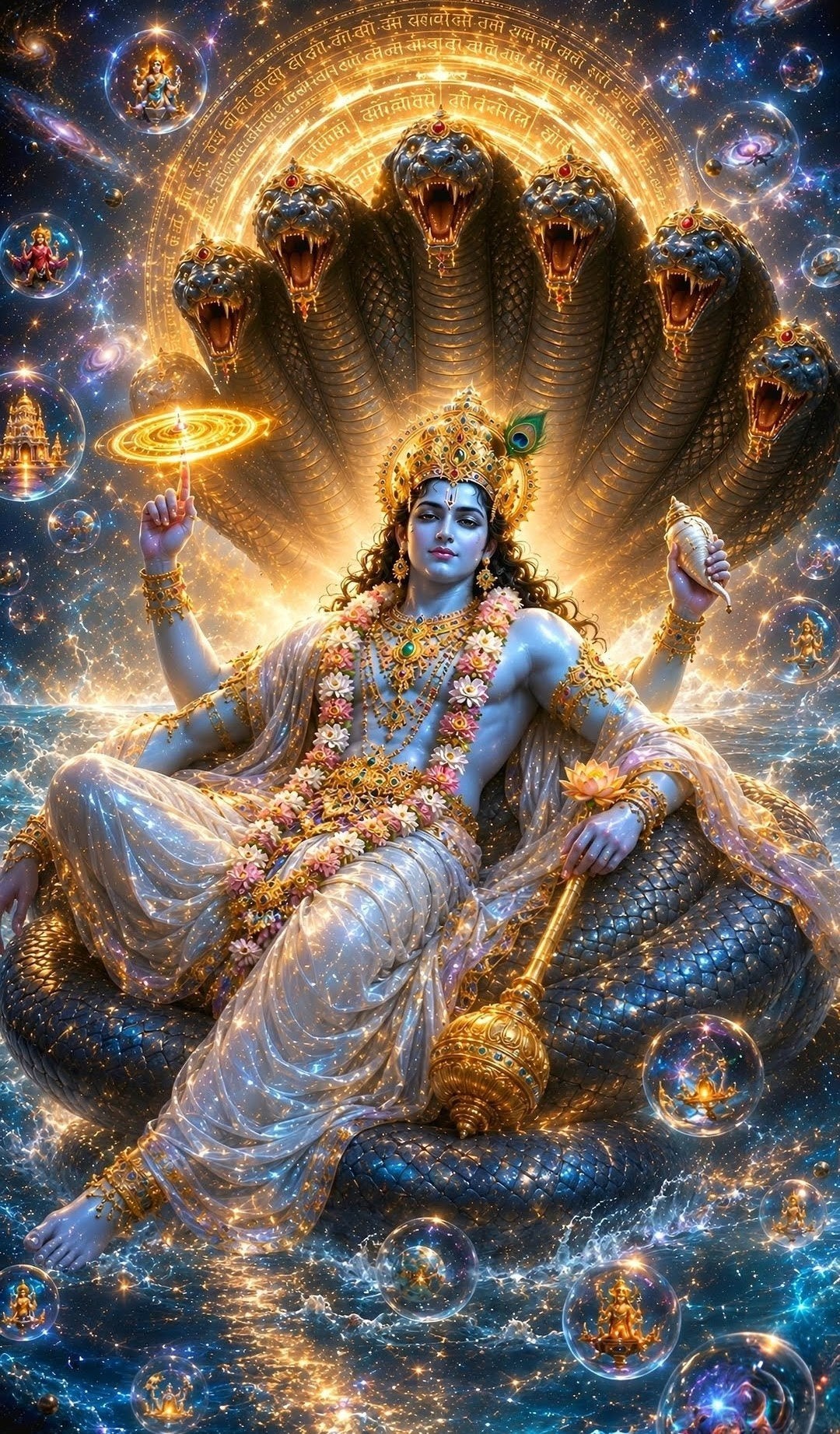
Introduction: Krishna as the Divine Guide of the Avatar's Many Dimensions
Many Dimensions
- In Mathura, he is born in prison.
- In Gokula, he is protected by love.
- In Vrindavan, he reveals divine sweetness.
- With Kaliya, he purifies poison.
- With Govardhan, he protects nature and humbles pride.
- With the gopis, he reveals supreme devotion.
- With Kamsa, he destroys tyranny.
- With Sandipani, he honors learning.
- With Dwaraka, he builds civilization.
- With Rukmini, he protects sincere devotion.
- With the Syamantaka jewel, he restores truth.
- With Narakasura, he restores dignity.
- With the Pandavas, he guides dharma through complexity.
- With Draupadi, he protects dignity when human systems fail.
- With Jarasandha and Shishupala, he removes arrogant opposition to dharma.
- With Duryodhana, he offers peace before consequence.
- With Karna, he offers truth before tragedy.
- With Arjuna, he reveals the Gita.
- With the Yadavas, he shows that even divine proximity cannot save those who abandon humility.
- In his departure, he teaches that the outer form leaves, but the wisdom remains.
Ways the Divine Acts
- Sometimes Krishna plays the flute.
- Sometimes he steals butter.
- Sometimes he lifts a mountain.
- Sometimes he kills a tyrant.
- Sometimes he refuses to fight with weapons.
- Sometimes he becomes a charioteer.
- Sometimes he gives the highest scripture in the middle of war.
- Sometimes he lets events unfold because karma must ripen.
Living Guidance
- Love deeply like Vrindavan.
- Act wisely like Dwaraka.
- Protect dignity like Krishna protects Draupadi.
- Seek truth like Arjuna.
- Release wounded pride like Karna could not.
- Reject ego like Duryodhana refused to do.
- Remember that dharma is not always soft, but it is always aligned with the highest good.
In the Mahabharatha, Krishna is not merely a character. He is the hidden intelligence of the entire epic.
- He is the friend beside the Pandavas.
- The mirror before Karna.
- The warning before Duryodhana.
- The refuge of Draupadi.
- The charioteer of Arjuna.
- The teacher of the Gita.
- The divine strategist of history.
And the eternal reminder that when life becomes Kurukshetra, the soul must let Krishna hold the reins.
1. The Prophecy of Kamsa and the Imprisonment of Devaki and Vasudeva
Who: Kamsa, Devaki, Vasudeva, the divine voice, Ugrasena.
Relevant Sanskrit Verse
SourceBhagavad Gita 4.7-4.8
Sanskritयदा यदा हि धर्मस्य ग्लानिर्भवति भारत।
अभ्युत्थानमधर्मस्य तदात्मानं सृजाम्यहम्॥
परित्राणाय साधूनां विनाशाय च दुष्कृताम्।
धर्मसंस्थापनार्थाय सम्भवामि युगे युगे॥
yadā yadā hi dharmasya glānir bhavati bhārata | abhyutthānam adharmasya tadātmānaṃ sṛjāmy aham || paritrāṇāya sādhūnāṃ vināśāya ca duṣkṛtām | dharma-saṃsthāpanārthāya sambhavāmi yuge yuge ||
English Translation"Whenever dharma declines and adharma rises, I manifest Myself. For the protection of the good, the destruction of evil-doers, and the re-establishment of dharma, I appear age after age."
What Happens
Kamsa, the ruler of Mathura, is present at the marriage of his sister Devaki to Vasudeva. At first, the event appears joyful and royal, but it suddenly turns ominous when a divine voice declares that Devaki's eighth child will be the cause of Kamsa's death. This prophecy immediately exposes Kamsa's inner nature: he is powerful outwardly, but ruled inwardly by fear. Instead of accepting destiny or reflecting on his conduct, he tries to control the future through violence. He imprisons Devaki and Vasudeva, turning family love into a prison of suspicion and terror. Each child born to Devaki becomes a threat in his eyes, and his insecurity makes him capable of cruelty. Vasudeva tries to reason with him, but fear does not listen to wisdom once it becomes obsession. Kamsa's actions show how ego reacts when it hears that its end is inevitable. Rather than transforming himself, he tries to destroy the conditions through which transformation may come. This event creates the dark background into which Krishna will be born. The prison becomes the symbolic womb of divine intervention. Krishna's life therefore begins not in comfort, but in oppression, danger, and the cry for dharma to return.
Purpose in Krishna's Avatar Journey
This event establishes the condition into which Krishna descends: a world ruled by fear, control, violence, and egoic insecurity. Krishna's birth is not random; it is a divine response to tyranny.
Symbolic Meaning
Kamsa represents fear-driven ego. He does not become cruel because he is strong; he becomes cruel because he is afraid. His attempt to control destiny only brings destiny closer.
Significance in the Bigger Storyline
The prophecy makes Krishna's birth an act of cosmic intervention. From the beginning, Krishna's avatar is connected with the restoration of dharma.
Outcome
Devaki and Vasudeva remain imprisoned, but divine destiny cannot be stopped.
Fear becomes destructive when it tries to control everything. The more ego tries to defeat destiny, the more it becomes trapped by destiny.
2. Krishna's Birth in Mathura and Transfer to Gokula
Who: Krishna, Devaki, Vasudeva, Kamsa, Yogamaya, Nanda, Yashoda.
Relevant Sanskrit Verse
SourceSrimad Bhagavatam 10.3.1, 10.3.5
Sanskritअथ सर्वगुणोपेतः कालः परमशोभनः।
यर्ह्येवाजनजन्मर्क्षं शान्तर्क्षग्रहतारकम्॥
मनांस्यासन् प्रसन्नानि साधूनामसुरद्रुहाम्।
जायमानेऽजने तस्मिन् नेदुर्दुन्दुभयो दिवि॥
atha sarva-guṇopetaḥ kālaḥ parama-śobhanaḥ | yarhy evājana-janmarkṣaṃ śāntarkṣa-graha-tārakam || manāṃsy āsan prasannāni sādhūnām asura-druhām | jāyamāne 'jane tasmin nedur dundubhayo divi ||
English Translation"Then came the most auspicious time, endowed with every good quality, when the birth-star of the unborn Lord appeared peaceful among the stars and planets. As the birthless One was being born, the hearts of the saintly became joyful, and heavenly drums resounded."
What Happens
Krishna is born at midnight in the prison of Mathura, where Devaki and Vasudeva have been kept under Kamsa's watch. The atmosphere of the universe becomes auspicious, suggesting that this is not an ordinary birth but a cosmic turning point. Though he appears as Devaki's child, the tradition reveals him as the unborn Lord choosing to enter human life. Devaki and Vasudeva behold the divine child and understand that the prophecy has now taken form. Yet the danger is immediate, because Kamsa is waiting to kill the eighth child. Vasudeva receives divine instruction to take the child across the Yamuna to Gokula. The prison doors open, the guards sleep, and the chains fall away, showing that when divine will moves, even iron systems of oppression lose their power. Vasudeva carries Krishna through the night, crossing the river under miraculous protection. In Gokula, Yashoda has given birth, and Vasudeva exchanges the divine child with the newborn girl, Yogamaya. Krishna is thus transferred from a prison of fear into a village of love. His biological parents remain in suffering, but his childhood is entrusted to Nanda and Yashoda. The event shows that divine destiny may be born in darkness but must be nourished in innocence, affection, and simplicity.
Purpose in Krishna's Avatar Journey
Krishna's divine mission begins in secrecy. Though born to royal parents, he grows up among simple pastoral people.
Symbolic Meaning
The Divine is not limited to palaces, temples, or royal courts. Krishna's transfer from prison to Gokula shows that divine consciousness can be born in darkness but nurtured in simplicity, love, and natural innocence.
Significance in the Bigger Storyline
This event separates Krishna from Kamsa's immediate reach and allows his childhood leelas to unfold in Gokula and Vrindavan.
Outcome
Kamsa is deceived, and Krishna's avatar among the cowherds begins.
Divinity may be born in danger but protected by love. The highest truth often grows quietly, away from the centers of power.
3. Krishna's Childhood Protection from Kamsa's Demons
Who: Krishna, Balarama, Yashoda, Nanda, Putana, Trinavarta, Shakatasura, other beings sent by Kamsa.
Relevant Sanskrit Verse
SourceSrimad Bhagavatam 10.6.35
Sanskritपूतना लोकबालघ्नी राक्षसी रुधिराशना।
जिघांसयापि हरये स्तनं दत्त्वाप सद्गतिम्॥
pūtanā loka-bāla-ghnī rākṣasī rudhirāśanā | jighāṃsayāpi haraye stanaṃ dattvāpa sad-gatim ||
English Translation"Putana, the child-killing rakshasi who fed on blood, came intending to kill Hari; yet because she offered him her breast, even with evil intention, she attained a blessed state."
What Happens
After Krishna is taken to Gokula, Kamsa does not stop trying to kill him. He sends dangerous beings and destructive forces one after another, hoping to eliminate the child before he grows. One of the earliest and most famous is Putana, who comes disguised as a beautiful motherly woman. She carries poison on her breast and intends to kill Krishna while pretending to nurse him. The people of Gokula do not immediately recognize the danger because evil often approaches under a pleasing appearance. Krishna accepts her breast, but instead of being harmed, he draws out not only the poisoned milk but her very life-force. Putana dies, revealing her terrifying form, and the village realizes that the child has survived something impossible. Other beings such as Trinavarta, Shakatasura, and similar threats also fail against him. These episodes show that Krishna's divinity is already active even in infancy. He does not fight like an adult warrior; he protects through effortless being. The attacks also increase the anxiety of the elders, who love him deeply but cannot fully understand his nature. Every attempt by Kamsa to destroy Krishna only reveals Krishna more clearly. The childhood demons become symbols of early threats to innocence: poison disguised as nurture, heaviness disguised as normality, and chaos disguised as play.
Purpose in Krishna's Avatar Journey
These events reveal that Krishna is not an ordinary child. His divinity appears through play, innocence, and effortless protection.
Symbolic Meaning
The demons sent by Kamsa represent early attacks on innocence: poison, confusion, heaviness, distraction, fear, and hidden danger. Krishna destroys them not through adult power, but through divine presence.
Significance in the Bigger Storyline
Kamsa's fear grows because every attempt to destroy Krishna only reveals Krishna's greatness more clearly.
Outcome
Krishna survives and protects Gokula. The people love him more deeply, even when they do not fully understand him.
True innocence is not weakness. When connected to the Divine, innocence carries a hidden strength that darkness cannot defeat.
4. The Butter-Stealing Leelas and Yashoda Binding Krishna
Who: Krishna, Yashoda, Nanda, Balarama, the gopis of Vrindavan.
Relevant Sanskrit Verse
SourceSrimad Bhagavatam 10.9.18
Sanskritस्वमातुः स्विन्नगात्राया विस्रस्तकबरस्रजः।
दृष्ट्वा परिश्रमं कृष्णः कृपयासीत् स्वबन्धने॥
sva-mātuḥ svinna-gātrāyā visrasta-kabara-srajaḥ | dṛṣṭvā pariśramaṃ kṛṣṇaḥ kṛpayāsīt sva-bandhane ||
English Translation"Seeing his mother's body covered with perspiration, her hair loosened and flowers falling, Krishna felt compassion for her effort and allowed himself to be bound."
What Happens
In Gokula and Vrindavan, Krishna grows not only as a miraculous child but as a deeply lovable and mischievous one. He steals butter from the homes of the gopis, shares it with his friends and monkeys, and turns ordinary village life into divine play. The gopis complain to Yashoda, but their complaints are mixed with affection because Krishna's mischief has already stolen their hearts. In one famous episode, Yashoda tries to discipline him after he breaks a pot of yogurt and steals butter. Krishna runs away like a frightened child, even though he is the Supreme Being whom yogis seek through meditation. Yashoda chases him, catches him, and tries to bind him to a mortar. Every rope she uses appears to be two fingers too short, no matter how many ropes are added. This shows that the infinite cannot be bound by physical means, effort, pride, or authority. Yet when Krishna sees Yashoda exhausted, perspiring, and full of loving determination, he allows himself to be bound. The event is one of the deepest images of bhakti: God cannot be captured by ego, but can be captured by love. Yashoda does not understand Krishna as a philosophical Absolute; she knows him as her son. That intimacy is precisely the beauty of the episode. The cosmic Lord becomes smaller than a mother's love, showing that devotion reaches where intellectual power cannot.
Purpose in Krishna's Avatar Journey
These events reveal Krishna as intimate divinity. He is not only the cosmic Lord; he is also the child whom a mother can love, scold, chase, and embrace.
Symbolic Meaning
Butter represents the essence extracted from milk, just as love is the essence extracted from life. Krishna steals butter because the Divine steals the heart's purest essence.
Yashoda binding Krishna shows the mystery of bhakti: the infinite cannot be bound by force, knowledge, or pride, but can be bound by love.
Significance in the Bigger Storyline
This establishes one of Krishna's most important identities: the lovable, intimate, accessible Divine.
Outcome
Vrindavan becomes the land of loving devotion, where God is experienced not as distant power but as beloved child.
The Divine is not only to be feared or worshipped from afar. The Divine can be loved personally, tenderly, and intimately.
5. Krishna Subdues Kaliya
Who: Krishna, Kaliya, the people of Vrindavan, the Yamuna, Kaliya's wives.
Relevant Sanskrit Verse
SourceSrimad Bhagavatam 10.16.30
Sanskritतच्चित्रताण्डवविरुग्णफणासहस्रो
रक्तं मुखैरुरु वमन्नृप भग्नगात्रः।
स्मृत्वा चराचरगुरुं पुरुषं पुराणं
नारायणं तमरणं मनसा जगाम॥
tac-citra-tāṇḍava-virugna-phaṇā-sahasro raktaṃ mukhair uru vaman nṛpa bhagna-gātraḥ | smṛtvā carācara-guruṃ puruṣaṃ purāṇaṃ nārāyaṇaṃ tam araṇaṃ manasā jagāma ||
English Translation"O king, his thousand hoods shattered by that wondrous dance, vomiting blood from his mouths and his body broken, Kaliya remembered the ancient Person, Narayana, the teacher of all moving and unmoving beings, and mentally took refuge in him."
What Happens
The serpent Kaliya poisons the waters of the Yamuna, making the river dangerous for the people, animals, and land around it. The Yamuna, which should be a life-giving flow, becomes contaminated by venom. Krishna enters this danger not as an anxious rescuer but as a fearless divine purifier. He climbs a tree and leaps into the poisoned waters, drawing Kaliya out. The serpent coils around him, and for a moment the people of Vrindavan are terrified, thinking Krishna may be lost. But Krishna expands and frees himself from the serpent's grip. He then rises above Kaliya and begins dancing on his many hoods. Each time Kaliya raises a hood in pride and anger, Krishna presses it down with his feet. The dance is both punishment and purification. Kaliya's poison, strength, and arrogance are exhausted, and his wives come forward in humility and prayer. Finally, Kaliya recognizes Krishna not merely as a village boy but as the divine Lord. Krishna does not kill him; he orders him to leave the Yamuna and go elsewhere. The river is restored, and the community is saved. This event reveals Krishna as the one who can enter poisoned consciousness, subdue its venom, and transform destruction into surrender.
Purpose in Krishna's Avatar Journey
Krishna becomes the purifier of poisoned environments. He does not merely protect individuals; he restores the flow of life itself.
Symbolic Meaning
Kaliya represents toxic ego, jealousy, poison, and psychological pollution. The Yamuna represents the flow of life and devotion. Krishna dancing on Kaliya means divine joy can master inner poison.
Significance in the Bigger Storyline
This event shows Krishna as purifier and restorer. His power is not only destructive; it transforms danger into surrender.
Outcome
The Yamuna is purified, Kaliya is humbled, and Vrindavan is saved.
Poison in the heart must be faced, not ignored. When divine awareness enters, even toxic forces can be subdued and redirected.
6. The Lifting of Govardhan Hill
Who: Krishna, Indra, Nanda, Yashoda, Balarama, the people of Vrindavan, the cows.
Relevant Sanskrit Verse
SourceSrimad Bhagavatam 10.25.19
Sanskritइत्युक्त्वैकेन हस्तेन कृत्वा गोवर्धनाचलम्।
दधार लीलया विष्णुश्छत्राकमिव बालकः॥
ity uktvaikena hastena kṛtvā govardhanācalam | dadhāra līlayā viṣṇuś chatrākam iva bālakaḥ ||
English Translation"Having said this, Vishnu, in the form of Krishna, lifted Govardhan Hill with one hand and held it playfully, like a child holding a mushroom."
What Happens
The people of Vrindavan are preparing their annual worship of Indra, the god of rain. Krishna questions the ritual and asks them to think more directly about their real life of duty, cattle, land, and the mountain that sustains them. He redirects their attention toward Govardhan Hill, the cows, the forests, and the natural environment that supports their livelihood. This is not merely a rejection of Indra; it is a reform of religious consciousness. Krishna teaches that worship should not be driven by fear of cosmic authority but by gratitude, humility, and alignment with one's actual dharma. The people follow Krishna's instruction and worship Govardhan instead. Indra becomes furious because his pride is wounded. He sends violent rains and storms upon Vrindavan, intending to punish the villagers. Krishna calmly lifts Govardhan Hill with one hand and holds it like an umbrella over the entire community. The people, cows, and families gather beneath the mountain and remain protected for days. Krishna stands effortlessly, smiling, while the storm exhausts itself. Indra eventually realizes his arrogance and withdraws. The event shows Krishna as protector, reformer, and master of nature. It also shows that divine strength shelters all: humans, animals, land, and community together.
Purpose in Krishna's Avatar Journey
This event reveals Krishna as protector and reformer of religious understanding. He redirects people from fear-based ritual toward gratitude for the immediate divine presence in nature.
Symbolic Meaning
Indra represents pride in cosmic authority. Govardhan represents the sacredness of nature and local life. Krishna lifting the hill represents divine protection through humility, devotion, and community.
Significance in the Bigger Storyline
Krishna shows that dharma is not blind ritual. True worship must be rooted in gratitude, humility, and right understanding.
Outcome
Indra's pride is humbled. Vrindavan is protected. Krishna's divine status becomes even more evident.
Religion without humility can become ego. True spirituality honors the Divine present in nature, community, and daily life.
7. Radha-Krishna - Divine Love, Separation, and the Soul's Longing for God

Who: Krishna, Radha, the gopis, Lalita, Vishakha, other sakhis, Yashoda, Nanda, Balarama, the people of Vrindavan, the Yamuna, the forest of Vrindavan.
Relevant Sanskrit Verses
SourceGita Govinda 1.1 (Jayadeva)
Sanskritमेघैर्मेदुरमम्बरं वनभुवः श्यामास्तमालद्रुमैर्
नक्तं भीरुरयं त्वमेव तदिमं राधे गृहं प्रापय ।
इत्थं नन्दनिदेशतश्चलितयोः प्रत्यध्वकुञ्जद्रुमं
राधामाधवयोर्जयन्ति यमुनाकूले रहःकेलयः ॥
meghair meduram ambaram vana-bhuvaḥ śyāmās tamāla-drumair
naktaṁ bhīrur ayaṁ tvam eva tad imaṁ rādhe gṛhaṁ prāpaya |
itthaṁ nanda-nideśataś calitayoḥ praty-adhva-kuñja-drumaṁ
rādhā-mādhavayor jayanti yamunā-kūle rahaḥ-kelayaḥ ||
"The sky is heavy with clouds, and the forest paths are dark with tamala trees. 'This boy is afraid of the night, Radha, so you must lead him home,' said Nanda. Thus, as Radha and Madhava set out together along the bower-lined path by the Yamuna, their secret love-play became gloriously manifest."
SourceSrimad Bhagavatam 10.31.9
Sanskritतव कथामृतं तप्तजीवनं
कविभिरीडितं कल्मषापहम्।
श्रवणमङ्गलं श्रीमदाततं
भुवि गृणन्ति ये भूरिदा जनाः॥
tava kathāmṛtaṁ tapta-jīvanaṁ kavibhir īḍitaṁ kalmaṣāpaham | śravaṇa-maṅgalaṁ śrīmad ātataṁ bhuvi gṛṇanti ye bhūri-dā janāḥ ||
English Translation"The nectar of your words gives life to the suffering. Celebrated by the wise, it removes impurity, brings auspiciousness when heard, and spreads spiritual beauty. Those who sing and share it in this world are truly great givers."
What Happens
After the Govardhan episode, Krishna's life in Vrindavan reaches its most intimate devotional height. By now, Krishna is no longer seen by the people of Vraja merely as a wonderful child or village protector. He has become the very center of their love, memory, joy, and identity. His flute calls not only to the ears, but to the deepest layer of the heart. The cows stop grazing when they hear it. The rivers seem to pause. The trees appear to bend toward him. The gopis, who outwardly live ordinary village lives, inwardly become completely absorbed in Krishna. Among all these devotees, Radha emerges in later Vaishnava tradition as the highest embodiment of divine love. She is not simply one beloved among many; she represents the soul's most complete longing for Krishna. Her love is not based on social status, possession, marriage, power, or ritual claim. It is pure attraction of the soul toward the Divine.
Radha's relationship with Krishna unfolds in the atmosphere of Vrindavan's forests, moonlit nights, the Yamuna banks, and the sound of Krishna's flute. In the devotional imagination, Vrindavan is not merely a geographic place; it is the inner field where the soul meets God in sweetness. Krishna's flute becomes the call of the Divine. Radha's response becomes the soul's answer to that call. When Krishna plays the flute, Radha and the gopis leave behind ordinary concerns, not because they reject life irresponsibly, but because divine love has become more real to them than worldly identity. Their movement toward Krishna represents the movement of consciousness from outer roles to inner truth. Radha's love is intense because she does not love Krishna as an idea. She loves him as the very life of her life.
In the rasa tradition, Krishna dances with the gopis, and yet each devotee experiences him as personally present. This reveals one of the deepest theological meanings of Krishna: the Divine is infinite, yet intimately available to each heart. Krishna is not divided by loving many. His fullness allows every soul to experience him completely. Yet within this circle of devotion, Radha's love is treated as supreme because it is the most selfless, the most total, and the most refined. She does not seek Krishna for reward. She does not seek liberation from him. She does not even seek public recognition as his greatest devotee. Her love is its own fulfillment and its own fire.
There are moments in the tradition where Krishna appears to disappear from the gopis. This disappearance is spiritually important. It is not abandonment in the ordinary sense. It is a deepening of love through separation. When Krishna is visibly present, love is sweet. When Krishna is hidden, love becomes longing. This longing, called viraha, becomes one of the highest forms of bhakti. Radha's greatness is most visible not only when she is united with Krishna, but when she continues to live in total remembrance during separation. Her separation is not emptiness; it is Krishna filling the heart so completely that even his physical absence becomes a form of presence.
The Bhagavata verse "anayārādhito nūnam" becomes central in later Radha theology because the gopis recognize that one particular gopi has worshipped Krishna so deeply that he has taken her aside. The name Radha is traditionally connected with the root ārādhana, meaning worship or adoration. Symbolically, Radha is the one who has worshipped Krishna most completely, and therefore she becomes the highest mirror of devotion. She is not merely a romantic figure; she is devotion personified. She is the soul in its purest longing. She is the heart emptied of ego and filled only with Krishna.
Krishna's relationship with Radha is also different from ordinary worldly love because it points beyond possession. In worldly love, the ego often says, "You are mine." In Radha's love, the soul says, "I am yours." This is the great reversal. Love is no longer about acquiring the beloved. Love becomes surrender into the beloved. Radha does not reduce Krishna to a personal object. She reveals Krishna as the supreme beloved of all existence. Similarly, Krishna's love for Radha reveals that the Divine responds most deeply to pure devotion, not to status, scholarship, power, or ritual pride.
This storyline also prepares the emotional background for Krishna's later departure from Vrindavan. When Krishna leaves for Mathura, the pain of separation becomes unbearable for Radha, the gopis, Yashoda, Nanda, and all Vraja. But that separation does not destroy their devotion. It spiritualizes it. Krishna leaves physically, but he becomes inwardly permanent. This is the paradox of Radha-Krishna bhakti: external separation can create internal union. Radha does not need Krishna as an object before her eyes because Krishna has become the essence of her consciousness. Her remembrance becomes worship. Her longing becomes meditation. Her pain becomes sacred because it is free from ego and full of divine love.
Purpose in Krishna's Avatar Journey
The Radha-Krishna storyline reveals a dimension of Krishna that cannot be understood through politics, war, strategy, or kingship alone. Before Krishna becomes the guide of Arjuna, the peace messenger to Hastinapura, or the strategist of the Mahabharatha, he is the beloved of Vrindavan. This matters because it shows that Krishna's divinity is not only majestic; it is intimate. He is not only the Lord who commands dharma. He is also the Lord who attracts the heart.
Radha's presence reveals Krishna as mādhurya, the sweetness of God. In Mathura, Krishna destroys tyranny. In Dwaraka, he protects civilization. In Kurukshetra, he teaches wisdom. But in Vrindavan, he reveals divine love in its purest form. This event therefore gives Krishna's life emotional and devotional completeness. Without Radha and Vrindavan, one may see Krishna only as strategist, diplomat, philosopher, and divine statesman. But Radha shows that Krishna is also the supreme object of love. The same Krishna who later tells Arjuna to rise and fight is the Krishna whose flute melts the hearts of the gopis. This is not a contradiction. It means divine wisdom and divine love are two sides of the same reality.
Radha-Krishna also gives the Mahabharatha context a deeper emotional foundation. Krishna guides the Pandavas not as a cold strategist, but as the same divine being whose nature is love. His strategies are not manipulation for selfish gain; they are movements of dharma guided by compassion and cosmic understanding.
Interpretation
Krishna represents the Divine Beloved. Radha represents the soul in its highest devotional state. The flute represents the call of God. Vrindavan represents the purified heart. The gopis represent different movements of devotion. The rasa dance represents the soul moving in rhythm with the Divine. Separation represents the deepening of love beyond physical presence. Union represents the recognition that the Divine was never truly absent.
Radha is the soul that no longer asks, "What can God give me?" She asks only, "How can I belong completely to Krishna?" Her love is beyond transaction. It is beyond fear. It is beyond social calculation. It is beyond spiritual ambition. This is why Radha becomes the highest symbol of bhakti.
Outcome
The outcome of the Radha-Krishna storyline is not marriage, kingdom, victory, or political resolution. Its outcome is the revelation of divine love as the highest spiritual force. Radha does not possess Krishna in a worldly way. Instead, she reveals the highest way to love Krishna. Krishna does not remain physically in Vrindavan forever, but Vrindavan remains eternally filled with him through remembrance. The physical storyline moves on to Mathura, Dwaraka, and Kurukshetra, but the inner Krishna remains forever in Vrindavan.
This is why devotees often see Radha-Krishna not as a past episode, but as an eternal spiritual reality. Radha's love becomes the model for the soul's longing. Krishna's flute becomes the call that every heart is secretly waiting to hear.
Takeaways
- Radha teaches that the highest love is not possession but surrender.
- Krishna teaches that the Divine responds to pure love more than status, power, or intellectual pride.
- Vrindavan teaches that the heart becomes sacred when it is filled with remembrance.
- The flute teaches that God's call is subtle; only a softened heart hears it.
- Separation teaches that absence can deepen devotion rather than destroy it.
- Radha-Krishna together teach that the deepest spiritual path is not fear of God, but love of God.
8. The Rasa Lila and the Love of the Gopis
Who: Krishna, Radha in later devotional traditions, the gopis, Vrindavan.
Relevant Sanskrit Verse
SourceSrimad Bhagavatam 10.29.1
Sanskritभगवानपि ता रात्रीः शरदोत्फुल्लमल्लिकाः।
वीक्ष्य रन्तुं मनश्चक्रे योगमायामुपाश्रितः॥
bhagavān api tā rātrīḥ śaradotphulla-mallikāḥ | vīkṣya rantuṃ manaś cakre yoga-māyām upāśritaḥ ||
English Translation"The Lord, seeing those autumn nights fragrant with blossoming jasmine, desired to sport in divine love, taking refuge in Yogamaya."
What Happens
The Rasa Lila unfolds in the atmosphere of Vrindavan, where Krishna's flute calls the gopis away from ordinary duties into the mystery of divine love. The gopis hear the sound and are inwardly drawn, not by social desire but by a soul-level attraction toward Krishna. They leave behind the usual structures of identity and move toward him as if responding to the call of their deepest Self. Krishna initially tests them, speaking as though they should return home, but the test reveals the depth of their devotion. Their love is not casual; it is total, immediate, and beyond calculation. Krishna then dances with them in the circular dance of the Rasa. Each gopi experiences Krishna as personally present with her, showing that the Divine is infinite enough to be intimately available to every soul. In later devotional traditions, Radha becomes the highest expression of this love, representing the soul's complete longing for Krishna. The event is often misunderstood if read only at the literal level; spiritually, it is about the soul's ecstatic movement around the Divine center. The circular dance suggests that all beings find their rhythm when Krishna is at the center. The Rasa Lila does not present devotion as dry obedience but as beauty, music, surrender, and joy. It completes the Vrindavan vision of Krishna as the beloved of the heart. This event becomes one of the deepest symbols of bhakti in Indian spirituality.
Purpose in Krishna's Avatar Journey
This event reveals Krishna as the center of divine love. He is not only the destroyer of evil or teacher of wisdom; he is the beloved of the soul.
Symbolic Meaning
The gopis represent souls drawn irresistibly toward the Divine. The Rasa Lila is not merely romantic imagery; spiritually, it symbolizes the soul's longing to move in rhythm with God.
Radha represents supreme devotion, love so complete that the separate self dissolves in the beloved.
Significance in the Bigger Storyline
This event gives Krishna's avatar its deepest bhakti dimension. Before he becomes statesman and strategist, he is the irresistible center of love.
Outcome
Vrindavan becomes the eternal symbol of divine love, longing, sweetness, and surrender.
The highest devotion is not bargaining with God. It is the soul's complete longing for union with the Divine.
9. Krishna Leaves Vrindavan for Mathura
Who: Krishna, Balarama, Akrura, Nanda, Yashoda, Radha and the gopis in devotional traditions, Kamsa.
Relevant Sanskrit Verse
SourceSrimad Bhagavatam 10.31.1
Sanskritजयति तेऽधिकं जन्मना व्रजः
श्रयत इन्दिरा शश्वदत्र हि।
दयित दृश्यतां दिक्षु तावकाः
त्वयि धृतासवस्त्वां विचिन्वते॥
jayati te 'dhikaṃ janmanā vrajaḥ śrayata indirā śaśvad atra hi | dayita dṛśyatāṃ dikṣu tāvakās tvayi dhṛtāsavas tvāṃ vicinvate ||
English Translation"O beloved, because of your birth, Vraja has become supremely glorious, and fortune ever dwells here. Please appear before those who belong to you; holding their very lives in you, they search for you in all directions."
What Happens
Akrura arrives in Vrindavan with a summons from Kamsa for Krishna and Balarama to come to Mathura. Outwardly, the invitation is framed through a royal event, but everyone senses that a major turning point has arrived. Krishna has lived as the beloved child and youth of Vrindavan, filling the village with play, music, protection, and sweetness. Now he must leave the intimate world of cowherds and gopis to confront the public tyranny of Mathura. Nanda and the elders prepare for the journey, but the hearts of the people of Vrindavan are shattered. The gopis, in particular, experience Krishna's departure as spiritual separation, not merely physical distance. Yashoda and Nanda face the pain of letting go of the child they raised with complete love. Krishna's departure shows that divine love does not always remain in the form one wants. The same Krishna who gives sweetness must also fulfill his mission of dharma. Akrura, whose name means not cruel, becomes the messenger of a moment that feels cruel to Vrindavan. The journey to Mathura marks Krishna's transition from hidden pastoral divinity to public restorer of justice. Vrindavan does not lose Krishna inwardly, but it loses his visible presence. This event creates the devotional theme of separation, where longing itself becomes a form of union.
Purpose in Krishna's Avatar Journey
Krishna's avatar moves from intimate childhood love to public destiny. He must leave the sweetness of Vrindavan to confront tyranny in Mathura.
Symbolic Meaning
Vrindavan represents the sweetness of divine intimacy. Mathura represents the field of duty and confrontation. Krishna's departure shows that love cannot remain confined to private joy when dharma calls.
Significance in the Bigger Storyline
Krishna now begins the next stage of his mission: ending Kamsa's rule.
Outcome
Vrindavan enters the mood of separation, while Krishna steps into his role as liberator of Mathura.
Sometimes the call of dharma requires leaving even the most beloved spaces. Love is not lost; it becomes deeper through separation.
10. Krishna Kills Kamsa and Frees His Parents
Who: Krishna, Balarama, Kamsa, Devaki, Vasudeva, Ugrasena, the people of Mathura.
Relevant Sanskrit Verse
SourceSrimad Bhagavatam 10.44.38
Sanskritतं सम्परेतं विचकर्ष भूमौ
हरिर्यथेभं जगतो विपश्यतः।
हाहेति शब्दः सुमहांस्तदाभू-
दुदीरितः सर्वजनैर्नरेन्द्र॥
taṃ samparetaṃ vicakarṣa bhūmau harir yathebhaṃ jagato vipaśyataḥ | hā heti śabdaḥ su-mahāṃs tadābhūd udīritaḥ sarva-janair narendra ||
English Translation"Like a lion dragging a fallen elephant, Hari dragged the dead Kamsa upon the ground before all the watching people; then a great cry of astonishment arose from everyone present."
What Happens
Krishna and Balarama enter Mathura after leaving Vrindavan, and the city becomes charged with expectation. Kamsa has arranged public contests and wrestling matches, intending to destroy the brothers under the cover of royal entertainment. Before reaching the arena, Krishna breaks the great bow and defeats forces sent against him, showing that Kamsa's system of intimidation is already collapsing. In the wrestling arena, Krishna and Balarama face powerful wrestlers before a crowd that includes their imprisoned parents and the people of Mathura. The match is unequal from the worldly point of view, because the boys appear young, while the wrestlers are seasoned fighters. Yet Krishna and Balarama defeat them with divine strength. Kamsa then loses control and orders harsh punishments against Nanda, Vasudeva, and others. At that moment, Krishna leaps toward him. The prophecy that Kamsa feared from the beginning now stands before him. Krishna seizes him and kills him, ending the tyrant's rule. The arena erupts in shock because the ruler who had terrorized Mathura is suddenly powerless. Krishna then frees Devaki and Vasudeva, restoring the parents from whom he was separated at birth. He also restores Ugrasena to the throne, showing that his purpose is not personal conquest but re-establishment of rightful order. The event closes the first major arc of Krishna's life: fear imprisoned love, but divine courage broke the prison.
Purpose in Krishna's Avatar Journey
This is the completion of the prophecy. Krishna ends the tyranny that tried to destroy him from birth.
Symbolic Meaning
Kamsa represents fear, control, and egoic violence. Krishna's victory shows that divine destiny cannot be imprisoned forever.
Significance in the Bigger Storyline
This event shifts Krishna from hidden child to public restorer of order.
Outcome
Devaki and Vasudeva are freed. Ugrasena is restored. Mathura is liberated from Kamsa's oppression.
Fear may rule for a time, but it cannot permanently defeat dharma. The prison of fear eventually opens when divine courage arrives.
11. Krishna Studies Under Sage Sandipani
Who: Krishna, Balarama, Sage Sandipani, Sandipani's wife, Sandipani's son.
Relevant Sanskrit Verse
SourceBhagavad Gita 4.34
Sanskritतद्विद्धि प्रणिपातेन परिप्रश्नेन सेवया।
उपदेक्ष्यन्ति ते ज्ञानं ज्ञानिनस्तत्त्वदर्शिनः॥
tad viddhi praṇipātena paripraśnena sevayā | upadekṣyanti te jñānaṃ jñāninas tattva-darśinaḥ ||
English Translation"Understand that wisdom by humble approach, by sincere questioning, and by service; the knowers of truth who have seen reality will instruct you in knowledge."
What Happens
After Kamsa's fall and the restoration of order in Mathura, Krishna and Balarama enter the stage of formal education. They go to Sage Sandipani's ashrama, accepting the role of students even though Krishna is divine. This is an important moment because Krishna does not reject human tradition simply because he transcends it. He honors the guru-disciple relationship, the discipline of learning, and the sacred order of education. In the ashrama, Krishna and Balarama study various branches of knowledge with extraordinary speed and brilliance. Their learning is not portrayed as arrogance but as respectful participation in dharma. When the time comes for guru-dakshina, Sandipani asks for the return of his lost son in many traditional tellings. Krishna and Balarama undertake the task and restore the son, thereby repaying their teacher in a way only they could. The act shows that knowledge must be joined with gratitude. Krishna's greatness is not diminished by bowing to a teacher; rather, it becomes more complete. This event also shows that divine incarnation accepts the structures of human life to sanctify them. Krishna models that even the highest being can live as a student. The episode teaches that true knowledge requires humility, service, and reverence.
Purpose in Krishna's Avatar Journey
Even though Krishna is divine, he honors the human process of learning and the teacher-student relationship.
Symbolic Meaning
This event shows humility within divinity. Krishna does not reject the role of student merely because he is the Supreme. He honors the structure of dharma.
Significance in the Bigger Storyline
Krishna's avatar models that greatness must still respect learning, discipline, and gratitude.
Outcome
Krishna completes his education and honors his guru.
No one is too great to learn. True greatness respects teachers, tradition, and gratitude.
12. Krishna Moves His People to Dwaraka
Who: Krishna, Balarama, Ugrasena, the Yadavas, Jarasandha, Kalayavana.
Relevant Sanskrit Verse
SourceBhagavad Gita 3.21
Sanskritयद्यदाचरति श्रेष्ठस्तत्तदेवेतरो जनः।
स यत्प्रमाणं कुरुते लोकस्तदनुवर्तते॥
yad yad ācarati śreṣṭhas tat tad evetaro janaḥ | sa yat pramāṇaṃ kurute lokas tad anuvartate ||
English Translation"Whatever a great person does, others follow; whatever standard such a person sets, the world acts according to it."
What Happens
After Kamsa's death, Krishna's problems do not end. Kamsa's father-in-law Jarasandha becomes a repeated threat to Mathura. He attacks again and again, determined to punish Krishna and the Yadavas. Krishna understands that leadership is not about proving bravery in every situation. If Mathura remains exposed to constant attack, the people will suffer repeatedly. Instead of allowing pride to dictate strategy, Krishna chooses preservation, relocation, and long-term security. He leads the Yadavas away from danger and establishes them in the fortified city of Dwaraka by the sea. This decision shows Krishna as statesman, not merely warrior. He does not confuse retreat with cowardice when the larger purpose is protection. Dwaraka becomes a new center of power, culture, diplomacy, and dharmic organization. Krishna's role expands from village protector and tyrant-slayer to national strategist and ruler. He shows that sometimes the wise response is not to keep fighting on the enemy's chosen ground. The move to Dwaraka also prepares Krishna for his later involvement in the politics of the Mahabharatha. From Dwaraka, he becomes a stabilizing force across kingdoms. The event teaches that dharma needs not only courage, but planning, infrastructure, and strategic intelligence.
Purpose in Krishna's Avatar Journey
Krishna now becomes protector, strategist, and statesman. He does not act out of pride by fighting every battle in the same way. He preserves his people through wise relocation.
Symbolic Meaning
Dwaraka represents organized dharmic civilization. Krishna shows that courage is not recklessness. Sometimes the highest strategy is not direct confrontation but protection of the larger mission.
Significance in the Bigger Storyline
Dwaraka becomes Krishna's political and royal center, from which he later engages with the Mahabharatha world.
Outcome
The Yadavas gain security, and Krishna's role expands from liberator of Mathura to ruler and strategist of Dwaraka.
Wisdom knows when to fight, when to withdraw, and when to build a stronger foundation.
13. Krishna Marries Rukmini and Establishes Dharmic Alliances
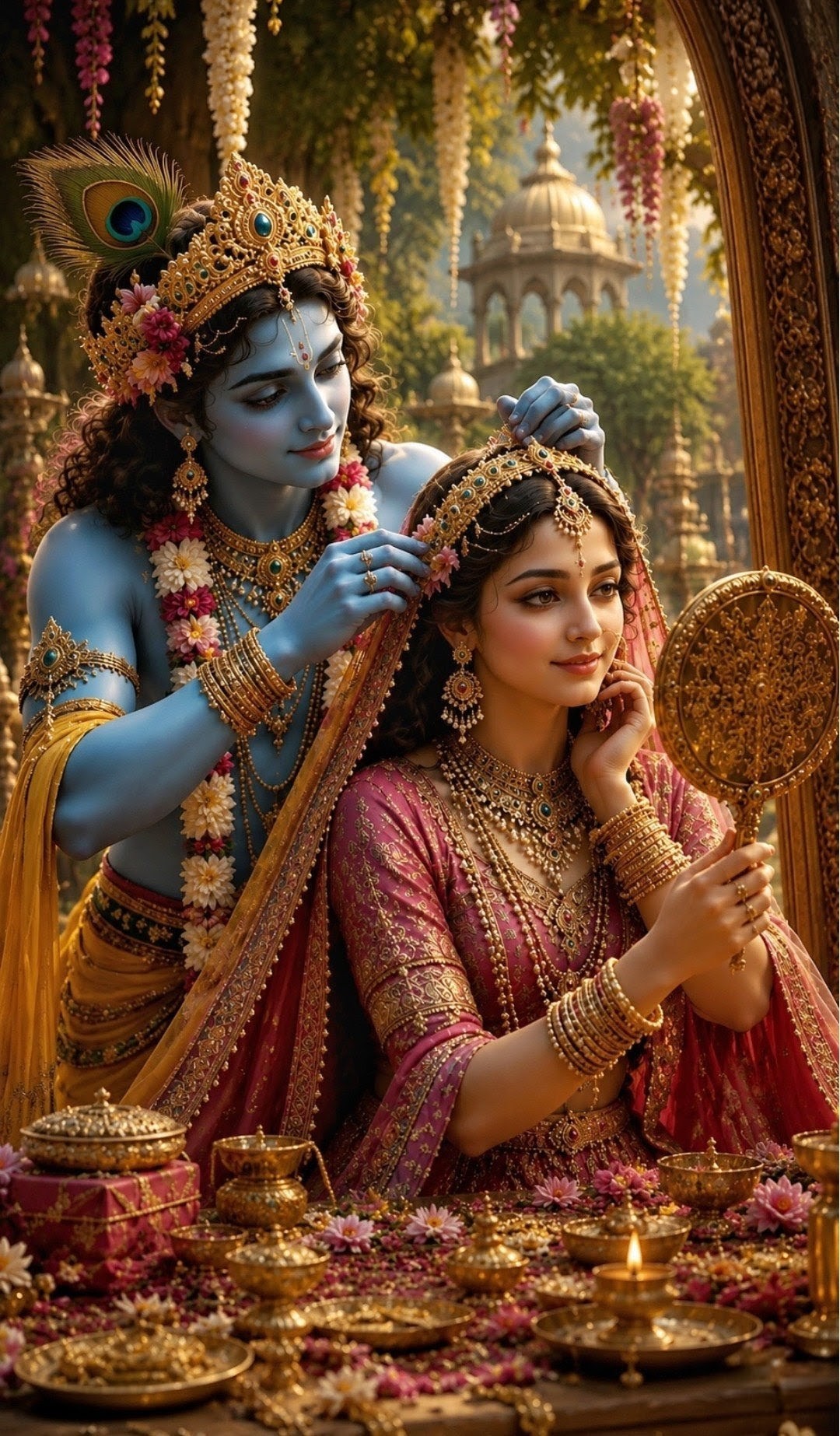
Who: Krishna, Rukmini, Rukmi, Balarama, the Yadavas, later queens including Satyabhama and Jambavati.
Relevant Sanskrit Verse
SourceSrimad Bhagavatam 10.52.37
Sanskritश्रुत्वा गुणान् भुवनसुन्दर शृण्वतां ते
निर्विश्य कर्णविवरैर्हरतोऽङ्गतापम्।
रूपं दृशां दृशिमतामखिलार्थलाभं
त्वय्यच्युताविशति चित्तमपत्रपं मे॥
śrutvā guṇān bhuvana-sundara śṛṇvatāṃ te nirviśya karṇa-vivarair harato 'ṅga-tāpam | rūpaṃ dṛśāṃ dṛśimatām akhilārtha-lābhaṃ tvayy acyutāviśati cittaṃ apatrapaṃ me ||
English Translation"O beauty of the worlds, hearing of your virtues enters the ears of listeners and removes the suffering of the body. Your form is the complete fulfillment of all who have eyes; O Achyuta, my shameless heart has entered you."
What Happens
Rukmini, princess of Vidarbha, hears of Krishna's qualities, beauty, strength, and dharma. Her heart chooses him before she has physically joined him, showing the power of devotion born through hearing. However, her family, especially her brother Rukmi, arranges for her to marry Shishupala against her will. Rukmini sends a message to Krishna, asking him to come and rescue her before the unwanted marriage takes place. Her message is not weak or vague; it is clear, courageous, and spiritually decisive. Krishna responds to her call and comes to Vidarbha. At the right moment, he takes Rukmini away, defeating the forces that would bind her to an adharmic arrangement. Rukmi pursues Krishna and is defeated, showing the failure of prideful opposition to a soul's true choice. Rukmini becomes Krishna's chief queen in many traditions. Through this marriage, Krishna's life in Dwaraka becomes more fully established in household and royal dharma. His other marriages and alliances later expand his role across different kingdoms and lineages. The event shows Krishna as protector of free, sincere, dharmic love. It also shows that devotion must sometimes act boldly against social pressure.
Purpose in Krishna's Avatar Journey
This event reveals Krishna as protector of sincere devotion and as a builder of dharmic political alliances.
Symbolic Meaning
Rukmini represents pure devotion that chooses the Divine above social pressure. Krishna's response shows that sincere calling reaches him.
Significance in the Bigger Storyline
Krishna's household life in Dwaraka becomes part of his kingly and social role. He is not only ascetic divinity; he participates in family, politics, governance, and alliance.
Outcome
Rukmini becomes Krishna's chief queen in many traditions. Dwaraka's network of alliances grows.
Devotion must be courageous. Rukmini does not merely wish for Krishna; she chooses him with clarity.
14. The Syamantaka Jewel Episode
Who: Krishna, Satrajit, Prasena, Jambavan, Jambavati, Satyabhama.
Relevant Sanskrit Verse
SourceBhagavad Gita 16.1-16.2
Sanskritअभयं सत्त्वसंशुद्धिर्ज्ञानयोगव्यवस्थितिः।
दानं दमश्च यज्ञश्च स्वाध्यायस्तप आर्जवम्॥
अहिंसा सत्यमक्रोधस्त्यागः शान्तिरपैशुनम्।
दया भूतेष्वलोलुप्त्वं मार्दवं ह्रीरचापलम्॥
abhayaṃ sattva-saṃśuddhir jñāna-yoga-vyavasthitiḥ | dānaṃ damaś ca yajñaś ca svādhyāyas tapa ārjavam || ahiṃsā satyam akrodhas tyāgaḥ śāntir apaiśunam | dayā bhūteṣv aloluptvaṃ mārdavaṃ hrīr acāpalam ||
English Translation"Fearlessness, purity of being, steadiness in knowledge and yoga, generosity, self-control, sacrifice, study, austerity, and straightforwardness; non-harm, truthfulness, absence of anger, renunciation, peace, avoidance of slander, compassion for beings, freedom from greed, gentleness, modesty, and steadiness - these are divine qualities."
What Happens
The Syamantaka jewel becomes the center of suspicion, prestige, and accusation in Dwaraka. Satrajit possesses the jewel, which is associated with brilliance and prosperity. When Satrajit's brother Prasena goes out wearing the jewel and does not return, rumor and suspicion begin to move toward Krishna. People begin to wonder whether Krishna himself may have taken the jewel. Krishna does not ignore the accusation or rely merely on his divine status to silence others. He investigates the matter personally and follows the trail of events. The truth leads to Jambavan, who had taken the jewel after a chain of incidents involving Prasena's death. Krishna battles Jambavan for many days in some traditional tellings before Jambavan recognizes who he truly is. The misunderstanding is cleared, and the jewel is restored. Jambavan gives his daughter Jambavati to Krishna, and in later connected developments Satyabhama also becomes linked to the episode. The event is important because it shows Krishna's conduct under public suspicion. He does not act offended, evasive, or authoritarian. He restores truth through action and evidence. The jewel itself symbolizes wealth and reputation, both of which can easily produce greed and mistrust. Krishna's handling of the episode teaches that even when one is innocent, truth sometimes must be patiently demonstrated.
Purpose in Krishna's Avatar Journey
This event shows Krishna's relationship to reputation, truth, and public accusation.
Symbolic Meaning
The jewel represents wealth, brilliance, and the danger of suspicion around valuable things. Krishna's conduct shows transparency. He does not ignore false accusation; he resolves it through truth.
Significance in the Bigger Storyline
Even Krishna, though divine, allows events to unfold in a way that teaches society about truth, responsibility, and the danger of greed.
Outcome
The truth is revealed, Krishna's honor is restored, and important bonds are formed.
When false accusation arises, truth must be clarified through patience, evidence, and integrity.
15. Krishna Defeats Narakasura and Frees the Captive Women
Who: Krishna, Satyabhama, Narakasura, the captive women, the devas.
Relevant Sanskrit Verse
SourceBhagavad Gita 4.8
Sanskritपरित्राणाय साधूनां विनाशाय च दुष्कृताम्।
धर्मसंस्थापनार्थाय सम्भवामि युगे युगे॥
paritrāṇāya sādhūnāṃ vināśāya ca duṣkṛtām | dharma-saṃsthāpanārthāya sambhavāmi yuge yuge ||
English Translation"For the protection of the good, the destruction of evil-doers, and the establishment of dharma, I manifest age after age."
What Happens
Narakasura is a powerful ruler who has become associated with arrogance, violence, and the imprisonment of women. His power is not merely political; it has become morally corrupt and oppressive. Krishna goes to confront him, and in many traditions Satyabhama accompanies him, making the episode also a moment of active feminine participation in the destruction of adharma. The battle against Narakasura is not fought for personal gain, but to free those whose dignity has been violated. Krishna defeats Narakasura and enters the spaces where the captive women have been held. These women are not treated as objects of shame; they are restored to dignity. This is crucial because society often blames the violated, but Krishna's action reverses that logic. He gives protection and status to those who were made vulnerable by another's wrongdoing. The event shows Krishna as liberator of the dishonored, not merely killer of a demon. It also expands the meaning of dharma beyond battlefield victory. Dharma includes the restoration of human dignity after trauma and captivity. Krishna's response prevents the freed women from being socially abandoned. The defeat of Narakasura therefore becomes both an act of justice and an act of compassionate restoration. The episode teaches that true dharma does not only punish evil; it heals those harmed by evil.
Purpose in Krishna's Avatar Journey
This event reveals Krishna as liberator of the dishonored and imprisoned.
Symbolic Meaning
Narakasura represents possessive, violent ego that imprisons dignity. The freed women represent violated dignity restored through divine intervention.
Significance in the Bigger Storyline
Krishna's dharma is not limited to royal politics. He restores those whom society might otherwise abandon.
Outcome
The captives are freed and given dignity.
A dharmic society must restore dignity to those who have suffered, not blame them for what was done to them.
16. Krishna's Bond with the Pandavas and Protection of Draupadi
Who: Krishna, Kunti, Yudhishthira, Bhima, Arjuna, Nakula, Sahadeva, Draupadi, Duryodhana, Dushasana, Shakuni.
Relevant Sanskrit Verse
SourceBhagavad Gita 9.22
Sanskritअनन्याश्चिन्तयन्तो मां ये जनाः पर्युपासते।
तेषां नित्याभियुक्तानां योगक्षेमं वहाम्यहम्॥
ananyāś cintayanto māṃ ye janāḥ paryupāsate | teṣāṃ nityābhiyuktānāṃ yoga-kṣemaṃ vahāmy aham ||
English Translation"Those who think of Me with single-pointed devotion and worship Me constantly - for them, ever united with Me, I carry what they lack and protect what they have."
What Happens
Krishna's relationship with the Pandavas is not casual political friendship. He is their relative, friend, counselor, protector, and guide through some of the darkest moments of their lives. Kunti recognizes Krishna's divinity and repeatedly turns toward him in crisis. Arjuna develops a deeply intimate bond with him, both as friend and later as disciple. Draupadi also shares a special relationship with Krishna as one who trusts him beyond ordinary human support. During the dice game, the Pandavas lose their kingdom, freedom, and dignity through Yudhishthira's defeat and Shakuni's manipulation. Draupadi is dragged into the court and questioned as though she were property. The elders remain largely ineffective, and the court becomes a place where dharma is discussed but not defended. Dushasana attempts to humiliate her publicly. In that moment, Draupadi calls upon Krishna with surrender. Human protection has failed: husbands, elders, kings, and teachers do not save her. Divine protection manifests, and her dignity is preserved. This event becomes one of the clearest examples of Krishna as refuge when all worldly structures collapse. It also binds the moral destiny of the Kuru house to its failure to protect dignity. Krishna does not immediately prevent all suffering, but he ensures that Draupadi is not spiritually defeated. Her cry becomes one of the moral turning points that makes the future war unavoidable.
Purpose in Krishna's Avatar Journey
Krishna's role now becomes deeply tied to the Mahabharatha's central conflict. He does not merely support the Pandavas because they are relatives; he supports the side that remains correctable and aligned with dharma.
Symbolic Meaning
Draupadi represents dignity under attack. Krishna's protection shows that when all human support fails, surrender to the Divine becomes the final refuge.
Significance in the Bigger Storyline
This event morally exposes the Kuru court and makes the eventual war spiritually unavoidable.
Outcome
Draupadi is protected, but the Kuru house loses moral legitimacy.
When dignity is violated and society remains silent, divine justice begins moving beneath the surface.
17. Krishna Guides the Destruction of Jarasandha and the Rajasuya Sacrifice
Who: Krishna, Yudhishthira, Bhima, Arjuna, Jarasandha, the imprisoned kings, Shishupala.
Relevant Sanskrit Verse
SourceBhagavad Gita 3.30
Sanskritमयि सर्वाणि कर्माणि संन्यस्याध्यात्मचेतसा।
निराशीर्निर्ममो भूत्वा युध्यस्व विगतज्वरः॥
mayi sarvāṇi karmāṇi sannyasyādhyātma-cetasā | nirāśīr nirmamo bhūtvā yudhyasva vigata-jvaraḥ ||
English Translation"Dedicate all actions to Me with consciousness rooted in the Self; free from expectation and possessiveness, fight without inner fever."
What Happens
Yudhishthira wishes to perform the Rajasuya sacrifice, but such a royal sacrifice requires moral and political legitimacy. Krishna understands that Jarasandha, the powerful ruler of Magadha, stands as a major obstacle because he has imprisoned many kings and represents oppressive dominance. Krishna does not approach the problem through a large war at first. Instead, he goes with Bhima and Arjuna in disguise to meet Jarasandha directly. The confrontation becomes a test of strength, destiny, and strategy. Bhima wrestles Jarasandha for a long period, but Jarasandha's body has a secret connected to how he was born. Krishna gives Bhima the clue needed to defeat him by tearing him apart in the proper way. The imprisoned kings are freed, and the path to Yudhishthira's Rajasuya opens. Later, at the Rajasuya sacrifice, Krishna is honored first among the assembled kings and elders. This honor reveals his recognized greatness but also provokes Shishupala's hatred. Shishupala repeatedly insults Krishna, exhausting the limit that had been granted to him. Krishna finally kills him, showing that patience is not endless permission for adharma. The Rajasuya becomes a peak moment of Pandava glory. But that same glory intensifies Duryodhana's jealousy, leading directly toward the dice game. Krishna's role throughout is not to seek power for himself, but to guide righteous power into position.
Purpose in Krishna's Avatar Journey
Krishna acts as strategist behind dharmic kingship. He does not seek the emperor's position for himself; he helps Yudhishthira rise when that rise serves dharma.
Symbolic Meaning
Jarasandha represents oppressive power that imprisons many. Shishupala represents chronic hostility toward divinity. Krishna's role shows that dharma requires both compassion and decisive correction.
Significance in the Bigger Storyline
The Rajasuya elevates the Pandavas, but also intensifies Duryodhana's jealousy, pushing the Mahabharatha closer to crisis.
Outcome
Yudhishthira's prestige rises. Duryodhana's envy deepens.
Even righteous success can provoke envy in those who cannot tolerate another's greatness.
18. Krishna's Peace Mission to Hastinapura
Who: Krishna, Duryodhana, Dhritarashtra, Bhishma, Drona, Vidura, Karna, the Pandavas, the Kauravas.
Relevant Sanskrit Verse
SourceBhagavad Gita 5.29
Sanskritभोक्तारं यज्ञतपसां सर्वलोकमहेश्वरम्।
सुहृदं सर्वभूतानां ज्ञात्वा मां शान्तिमृच्छति॥
bhoktāraṃ yajña-tapasāṃ sarva-loka-maheśvaram | suhṛdaṃ sarva-bhūtānāṃ jñātvā māṃ śāntim ṛcchati ||
English Translation"Knowing Me as the enjoyer of sacrifice and austerity, the great Lord of all worlds, and the friend of all beings, one attains peace."
What Happens
Before the Kurukshetra war begins, Krishna goes to Hastinapura as a peace messenger on behalf of the Pandavas. The Pandavas have suffered exile, humiliation, and loss, yet they are still willing to accept a settlement rather than plunge the world into war. Krishna's mission shows that dharma does not rush toward violence. He enters the Kuru court and speaks before Dhritarashtra, Bhishma, Drona, Vidura, Duryodhana, Karna, and the assembled elders. He asks for justice, but he also gives the Kauravas a final opportunity to avoid destruction. Duryodhana refuses even the smallest concession. His refusal is not based on reason but on envy and entitlement. In some traditional tellings, Duryodhana even attempts to seize Krishna, revealing how blind arrogance becomes when confronted with divine wisdom. Krishna then reveals his divine form, showing that he cannot be contained by political force. The elders witness the magnitude of what Duryodhana is rejecting. Vidura understands Krishna's greatness, but Dhritarashtra remains trapped in attachment. The mission fails outwardly because Duryodhana refuses peace. But it succeeds morally because it establishes that every opportunity for reconciliation was offered. When war comes, it is no longer a matter of impatience; it is the consequence of ego refusing correction. Krishna stands as the friend of all beings, even while allowing consequences to unfold.
Purpose in Krishna's Avatar Journey
Krishna gives adharma a final chance to correct itself. He does not rush to war. He first exhausts the possibility of peace.
Symbolic Meaning
Krishna as peace messenger represents divine wisdom approaching ego before destruction becomes inevitable. Duryodhana's refusal shows ego's final rigidity.
Significance in the Bigger Storyline
This event proves that the war is not caused by Krishna's manipulation or Pandava impatience. Peace was offered. Adharma rejected it.
Outcome
War becomes unavoidable.
Dharma tries correction before confrontation. But when ego refuses every chance, consequences become inevitable.
19. Krishna's Final Counsel to Karna
Who: Krishna, Karna, Kunti, Duryodhana, the Pandavas.
Relevant Sanskrit Verse
SourceBhagavad Gita 18.63
Sanskritइति ते ज्ञानमाख्यातं गुह्याद्गुह्यतरं मया।
विमृश्यैतदशेषेण यथेच्छसि तथा कुरु॥
iti te jñānam ākhyātaṃ guhyād guhyataraṃ mayā | vimṛśyaitad aśeṣeṇa yathecchasi tathā kuru ||
English Translation"Thus I have taught you wisdom more secret than the secret. Reflect on it completely, and then act as you choose."
What Happens
Before the war, Krishna meets Karna privately and reveals one of the greatest hidden truths of the epic: Karna is not the son of a charioteer by birth, but Kunti's firstborn son. This means Karna is the eldest Pandava, older than Yudhishthira, Bhima, Arjuna, Nakula, and Sahadeva. Krishna offers him the chance to join his brothers and stand on the side of dharma. He even tells Karna that if he accepts, he will be honored as the rightful elder and kingly heir. This is one of the most emotionally charged moments in the Mahabharatha because it gives Karna a real path out of tragedy. Karna listens and understands the truth, but he is not able to abandon Duryodhana. Duryodhana gave him status, friendship, and recognition when the world insulted him. Karna's gratitude is noble, but it has become tied to the wrong cause. He also feels bound by his public identity as Radheya, the son of Radha, and by his lifelong rivalry with Arjuna. Krishna does not force him. Like the Gita's teaching to Arjuna, Krishna presents truth and leaves the choice to the person. Karna chooses loyalty to Duryodhana even while knowing that the Pandavas are his brothers. His refusal seals his tragic destiny. The event shows that truth alone is not enough if identity, wound, pride, and obligation are stronger than surrender. Krishna's counsel becomes the final mirror offered to Karna before the battlefield consumes him.
Purpose in Krishna's Avatar Journey
Krishna attempts to resolve one of the deepest hidden wounds of the Mahabharatha before the war begins.
Symbolic Meaning
Karna represents wounded greatness. Krishna's counsel represents divine truth offered at the last possible moment. Karna's refusal shows how pain, gratitude, pride, and loyalty can bind even a noble soul to the wrong side.
Significance in the Bigger Storyline
If Karna had accepted Krishna's offer, the war's emotional and military structure would have changed completely. His refusal seals his tragic destiny.
Outcome
Karna remains with Duryodhana, though he knows the deeper truth of his birth.
Truth alone does not free a person unless the heart is ready to release its old identity.
20. Krishna Gives the Bhagavad Gita to Arjuna
Who: Krishna, Arjuna, Sanjaya, Dhritarashtra, the Pandava and Kaurava armies.
Relevant Sanskrit Verses
SourceBhagavad Gita 2.7
Sanskritकार्पण्यदोषोपहतस्वभावः
पृच्छामि त्वां धर्मसम्मूढचेताः।
यच्छ्रेयः स्यान्निश्चितं ब्रूहि तन्मे
शिष्यस्तेऽहं शाधि मां त्वां प्रपन्नम्॥
kārpaṇya-doṣopahata-svabhāvaḥ pṛcchāmi tvāṃ dharma-sammūḍha-cetāḥ | yac chreyaḥ syān niścitaṃ brūhi tan me śiṣyas te 'haṃ śādhi māṃ tvāṃ prapannam ||
English Translation"My nature is overcome by weakness; my mind is confused about dharma. Tell me clearly what is truly good for me. I am your disciple; instruct me, for I have taken refuge in you."
SourceBhagavad Gita 18.73
Sanskritनष्टो मोहः स्मृतिर्लब्धा त्वत्प्रसादान्मयाच्युत।
स्थितोऽस्मि गतसन्देहः करिष्ये वचनं तव॥
naṣṭo mohaḥ smṛtir labdhā tvat-prasādān mayācyuta | sthito 'smi gata-sandehaḥ kariṣye vacanaṃ tava ||
English Translation"My delusion is destroyed, and memory has returned through your grace, O Achyuta. I stand firm, free of doubt; I will act according to your word."
What Happens
At the beginning of the Kurukshetra war, Arjuna asks Krishna to place the chariot between the two armies. He wants to see those assembled for battle. When he sees Bhishma, Drona, relatives, friends, elders, and former companions on both sides, his confidence collapses. His bow slips, his body trembles, and his mind becomes overwhelmed by grief and moral confusion. He does not want kingdom, pleasure, victory, or life if they must be purchased through the death of those he loves. At first, his refusal appears compassionate, but Krishna sees that it is mixed with attachment, fear, and confusion about duty. Arjuna then does the most important thing: he stops arguing and becomes a disciple. He asks Krishna to teach him what is truly good. Krishna begins with the immortality of the Self, then teaches karma yoga, jnana, meditation, devotion, the gunas, divine and demonic qualities, surrender, and the vision of the cosmic form. The battlefield becomes a classroom of ultimate reality. Krishna does not tell Arjuna to fight out of hatred; he teaches him to act without ego, attachment, or selfish motive. Arjuna's crisis becomes the occasion for one of the world's greatest spiritual teachings. By the end, Arjuna's delusion is gone. He does not become emotionless; he becomes clear. Krishna's role as charioteer becomes the perfect symbol: the Divine does not always remove the battle, but guides the seeker through it.
Purpose in Krishna's Avatar Journey
This is Krishna's highest teaching moment. Until now, he has protected, guided, played, ruled, negotiated, and strategized. Here, he reveals the nature of Self, duty, action, devotion, knowledge, surrender, and divine reality.
Symbolic Meaning
Arjuna represents the confused but sincere seeker. Krishna represents divine wisdom. The chariot represents the body-mind. The battlefield represents life. The Gita shows that clarity does not come by escaping the battlefield, but by seeing it correctly.
Significance in the Bigger Storyline
The outer war pauses so the inner war can be resolved. Without the Gita, the Mahabharatha would be a great epic. With the Gita, it becomes a universal scripture of consciousness.
Outcome
Arjuna's confusion is removed. He chooses action guided by wisdom rather than emotion, ego, or avoidance.
The highest guidance often arrives at the point of greatest crisis. Confusion becomes sacred when brought to divine wisdom.
21. Krishna's Final Years, the Fall of the Yadavas, and His Departure
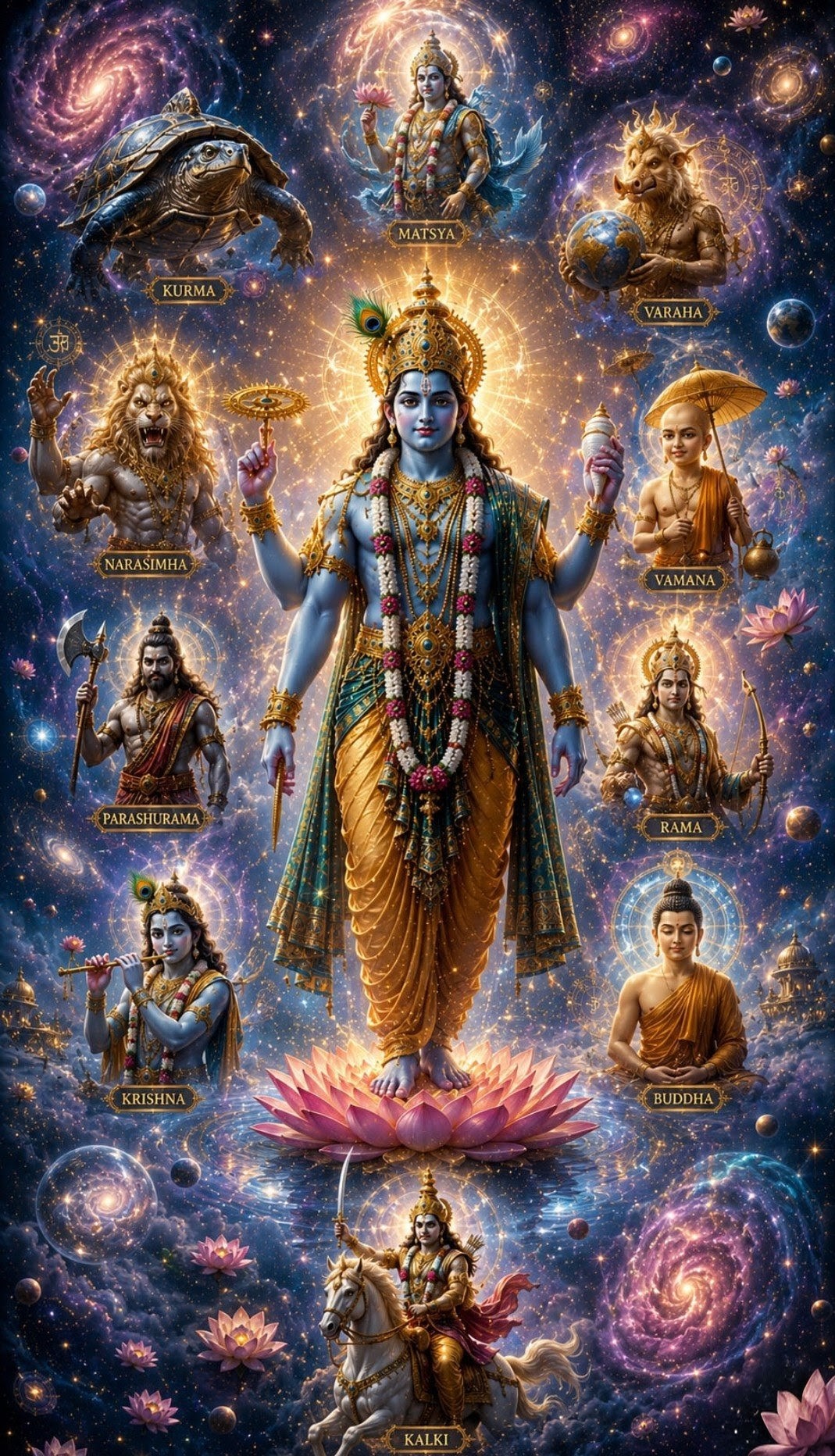
Who: Krishna, Balarama, Gandhari, the Yadavas, Uddhava, Jara, Arjuna.
Relevant Sanskrit Verse
SourceBhagavad Gita 4.9
Sanskritजन्म कर्म च मे दिव्यमेवं यो वेत्ति तत्त्वतः।
त्यक्त्वा देहं पुनर्जन्म नैति मामेति सोऽर्जुन॥
janma karma ca me divyam evaṃ yo vetti tattvataḥ | tyaktvā dehaṃ punar janma naiti mām eti so 'rjuna ||
English Translation"One who truly understands My divine birth and action, after leaving the body, is not born again, but comes to Me, O Arjuna."
What Happens
After the Kurukshetra war, Krishna remains present in the world, but the great work of the age has already been accomplished. The Pandavas rule, but their victory is filled with grief, and Gandhari, devastated by the loss of her sons, curses Krishna in sorrow. Krishna accepts the unfolding of destiny because he knows that the Yadava clan too must face the consequences of its own inner decline. Over time, the Yadavas become powerful, proud, and careless. The clan that lived close to Krishna does not automatically remain protected from arrogance. Through a chain of events involving mockery, curse, intoxication, quarrel, and violence, the Yadavas destroy themselves. This is one of the most sobering episodes in Krishna's life because it shows that proximity to divinity does not replace personal responsibility. Balarama withdraws from the world, and Krishna prepares for his own departure. In traditions connected to the Uddhava teachings, Krishna gives final wisdom to Uddhava, ensuring that the teaching continues even after his visible form is gone. Eventually, Krishna sits in the forest, and a hunter named Jara mistakes his foot for a deer and shoots him. Krishna does not respond with anger; he completes the final act of his earthly incarnation with serenity. His departure marks the end of a sacred era and the transition into a darker age. Dwaraka's glory fades, and Arjuna later experiences that without Krishna's living presence, his former strength is diminished. The world is left not with Krishna's physical presence, but with Krishna's teaching, memory, and inner guidance. His life ends as it began: not as ordinary human helplessness, but as divine action completing its purpose.
Purpose in Krishna's Avatar Journey
This event completes Krishna's earthly mission. He does not remain forever as a political stabilizer. Once his role in restoring dharma is complete, the age changes.
Symbolic Meaning
The fall of the Yadavas shows that no clan, however close to divinity, is safe if pride, intoxication, mockery, and internal decay arise. Krishna's departure shows that divine incarnation enters time for a purpose and leaves when that purpose is complete.
Significance in the Bigger Storyline
Krishna's departure marks the end of one sacred era and the transition toward Kali Yuga in traditional understanding.
Outcome
Dwaraka's glory fades. Arjuna experiences the loss of Krishna's living presence. The world must now live by the wisdom Krishna has already given.
Even divine presence does not remove human responsibility forever. The teaching must eventually be internalized.