Secrets of Light
The messenger through which the universe reveals itself
Light is so familiar that it is easy to underestimate how strange it really is. It streams through a window, reflects from a mirror, carries images into our eyes, and transports energy from the Sun to Earth. Yet the deeper physics of light forced humanity to abandon several apparently obvious ideas: that space and time are universal, that physical objects must be either particles or waves, and that measurement merely reveals properties that already possess definite values.
Almost everything we know about the distant universe reaches us through some form of light. Stars, planets, galaxies, black holes, and the early universe cannot usually be touched or sampled directly. Instead, their light carries information about temperature, motion, chemical composition, magnetic fields, distance, and history. Understanding light therefore became one of the main pathways through which physics learned how reality itself is structured.
1. What exactly is light?
Light is an excitation of the electromagnetic field.
In classical physics, light is described as a self-propagating electromagnetic wave: a changing electric field produces a changing magnetic field, and the changing magnetic field produces a changing electric field. The coupled disturbance travels through space.
In quantum physics, the electromagnetic field exchanges energy and momentum in discrete excitations called photons. A photon is not simply a tiny glowing object on a perfectly defined miniature path. It is a quantum excitation whose measurable behaviour depends on how it is produced, allowed to evolve, and detected.
The words wave and particle remain useful, but neither is a complete literal picture. Light produces interference and diffraction like a wave, yet it is emitted and absorbed in discrete interactions like a particle.
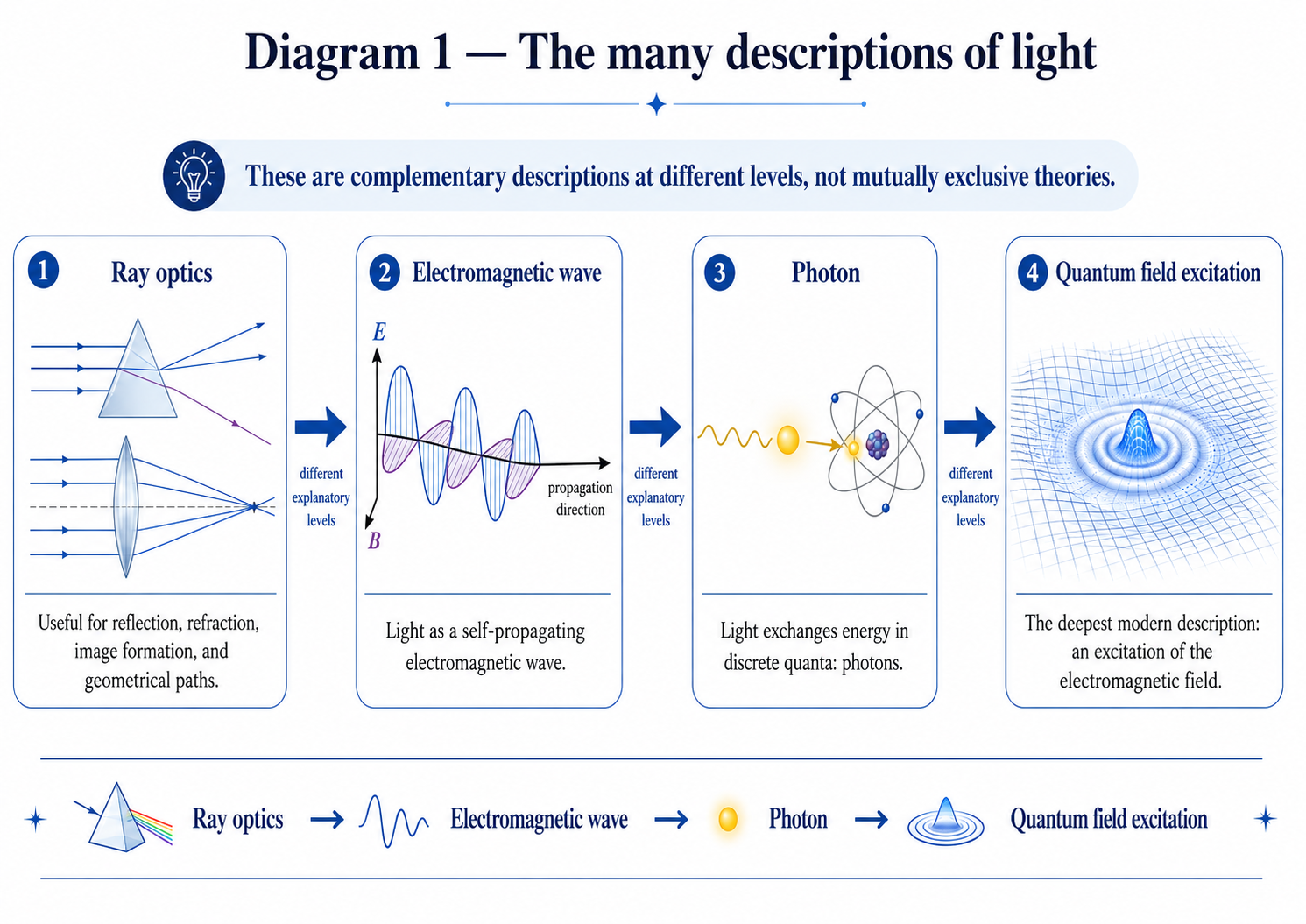
A useful hierarchy
A camera does not photograph a continuous substance called light. Its sensor records many localized photon-matter interactions, and the smooth image emerges from the statistical arrangement of a very large number of detection events.
2. The long search for the nature of light
The history of light is not a simple progression from ignorance to truth. Different theories explained different observations, and each successful theory revealed where the previous picture was incomplete.
| Period | Important idea or observation | Significance |
|---|---|---|
| Ancient world | Geometrical rays, reflection, and vision theories | Established the foundations of geometrical optics |
| 11th century | Ibn al-Haytham developed an experimental theory of vision and optics | Argued that light enters the eye rather than being emitted by it |
| 17th century | Newton proposed corpuscles; Huygens proposed waves | Created the classical particle-wave debate |
| Early 19th century | Thomas Young demonstrated interference | Strong evidence that light behaves as a wave |
| 19th century | Fresnel developed diffraction theory | Explained how light bends and spreads around obstacles |
| 1860s | Maxwell unified electricity, magnetism, and optics | Identified light as an electromagnetic wave |
| 1887 | Michelson and Morley found no detectable ether wind | Undermined the proposed stationary medium for light |
| 1900 | Planck introduced quantized energy in thermal radiation | Began the quantum revolution |
| 1905 | Einstein proposed light quanta and special relativity | Explained the photoelectric effect and rebuilt space and time around invariant light speed |
| 1920s | Compton scattering confirmed photon momentum | Strengthened the particle-like description of light |
| Mid-20th century | Quantum electrodynamics was developed | Unified photons, charged particles, and electromagnetic interactions |
| 1960 onward | Lasers produced highly coherent light | Enabled precision measurement, communications, and modern quantum optics |
3. The anatomy of a light wave
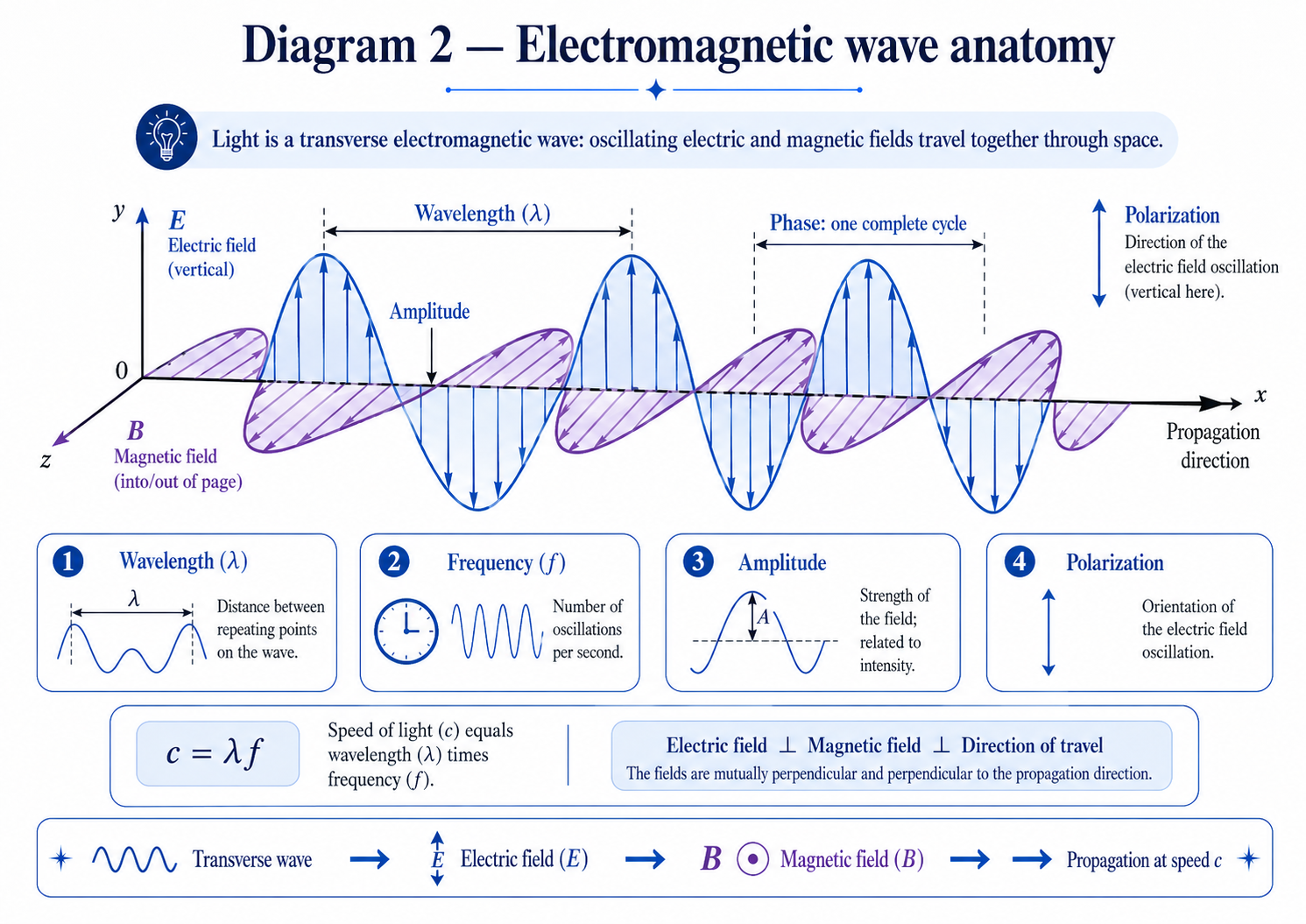
A classical light wave can be described using several connected properties.
Wavelength
The wavelength, represented by lambda, is the distance between equivalent points on successive wave cycles. Long wavelengths correspond to radio waves and microwaves; short wavelengths correspond to ultraviolet radiation, X-rays, and gamma rays.
Frequency
The frequency, represented by f or nu, is the number of oscillations passing a point each second.
A longer wavelength therefore corresponds to a lower frequency, while a shorter wavelength corresponds to a higher frequency.
Amplitude
Amplitude describes the strength of the electromagnetic field. In classical optics, greater amplitude corresponds to greater intensity. In quantum language, brighter light usually means more photon energy arriving per unit time and area.
Phase
Phase indicates where a wave is within its oscillation cycle. Phase relationships determine whether overlapping waves reinforce or cancel one another. Phase is central to interference, holography, lasers, and precision interferometers.
Polarization
Polarization describes the orientation of the oscillating electric field. Polarization reveals that light is a transverse wave: its field oscillations are perpendicular to its direction of propagation.
4. The electromagnetic spectrum
Visible light is only a narrow region of a much larger family of electromagnetic radiation.
These are not fundamentally different substances. They are all electromagnetic radiation. What changes is primarily wavelength, frequency, photon energy, and interaction with matter.
Higher-frequency photons therefore carry more energy than lower-frequency photons. Different wavelengths reveal different universes: visible light shows stars and surfaces, infrared reveals dust and warm structures, radio waves expose cold gas and magnetic processes, X-rays show extreme temperatures, and gamma rays show the most energetic events.
5. How light behaves
The behaviour of light depends on its wavelength, the geometry of the experiment, and the material with which it interacts.
Reflection
The angle of incidence equals the angle of reflection. Mirrors form clear images because neighboring rays preserve an orderly geometrical relationship.
Refraction
Refraction explains lenses, prisms, rainbows, and the focusing systems of eyes and cameras.
Diffraction
Diffraction is the spreading of a wave after it passes through an opening or around an obstacle. It imposes a fundamental resolution limit on optical systems.
Interference
When waves overlap, their field amplitudes combine. If they arrive in phase, they reinforce; if they arrive out of phase, they partially or completely cancel.
Scattering
Scattering occurs when light is redirected by particles, atoms, molecules, or structures. The blue sky and red sunsets are standard consequences of wavelength-dependent atmospheric scattering.
6. Young's double-slit experiment
The double-slit experiment is among the most important experiments in physics because the same simple arrangement exposes both the classical wave behaviour of light and the nonclassical logic of quantum mechanics.
Classical arrangement
A coherent light source illuminates two narrow slits separated by distance d. Light emerging from the slits overlaps on a screen and produces alternating bright and dark bands called interference fringes.
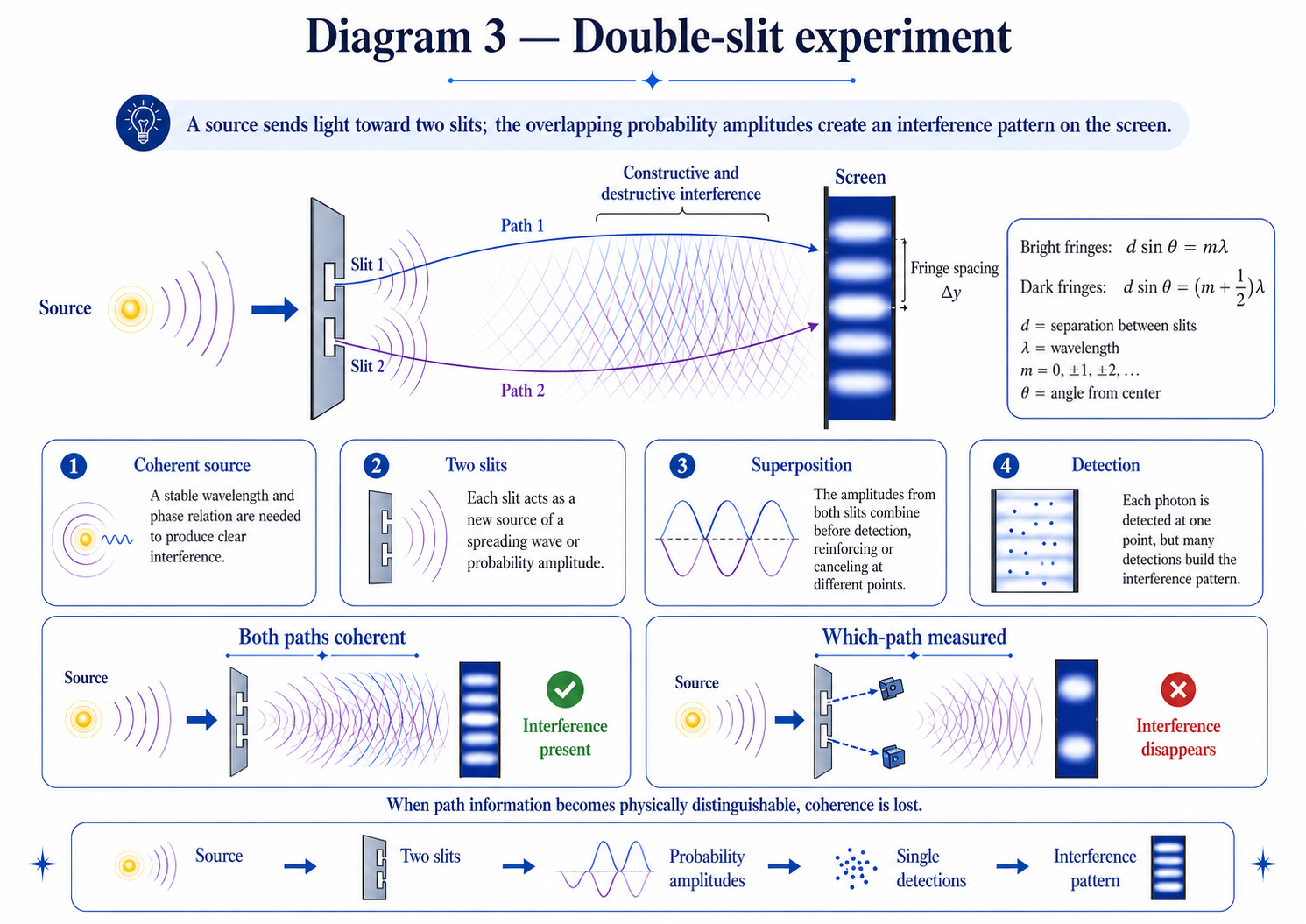
For bright fringes, the path lengths differ by a whole number of wavelengths. For dark fringes, the difference is an odd multiple of half a wavelength.
The experiment with single photons
When the source is weakened until photons arrive one at a time, each photon is still detected as one localized event. Yet after many detections, the accumulated pattern is the same interference pattern.
The final term is the interference term. In quantum mechanics, amplitudes are combined first; probabilities are calculated afterward.
What happens when we measure the path?
If a detector records which slit the photon passes through, the interference pattern disappears. The crucial event is not human awareness but a physical interaction that makes the alternatives distinguishable and destroys their stable phase relationship.
7. What the double-slit experiment inspired
- Matter waves: electrons, neutrons, atoms, and larger molecules can also produce interference.
- Superposition: quantum systems are described using combinations of possible states.
- Complementarity: preserving interference usually removes definite path information, and vice versa.
- Quantum probability: complex amplitudes interfere in ways ordinary ignorance probabilities cannot reproduce.
- Decoherence: environmental interactions distribute phase information and help explain classical appearance.
- Quantum technology: interference is foundational in quantum sensing, quantum computing, atomic clocks, and interferometric detection.
8. The photoelectric effect: when light arrives in packets
Classical wave theory predicted that sufficiently intense light should eventually eject electrons from a metal, regardless of frequency. Experiments instead showed a threshold frequency and immediate emission above that threshold.
The photoelectric effect showed that energy exchange between light and matter is quantized. It is now central to solar cells, cameras, photodiodes, and light sensors.
9. Photon momentum and the Compton effect
A photon has no rest mass, but it carries energy and momentum.
Compton scattering provided strong evidence that electromagnetic radiation carries particle-like momentum as well as displaying wave-like propagation.
10. Maxwell's great unification
Maxwell's equations showed that changing electric and magnetic fields sustain one another and can propagate through empty space. The equations predicted a wave speed equal to the measured speed of light.
This led to one of the great unifications in science: light is an electromagnetic wave.
11. The ether and the Michelson-Morley experiment
Because ordinary waves usually require a medium, physicists once proposed a luminiferous ether filling the universe. If Earth moved through this ether, a detectable “ether wind” should change light travel times in different directions.
Michelson and Morley used an interferometer to look for that effect. The expected signal was not observed. This powerful null result undermined a simple stationary ether and helped clear the way for relativity.
12. Why is the speed of light constant?
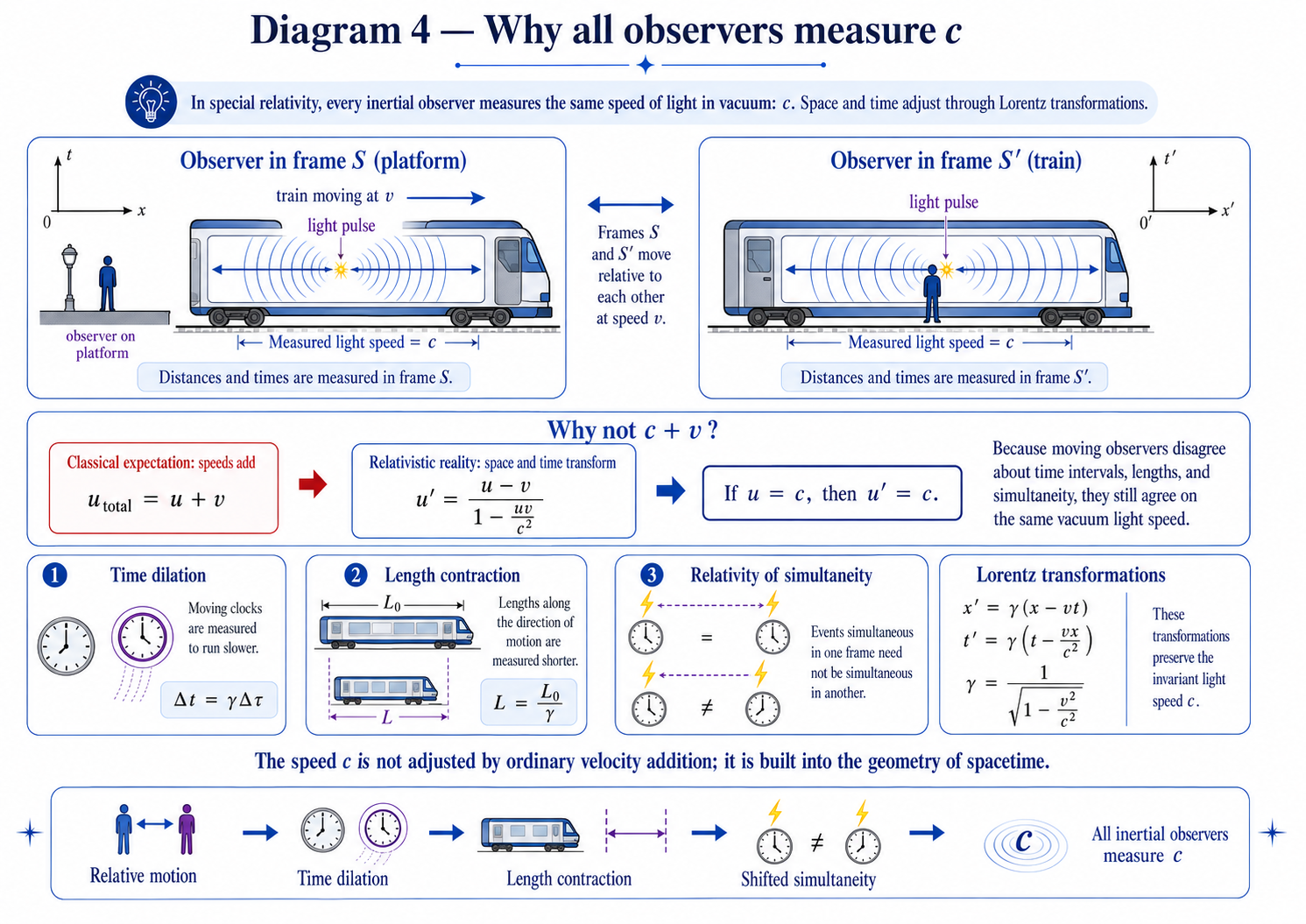
The experimentally established statement is that every inertial observer locally measures the same speed c for light in vacuum, regardless of the motion of source or observer.
This is not ordinary Galilean addition. In relativity, c is built into the geometry of spacetime. Observers moving relative to one another may disagree about distances, durations, and simultaneity, but these adjustments fit together so that they agree on the local vacuum speed of light.
- The laws of physics have the same form in every inertial frame.
- Light in vacuum has the same speed for every inertial observer.
13. Lorentz transformations
The Lorentz transformations relate coordinates in two inertial frames moving at constant relative velocity v.
These transformations preserve light speed and lead directly to the relativity of simultaneity, time dilation, length contraction, and relativistic velocity addition.
No inertial observer obtains a light speed greater or smaller than c.
14. Light cones and causality
A flash of light emitted at an event expands through spacetime, defining a future light cone and a past light cone.
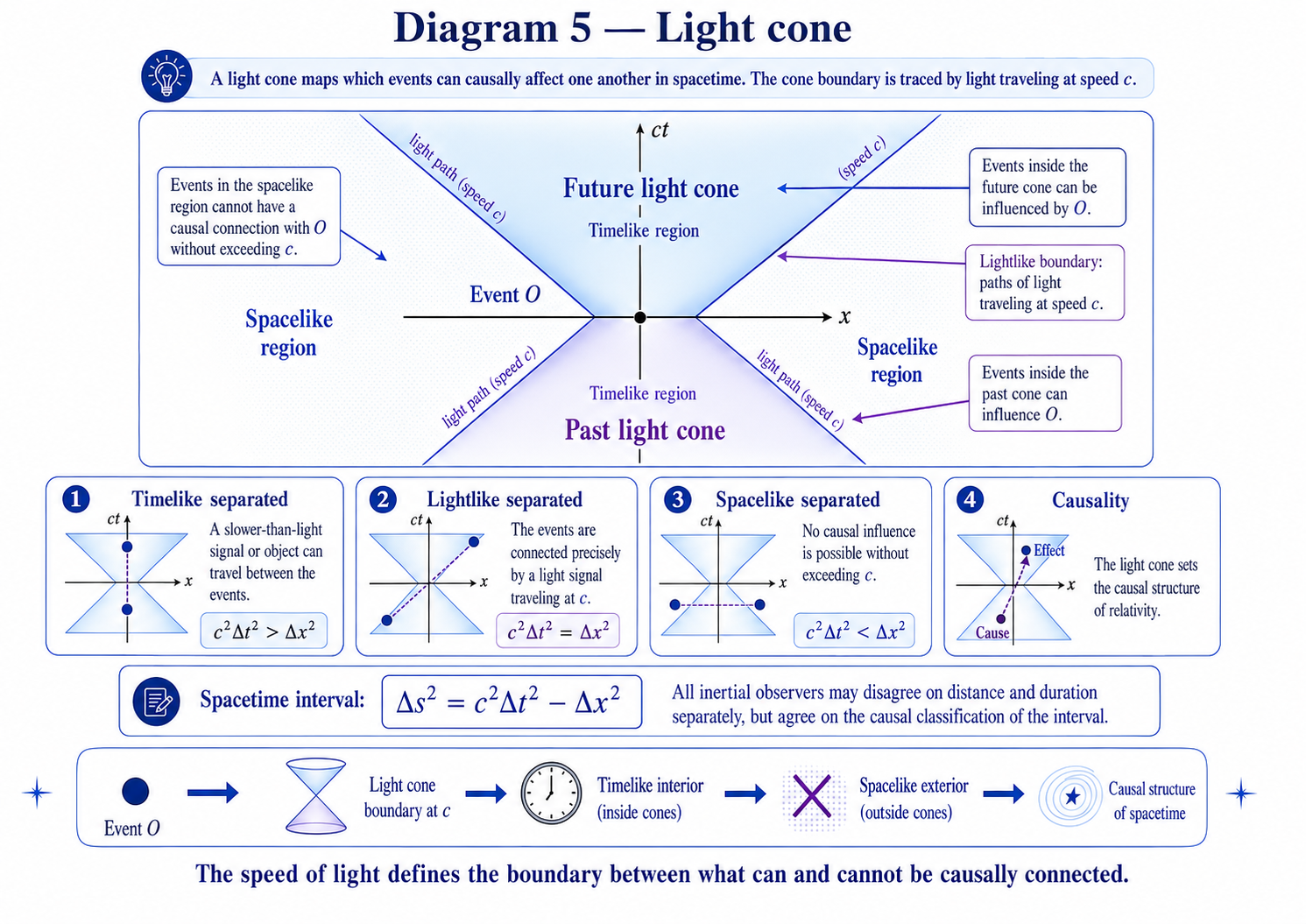
- Timelike separated: one event can influence another below light speed.
- Lightlike separated: the events are connected exactly by light.
- Spacelike separated: no causal influence limited by c can connect them in the available time.
The invariant speed c therefore acts as the boundary between causally connected and causally disconnected events.
15. Does light slow down in glass or water?
This does not mean the fundamental constant c has changed. Inside matter, the electromagnetic field interacts with charged particles in the material, changing the effective propagation of the wave packet through the medium.
In unusual dispersive media, phase or group velocities can exceed c, but this does not allow usable information or causal influence to travel faster than the vacuum light limit.
16. Light, gravity, and curved spacetime
General relativity describes gravity geometrically: matter and energy curve spacetime, and freely moving objects follow that geometry. Light follows null paths through curved spacetime.
Gravitational lensing
Massive objects can bend and magnify light from more distant sources, producing distorted arcs, multiple images, Einstein rings, and microlensing brightening.
Gravitational redshift
Light climbing out of a gravitational field is redshifted, while light falling deeper into a gravitational field is blueshifted.
Coordinate speeds can differ in curved spacetime descriptions, but a local freely falling observer still measures vacuum light at c.
17. Coherence and lasers
Two waves are coherent when their relative phase remains predictable over the relevant time and distance. Ordinary thermal light contains many atoms emitting independently, so its phase relationships fluctuate rapidly.
Laser light is produced through stimulated emission and is typically highly directional, spectrally narrow, strongly coherent, and capable of being tightly focused.
These properties make lasers useful in fiber communication, surgery, manufacturing, atomic clocks, gravitational-wave observatories, and quantum experiments.
18. Spectroscopy, redshift, and color
Spectroscopy
Atoms and molecules possess quantized energy levels, so they absorb and emit photons at characteristic energies. Spectroscopy lets us infer chemical composition, temperature, density, pressure, magnetic fields, motion, and history from light alone.
Doppler effect and redshift
Relative motion changes the observed wavelength of light.
On cosmological scales, redshift also records the expansion of spacetime itself.
Color
Color is not identical to wavelength. Wavelength is a physical property; color is a perceptual experience produced by the visual system. Different spectra can produce the same perceived color, and not every perceived color corresponds to one single wavelength.
19. The modern quantum-field view
Quantum electrodynamics, or QED, describes interactions among the electromagnetic field and electrically charged quantum fields.
- Photons are excitations of the electromagnetic field.
- Electrons are excitations of the electron field.
- Interactions are described through quantum amplitudes.
- Measured probabilities come from combining allowed amplitudes.
- Energy and momentum are conserved at interactions.
Even empty space is not absolute nothingness. It is the lowest-energy state of quantum fields and can exhibit measurable quantum effects.
20. Common misconceptions about light
- Light is not literally a classical wave sometimes and a classical particle at other times.
- A conscious observer is not required for the photon to “change behaviour.”
- Photons do not have an ordinary valid inertial rest frame.
- Light always travels at c only in vacuum; its effective propagation in materials is lower.
- Single-photon interference does not require photons to collide with one another.
- Not every quantity exceeding c corresponds to faster-than-light information transfer.
21. What remains mysterious?
- What exactly the quantum state represents
- What physically happens in measurement
- How gravity and quantum field theory should be fully unified
- Whether the photon is exactly massless
- Whether undiscovered particles such as axions or dark photons couple to light
- Why the constants of nature have the values we measure
22. The essential equations of light
| Idea | Equation |
|---|---|
| Wave relationship | c = lambda f |
| Photon energy | E = hf = hc / lambda |
| Photon momentum | p = h / lambda = E / c |
| Refractive index | n = c / v |
| Snell's law | n1 sin(theta1) = n2 sin(theta2) |
| Double-slit maxima | d sin(theta) = m lambda |
| Photoelectric equation | Kmax = hf - phi |
| Lorentz factor | gamma = 1 / sqrt(1 - v^2 / c^2) |
| Time dilation | Delta t = gamma Delta tau |
| Length contraction | L = L0 / gamma |
| Spacetime interval | Delta s^2 = c^2 Delta t^2 - Delta x^2 |
| Relativistic velocity transformation | u' = (u - v) / (1 - uv / c^2) |
| Redshift | z = (lambda_o - lambda_e) / lambda_e |
23. A deeper way to think about light
Light is not merely something that moves through the universe. It helps define the causal structure of the universe.
- Its invariant speed separates reachable events from unreachable ones.
- Its wavelengths carry the signatures of atoms.
- Its interference reveals that quantum possibilities combine through amplitudes.
- Its bending exposes the curvature of spacetime.
- Its redshift records motion and cosmic expansion.
- Its photons transfer energy and momentum in discrete interactions.
The closer we examine light, the more it becomes a meeting point of the fundamental ideas through which modern physics understands reality.
24. Suggested diagrams and visual elements
Diagram 1 - The many descriptions of light
Ray optics -> Electromagnetic wave -> Photon -> Quantum field excitation
Placeholder for future upload. Suggested asset path: assets/physics/secrets-of-light/descriptions-of-light.png
Diagram 2 - Electromagnetic wave anatomy
Show perpendicular electric and magnetic fields oscillating while the wave propagates forward. Label wavelength, amplitude, direction of travel, and polarization.
Placeholder for future upload. Suggested asset path: assets/physics/secrets-of-light/electromagnetic-wave-anatomy.png
Diagram 3 - Double-slit experiment
Single-photon source -> two slits -> probability amplitudes -> individual detections -> accumulated interference pattern
- Both paths coherent
- Which-path detector active
- Interference present versus absent
Placeholder for future upload. Suggested asset path: assets/physics/secrets-of-light/double-slit-experiment.png
Diagram 4 - Why all observers measure c
Show two observers moving relative to one another, each measuring the same light pulse. Connect the result to time dilation, length contraction, and relativity of simultaneity.
Placeholder for future upload. Suggested asset path: assets/physics/secrets-of-light/why-all-observers-measure-c.png
Diagram 5 - Light cone
- Future light cone
- Past light cone
- Timelike region
- Spacelike region
- Lightlike boundary
Placeholder for future upload. Suggested asset path: assets/physics/secrets-of-light/light-cone.png
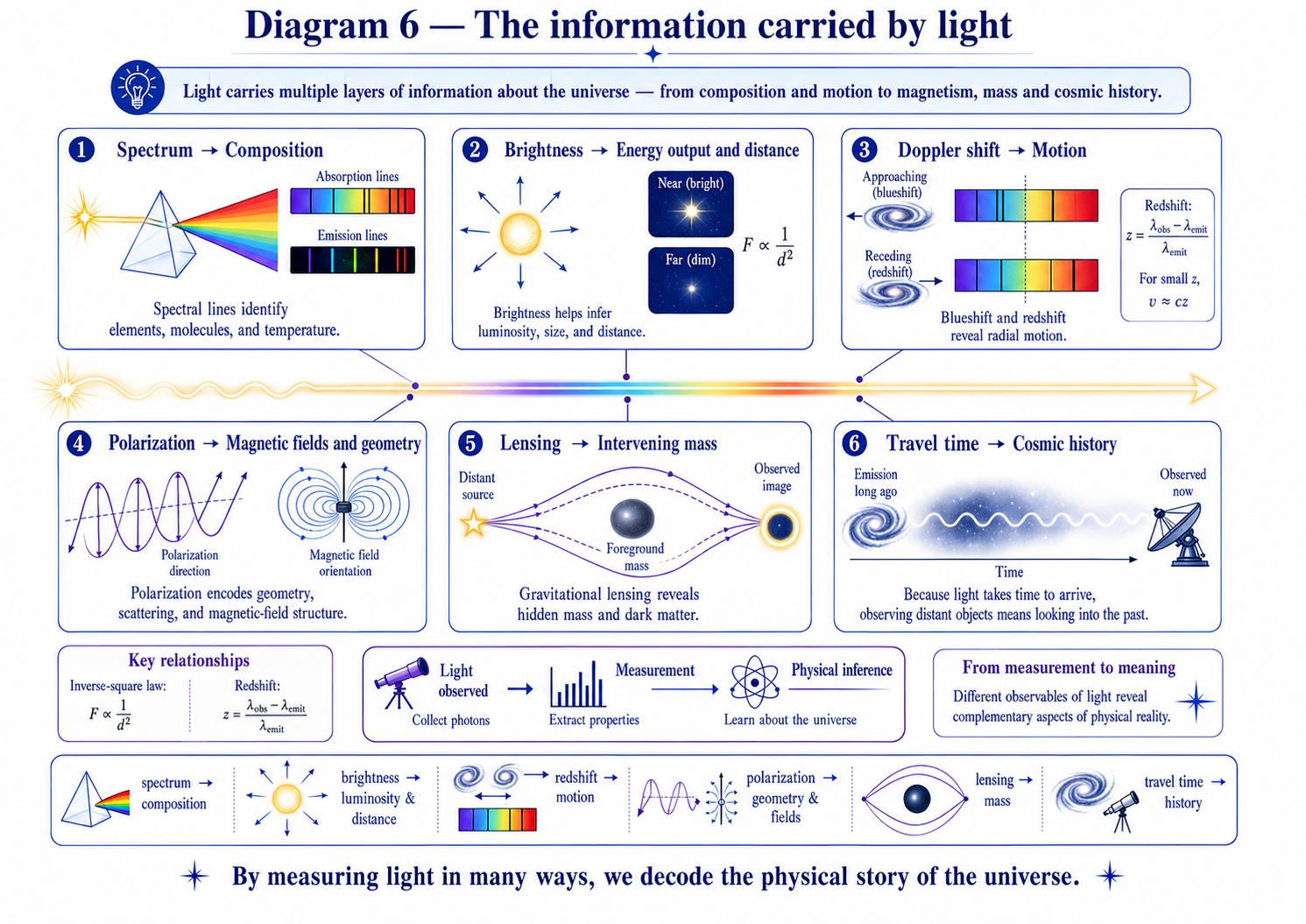
Diagram 6 - The information carried by light
- Spectrum -> composition
- Brightness -> energy output and distance
- Doppler shift -> motion
- Polarization -> magnetic fields and geometry
- Lensing -> intervening mass
- Travel time -> cosmic history
Placeholder for future upload. Suggested asset path: assets/physics/secrets-of-light/information-carried-by-light.png
25. Further reading
- NASA Science - The Electromagnetic Spectrum
- NIST - Speed of light in vacuum
- Einstein's 1905 paper: On the Electrodynamics of Moving Bodies
- Library of Congress - Einstein's 1905 papers
- APS - Thomas Young and the nature of light
- APS - Michelson and Morley report failure to detect ether
- Nobel Prize - Einstein and the photoelectric effect
- Nobel Prize - Arthur Compton
- NASA Science - Hubble gravitational lenses
- NIST - What is a laser?
- CERN - Direct evidence of light-by-light scattering