High energy particle physics
1. Overview
High Energy Particle Physics (HEP), also known as particle physics, studies the most fundamental constituents of matter and energy, and the forces through which they interact.
While classical physics describes macroscopic systems and quantum mechanics explains atomic behavior, particle physics probes the subatomic and fundamental level, where particles are best understood as elementary excitations of quantum fields.
- Particle physics explores the deepest layer of reality.
- It unifies quantum mechanics and relativity (partially).
- The Standard Model is powerful but incomplete.
- The search for deeper understanding continues.
The field seeks to answer questions such as:
- What are the smallest building blocks of the universe?
- What are the fundamental forces governing interactions?
- Why do particles have mass?
- What existed in the early universe?
- Is there a deeper unified theory beyond the Standard Model?
HEP derives its name from the fact that probing smaller scales requires higher energies, achieved using particle accelerators.
2. Knowledge map of high energy particle physics
HIGH ENERGY PARTICLE PHYSICS
|
+--- FOUNDATIONS
|   |
|   +--- quantum field theory
|   +--- relativistic quantum mechanics
|   +--- symmetry principles
|
+--- FUNDAMENTAL PARTICLES
|   |
|   +--- quarks
|   +--- leptons
|   +--- gauge bosons
|   +--- Higgs boson
|
+--- FUNDAMENTAL FORCES
|   |
|   +--- strong force
|   +--- weak force
|   +--- electromagnetic force
|   +--- gravity (not unified)
|
+--- STANDARD MODEL
|   |
|   +--- particle classification
|   +--- interactions
|   +--- conservation laws
|
+--- SYMMETRIES
|   |
|   +--- gauge symmetry
|   +--- spontaneous symmetry breaking
|
+--- EXPERIMENTAL METHODS
|   |
|   +--- particle accelerators
|   +--- detectors
|   +--- collision experiments
|
+--- BEYOND STANDARD MODEL
    |
    +--- dark matter
    +--- supersymmetry
    +--- grand unification
3. Foundations of particle physics
Particle physics emerged from the need to understand phenomena that could not be explained by atomic physics alone.
3.1 Key historical problems
- Discovery of subatomic particles (electron, proton, neutron)
- Radioactivity and nuclear decay
- Cosmic rays revealing new particles
- Proliferation of the “particle zoo” in experiments
These led to the realization that matter is not made of indivisible atoms, but of layers of increasingly fundamental particles.
3.2 Key conceptual shift
- Matter is not made of “solid particles”.
- Instead: quantized excitations of underlying fields.
This is formalized in Quantum Field Theory (QFT).
3.3 Questions that led to this field
- What lies beyond protons and neutrons?
- Are particles truly fundamental?
- Why do forces exist?
- Can all forces be unified?
4. Quantum field theory (QFT) — the core framework
4.1 What problem did it solve?
Quantum mechanics describes particles and relativity describes high-speed motion, but combining them led to inconsistencies. QFT resolves this by treating particles as excitations of fields, and fields as the fundamental entities.
4.2 Key idea
Every particle corresponds to a field:
- Electron → electron field
- Photon → electromagnetic field
Particles appear when these fields are excited.
4.3 Questions to think about
- Is a particle a real object or just a field excitation?
- Are fields more fundamental than matter?
4.4 Applications
- Particle physics predictions
- Condensed matter physics
- Quantum computing theory
5. Fundamental particles
5.1 Quarks
- Up, Down, Charm, Strange, Top, Bottom
- Combine to form protons and neutrons
5.2 Leptons
- Electron, muon, tau
- Neutrinos
5.3 Force carriers (gauge bosons)
- Photon → electromagnetic force
- Gluon → strong force
- W/Z bosons → weak force
5.4 Higgs boson
Explains how particles acquire mass.
5.5 Questions to think about
- Why are there exactly these particles?
- Are quarks truly fundamental?
- Why do particles have different masses?
5.6 Applications
- Nuclear physics
- Medical imaging (PET scans)
- Radiation therapy
6. Fundamental forces
Particle physics identifies four fundamental forces:
- Electromagnetic — acts on charged particles; infinite range
- Strong — binds quarks; extremely strong but short range
- Weak — responsible for radioactive decay
- Gravity — not yet unified with quantum theory
6.1 Questions to think about
- Why are there exactly four forces?
- Can all forces be unified?
7. The Standard Model
The Standard Model is the most successful theory in physics, describing all known particles and interactions (except gravity).
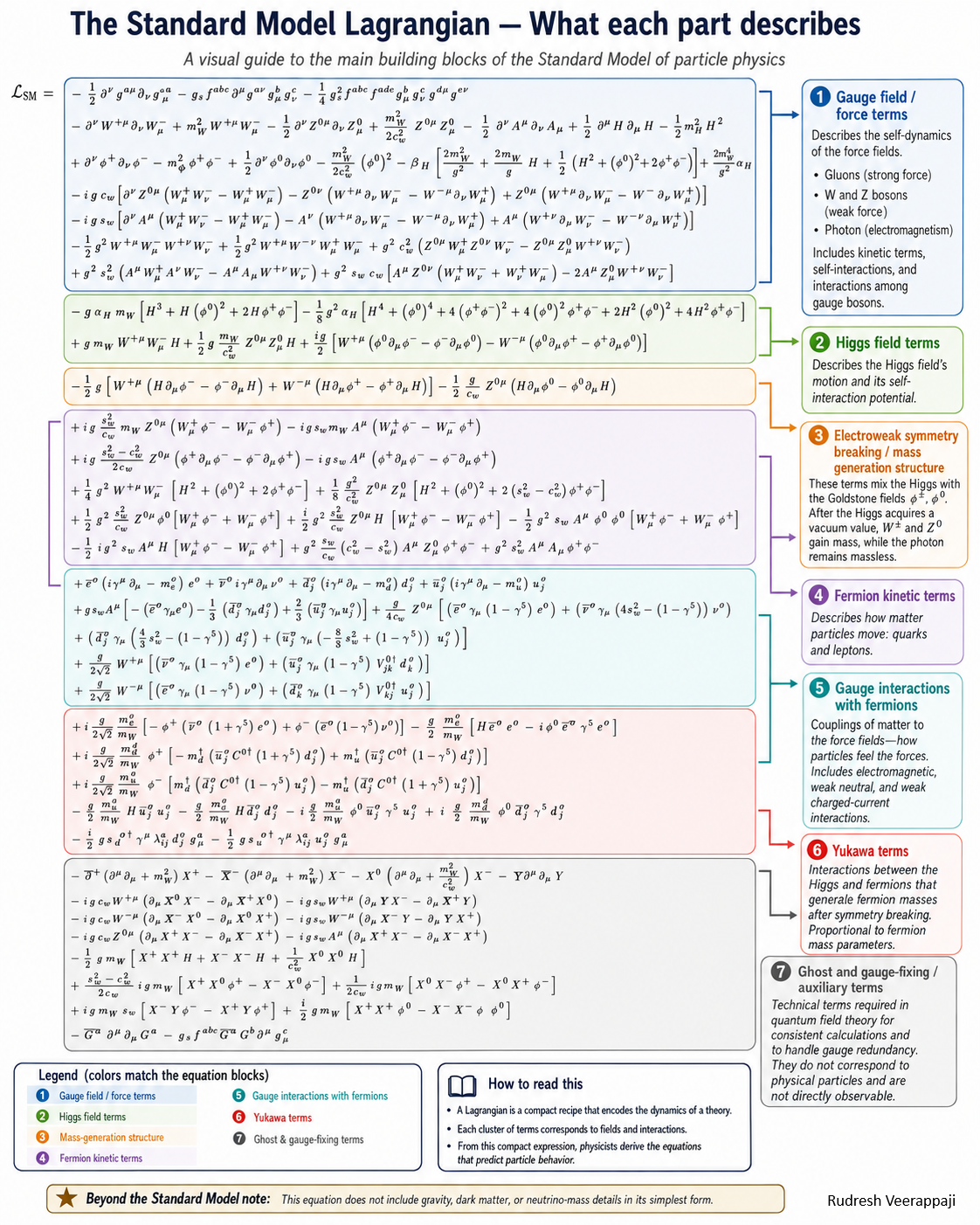
At its deepest level, the Standard Model can be written as a compact equation called the Standard Model Lagrangian. That single expression encodes the behavior of matter particles, force-carrying particles, the Higgs field, and the interaction terms that tell us how these pieces influence one another.
The image below breaks down this equation into its major parts and gives an intuitive explanation of what each section represents.
7.1 Symbol glossary
Here are the main symbols in the equation and what they mean.
𝓛SM- The Standard Model Lagrangian, the full mathematical expression describing the particles, fields, forces, and interactions of the Standard Model.
∂μ- A spacetime derivative; it describes how a field changes with position or time.
μ, ν- Spacetime indices, usually labeling the four coordinates: one time direction and three spatial directions.
gμa- The gluon field, which carries the strong nuclear force.
a, b, c, ...- Internal color or gauge indices, used to distinguish different components of fields such as the eight gluons.
fabc- The structure constants of SU(3), which encode how gluons interact with one another.
gs- The strong-force coupling constant, setting the interaction strength for gluons and quarks.
Wμ+, Wμ-- The electrically charged W boson fields, responsible for charged weak interactions.
Zμ0- The Z boson field, responsible for neutral weak interactions.
Aμ- The photon or electromagnetic field.
g- The main electroweak coupling constant, which determines the strength of weak interactions.
θW- The Weinberg angle or weak-mixing angle, describing how the original electroweak fields combine to form the photon and the Z boson.
sW- Shorthand for
sin(θW). cW- Shorthand for
cos(θW). H- The physical Higgs field or Higgs boson that remains after electroweak symmetry breaking.
φ+, φ-, φ0- Higgs-sector Goldstone fields that appear explicitly in this gauge-fixed form of the Standard Model.
mW- The mass of the W boson.
mH- The mass of the Higgs boson.
e- The electron field; similar notation is used for other charged leptons.
ν- A neutrino field.
u- An up-type quark field; the same structure can represent up, charm, and top quarks.
d- A down-type quark field; the same structure can represent down, strange, and bottom quarks.
ē, ū, d̄, ...- The bar denotes the Dirac adjoint of a fermion field, required when building relativistically valid fermion terms.
me, mu, md, ...- Fermion mass parameters, representing masses of electrons and different quarks.
γμ- Dirac gamma matrices, used to describe relativistic spin-1/2 particles such as electrons and quarks.
γ5- A special gamma matrix used to distinguish left-handed and right-handed chirality of fermions.
1 - γ5- Selects mainly left-handed fermion components, which participate in charged weak interactions.
1 + γ5- Selects the corresponding right-handed fermion components.
i, j, k- Indices used to distinguish quark generations, flavors, or color components, depending on the term.
Vjk- Elements of the CKM matrix, describing how different quark generations mix during weak interactions.
λaij- Gell-Mann matrices, the generators of the SU(3) color symmetry acting on quarks.
αH, βH- Parameters associated with the Higgs potential and its renormalization in this expanded formulation.
X+, X-, X0, Y- Electroweak ghost fields introduced when quantizing a gauge theory; they are bookkeeping fields, not observable particles.
Ga, Ḡa- QCD ghost fields, required for consistent quantum calculations involving gluons.
+and-superscripts- Usually indicate the electric charge of a field, as in
W+,W-,φ+, andφ-. 0superscript- Depending on context, can indicate a neutral field such as
Z0or a bare or unmixed field in the chosen notation. Repeated indices- When the same index appears twice, physicists usually sum over all allowed values automatically; this is Einstein summation notation.
Products such as W+W-H- These represent interactions between fields; the fields appearing together tell you which particles can meet at a vertex.
Coefficients such as g, g2, or gs- These tell you the strength or probability amplitude associated with an interaction.
Terms containing m2φ2- These typically represent mass terms for a field.
Terms containing (∂μφ)2- These usually represent a field's kinetic or propagation energy.
Terms containing three fields- These usually correspond to a possible three-particle interaction vertex.
Terms containing four fields- These usually correspond to a possible four-particle interaction vertex.
Five conceptual families
Fields→ particles that exist∂→ how those fields move or changem→ their massesg→ interaction strengthsProducts of fields→ which particles can interact
Once you see it this way, the intimidating equation becomes much more readable: it is essentially a large catalogue saying “these fields exist, these are their properties, and these are all the ways they are allowed to interact.”
7.2 What problem did it solve?
- Unified electromagnetic and weak interactions
- Organized the “particle zoo”
- Predicted new particles (including the Higgs boson)
7.3 Key features
- Based on symmetry principles
- Uses gauge theory
- Predicts interaction strengths and outcomes
7.4 Limitations
- Does not include gravity
- Cannot explain dark matter
- Cannot fully explain neutrino masses
8. Symmetry and conservation laws
Symmetry is central to modern physics.
8.1 Key idea
Every symmetry corresponds to a conservation law.
Example: time symmetry → energy conservation.
8.2 Spontaneous symmetry breaking
The Higgs mechanism breaks symmetry to give particles mass.
8.3 Questions to think about
- Why is symmetry so fundamental?
- Why does symmetry break in nature?
9. Experimental methods
9.1 Particle accelerators
Machines that accelerate particles to near light speed (e.g., the Large Hadron Collider).
9.2 Detectors
Used to observe particle collisions and decay products.
9.3 Collisions
High-energy collisions recreate early-universe conditions.
9.4 Questions to think about
- Why do higher energies reveal smaller structures?
- How do we detect invisible particles?
9.5 Applications
- Medical imaging
- Cancer treatment
- Materials science
10. Key discoveries and milestones
- Electron discovery (J.J. Thomson)
- Proton and neutron discovery
- Quantum field theory development
- Standard Model formulation
- Higgs boson discovery (2012)
11. Top physicists and contributions
- Richard Feynman — QED
- Paul Dirac — relativistic quantum mechanics
- Murray Gell-Mann — quarks
- Peter Higgs — Higgs mechanism
- Steven Weinberg — electroweak theory
12. Tools that enabled particle physics
- Particle accelerators
- Bubble chambers
- Cloud chambers
- Silicon detectors
- Supercomputers
13. Beyond the Standard Model
Current research explores:
13.1 Dark matter
Unknown matter that dominates the universe.
13.2 Supersymmetry
Proposes partner particles for all known particles.
13.3 Grand unified theories
Attempts to unify forces.
13.4 Quantum gravity
Unifying relativity and quantum mechanics.
13.5 Questions to think about
- What is dark matter made of?
- Is there a deeper underlying theory?
- Are there more dimensions?
14. Practical impact of particle physics
- Semiconductors and electronics
- Medical imaging (MRI, PET)
- Nuclear energy
- Radiation therapy
- Data processing (CERN → World Wide Web)
15. Conceptual takeaways
- Matter is not fundamental—fields are.
- Forces arise from field interactions.
- Symmetry governs physical laws.
- The universe at its core is quantum and relativistic.
16. Further references
Books
- The Quantum Theory of Fields — Weinberg
- QED — Feynman
Courses
- MIT OpenCourseWare (Particle Physics)
- CERN educational resources