Deep Sky Images
Some of the most incredible deep sky images from different generations of telescopes, and the scientific significance behind capturing them.
1. Pillars of Creation - Hubble Space Telescope - 1995
Perhaps the most recognizable deep-space image ever produced. The towering columns are clouds of gas and dust inside the Eagle Nebula where new stars are forming; Hubble first photographed them in 1995, transforming them into an enduring symbol of astronomy. In NASA's color mapping for this image, blue traces oxygen, red traces sulfur, and green represents nitrogen and hydrogen. The pillars themselves are dense pockets of material that can shield newborn stars inside them, while ultraviolet radiation and stellar winds from hot young stars just outside the frame are slowly eroding the towers away.
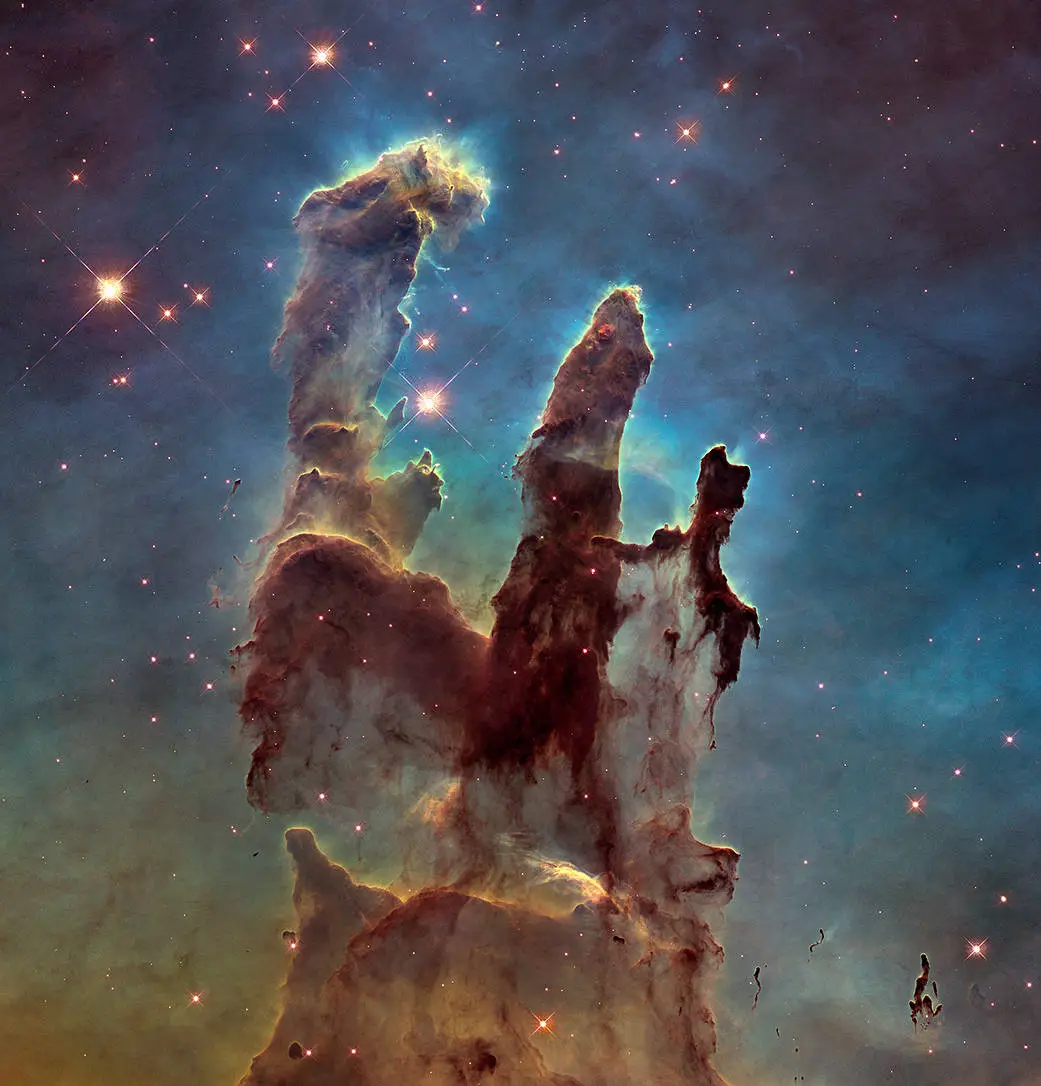
Approx. distance from Earth: about 7,000 light-years.
Approx. width of the object(s) in the image: about 4 to 5 light-years across for the Pillars themselves.
Approximate sky region: inside the Eagle Nebula in the constellation Serpens, along the Milky Way in the northern summer sky.
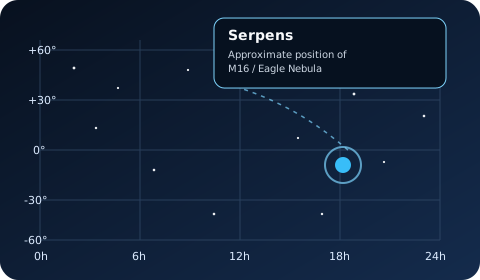
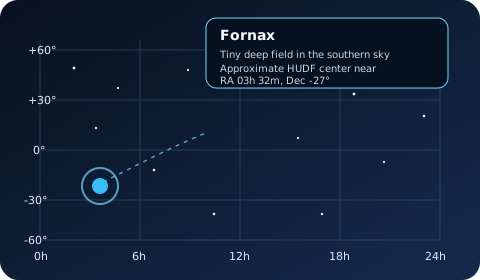
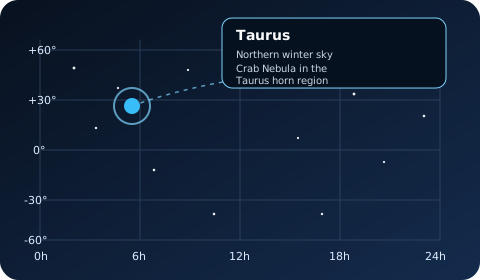
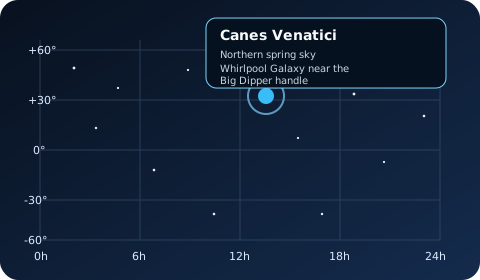
How to read this map: the horizontal axis shows right ascension, the sky's east-west coordinate, labeled in hours from 0h to 24h. The vertical axis shows declination, the sky's north-south coordinate, labeled in degrees above or below the celestial equator. The small white dots mark reference stars to give orientation, not exact scale drawings of brightness or size. The highlighted blue marker shows the approximate position of the Eagle Nebula region, and the label plus dashed line identify which point in the wider sky corresponds to the object in the image above.
Source: NASA
2. Hubble Ultra Deep Field - Hubble Space Telescope - 2003-2004
Hubble stared at an apparently almost empty patch of sky and revealed nearly 10,000 galaxies. The snapshot includes galaxies of various ages, sizes, shapes, and colors, making the image a visual history of galaxy formation. The smallest, reddest galaxies may be among the most distant known, existing when the universe was just about 800 million years old. The nearest galaxies, the larger, brighter, well-defined spirals and ellipticals, thrived about 1 billion years ago, when the cosmos was 13 billion years old. The image required 800 exposures taken over the course of 400 Hubble orbits around Earth. The total amount of exposure time was 11.3 days, taken between Sept. 24, 2003 and Jan. 16, 2004.
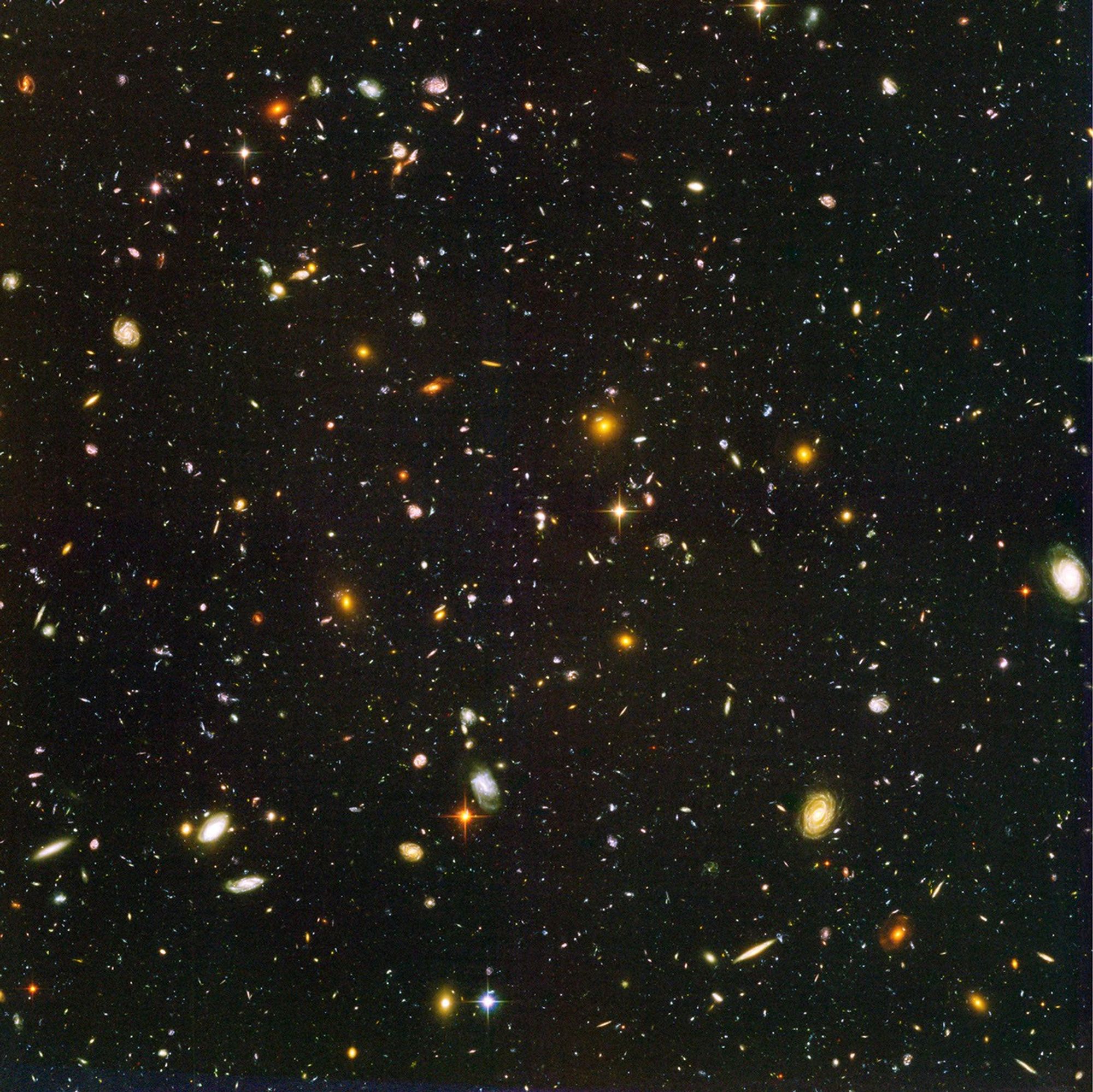
Approx. distance from Earth: this is a mixed deep field rather than one object; the visible galaxies span roughly 1 billion light-years to well over 13 billion light-years in lookback distance.
Approx. width of the object(s) in the image: there is no single fixed light-year width here, because the image is a pencil-beam survey containing galaxies at many different distances rather than one bounded object.
Approximate sky region: a tiny patch of sky in the constellation Fornax, deep in the southern sky.
Source: NASA Science
3. First black-hole image, M87* - Event Horizon Telescope - 2017 (released in 2019)
Released by the Event Horizon Telescope collaboration in 2019, this was humanity’s first image of a black hole’s shadow. It shows glowing material surrounding the supermassive black hole at the centre of galaxy M87, approximately 55 million light-years away and about 6.5 billion times the Sun’s mass. The bright ring marks superheated material in the black hole's immediate environment, while the dark center is the shadow produced because gravity bends and captures light near the event horizon. The ring is not perfectly uniform, which matched models that include warped spacetime, superheated matter, and strong magnetic fields around the black hole.
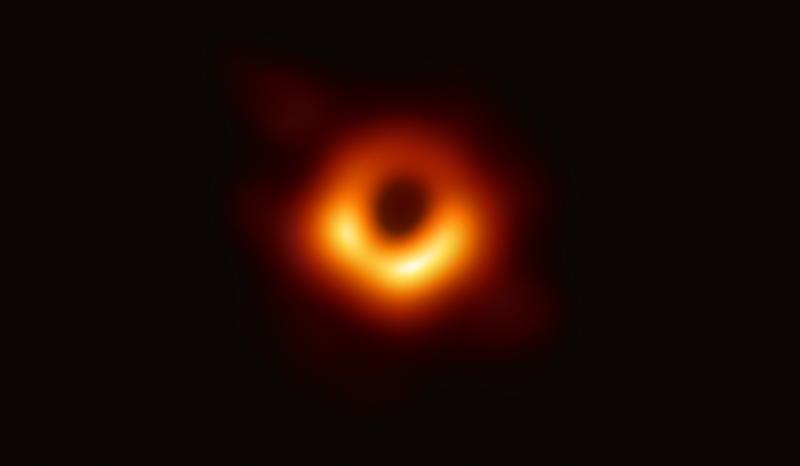
Approx. distance from Earth: about 55 million light-years.
Approx. width of the object(s) in the image: the black hole's event-horizon boundary is just under 40 billion km across, about 0.004 light-years; the visible shadow ring is roughly 0.01 light-years across.
Approximate sky region: the giant galaxy M87 in the constellation Virgo, within the Virgo Cluster in the spring sky.
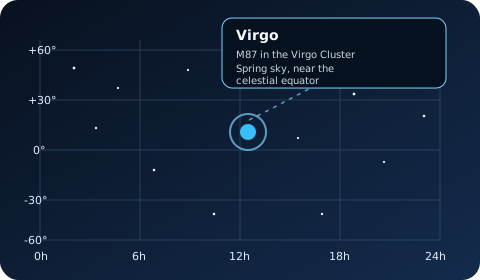
Source: Event Horizon Telescope
4. Webb’s First Deep Field, SMACS 0723 - James Webb Space Telescope - 2022
The first major deep-field image released by the James Webb Space Telescope showed thousands of galaxies in infrared light. The foreground galaxy cluster bends and magnifies light from more distant galaxies through gravitational lensing, allowing Webb to examine extremely remote parts of the universe. The bright white elliptical galaxies near the center belong to the lensing cluster, whose combined mass and dark matter act like a natural telescope. Many of the orange arcs are the same background galaxies stretched, mirrored, and magnified by lensing, while the tiniest, clumpier galaxies in the far background show the early universe before many galaxies settled into well-ordered spiral shapes.
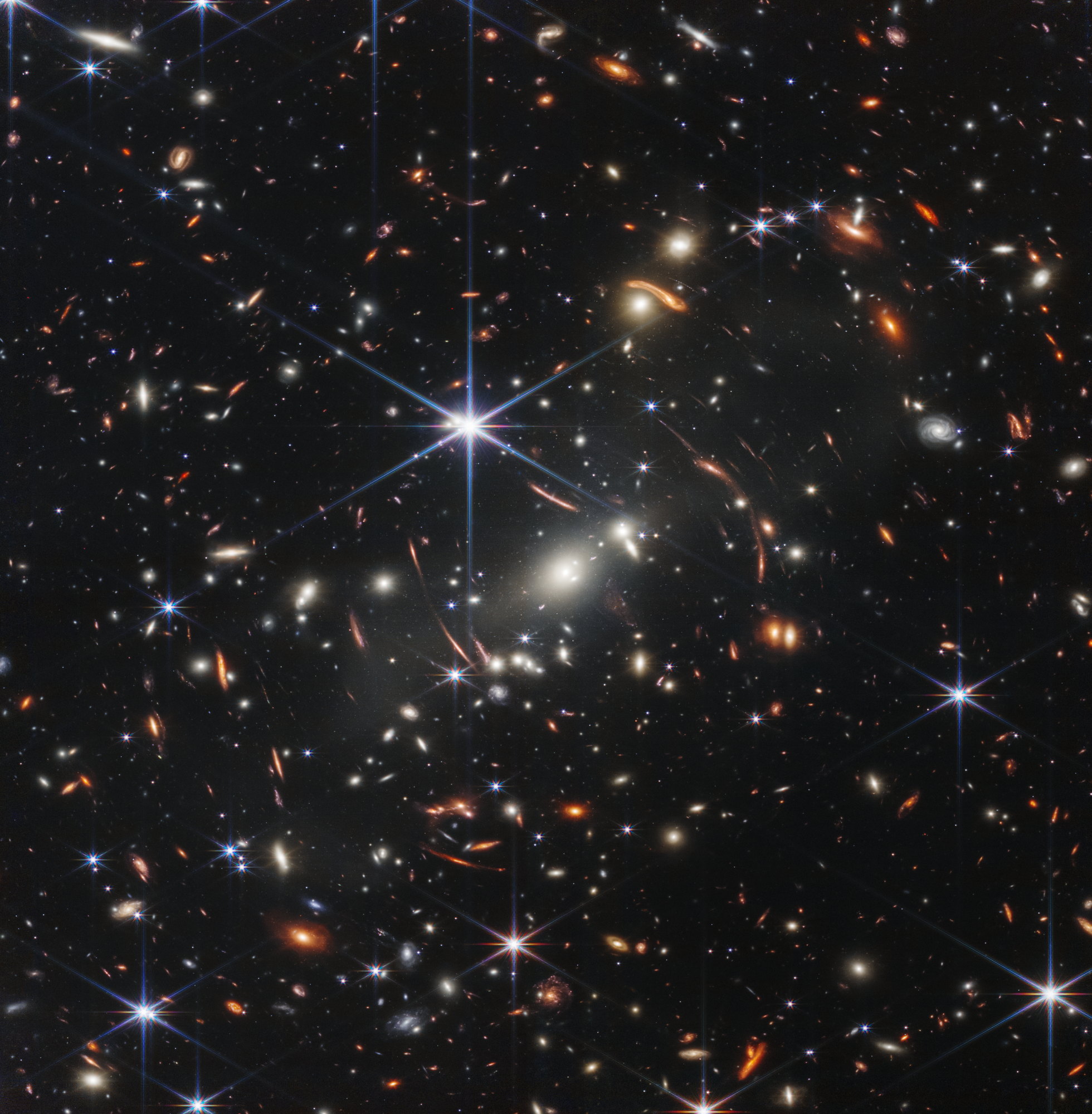
Approx. distance from Earth: about 4.24 billion light-years to the lensing cluster SMACS 0723; many of the background galaxies are much farther away.
Approx. width of the object(s) in the image: at the distance of the foreground cluster, the 2.4-arcminute-wide field spans roughly 3 million light-years across.
Approximate sky region: in the constellation Volans, low in the deep southern sky.
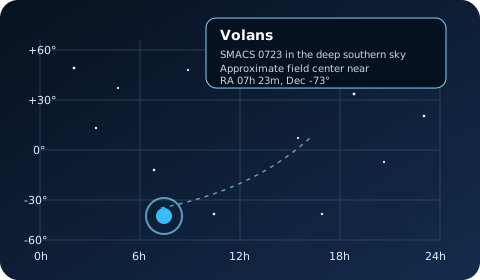
Source: NASA Science
5. Cosmic Cliffs, Carina Nebula - James Webb Space Telescope - 2022
This image looks like a mountainous landscape but actually shows the edge of the star-forming region NGC 3324. Webb’s infrared vision penetrated dust and revealed previously concealed young stars, jets and cavities produced by stellar radiation. NASA explains that the apparent "steam" rising from the ridge is actually hot ionized gas and hot dust streaming away under intense ultraviolet radiation. The towering wall marks the edge of a huge cavity carved by radiation and stellar winds from massive young stars above the frame, and some of the golden features are protostellar jets and outflows from newborn stars still embedded in dust.
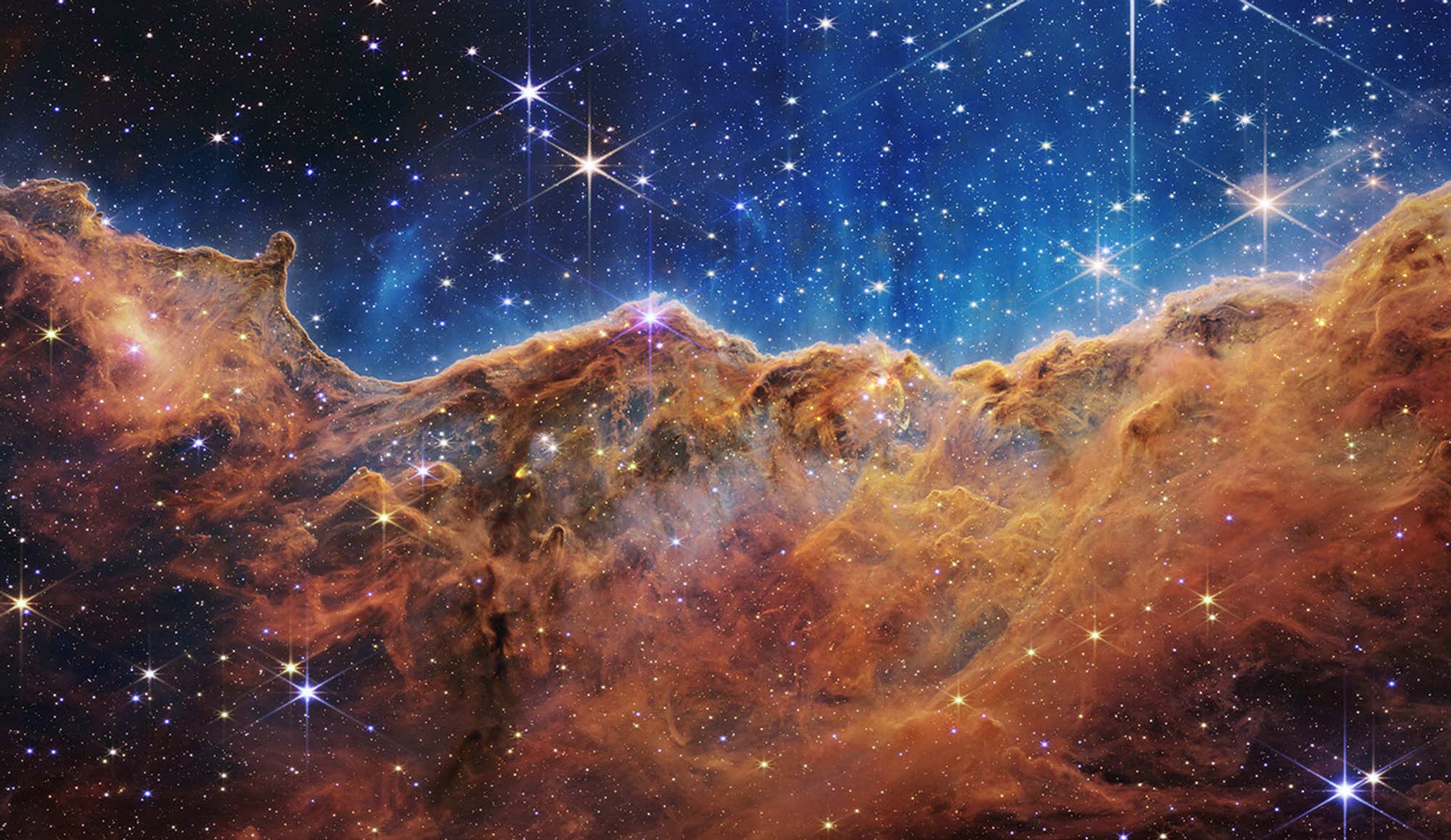
Approx. distance from Earth: about 7,600 light-years.
Approx. width of the object(s) in the image: the scene spans about 16 light-years across, with the tallest peaks rising about 7 light-years high.
Approximate sky region: NGC 3324 at the northwest corner of the Carina Nebula in the constellation Carina, best placed for southern skies.
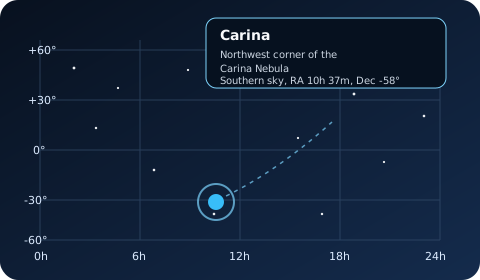
Source: NASA Science
6. Andromeda Galaxy panoramic mosaic - Hubble Space Telescope - 2010-2013
This enormous portrait of our nearest major galactic neighbour was assembled from 7,398 exposures across 411 telescope pointings. The 1.5-billion-pixel mosaic resolves more than 100 million stars across a 61,000-light-year section of Andromeda’s disk, comparable to photographing a beach and distinguishing individual grains of sand. In the image, large groups of young blue stars mark star clusters and active star-forming regions, while the dark streaks are dust lanes threading through the disk. Beneath those features is a smoother distribution of cooler red stars, which traces the galaxy's older stellar population and shows how much of Andromeda's mass is concentrated in its bulge and broad disk.
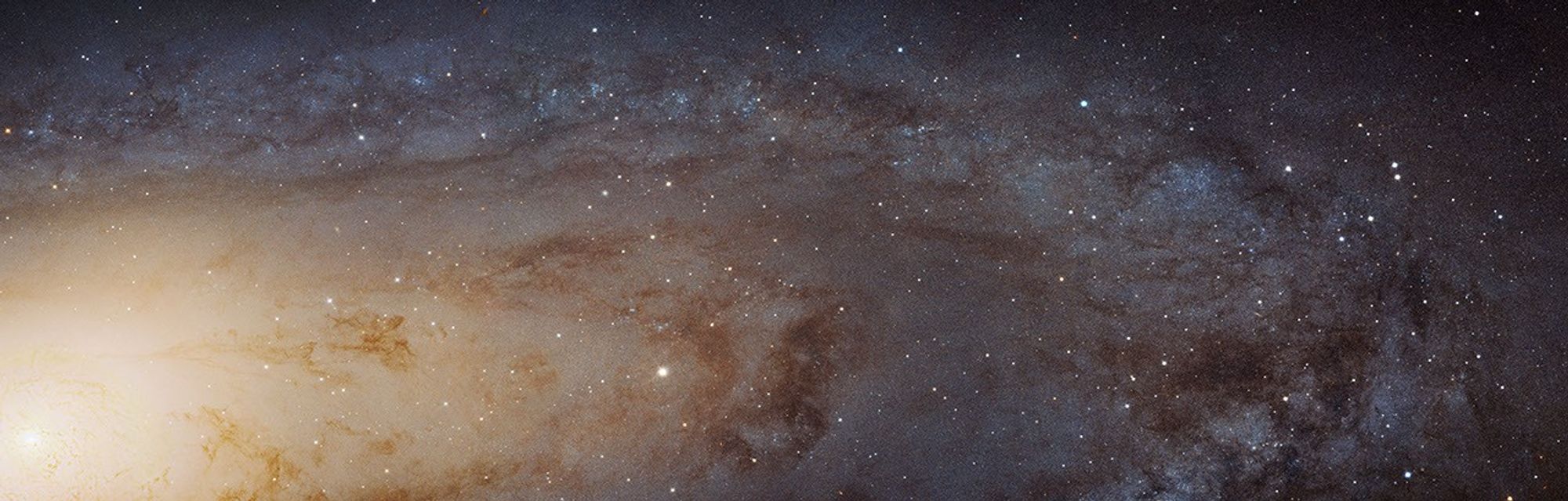
Approx. distance from Earth: about 2.5 million light-years.
Approx. width of the object(s) in the image: this Hubble mosaic section covers about 61,000 light-years across Andromeda's disk.
Approximate sky region: the constellation Andromeda in the northern autumn sky.
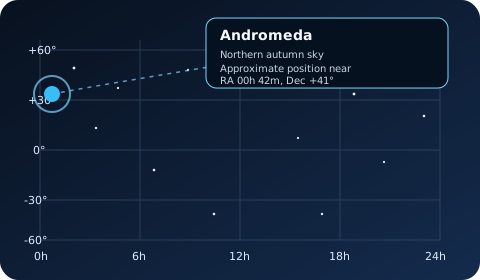
Source: NASA Science
7. Crab Nebula mosaic - Hubble Space Telescope - 1999-2000
The Crab Nebula is the expanding wreckage of a massive star whose explosion was observed from Earth in 1054. Hubble’s 24-exposure mosaic reveals complex filaments of hydrogen and oxygen surrounding a rapidly rotating neutron star that energizes the nebula. NASA notes that the orange filaments are mostly hydrogen, the blue outer filaments trace neutral oxygen, green marks singly ionized sulfur, and red indicates doubly ionized oxygen, so the colors help show the chemical debris thrown out by the supernova. The eerie blue glow in the interior comes from electrons whipping around magnetic field lines near the pulsar, showing how the collapsed stellar core is still pumping energy into the expanding remnant.
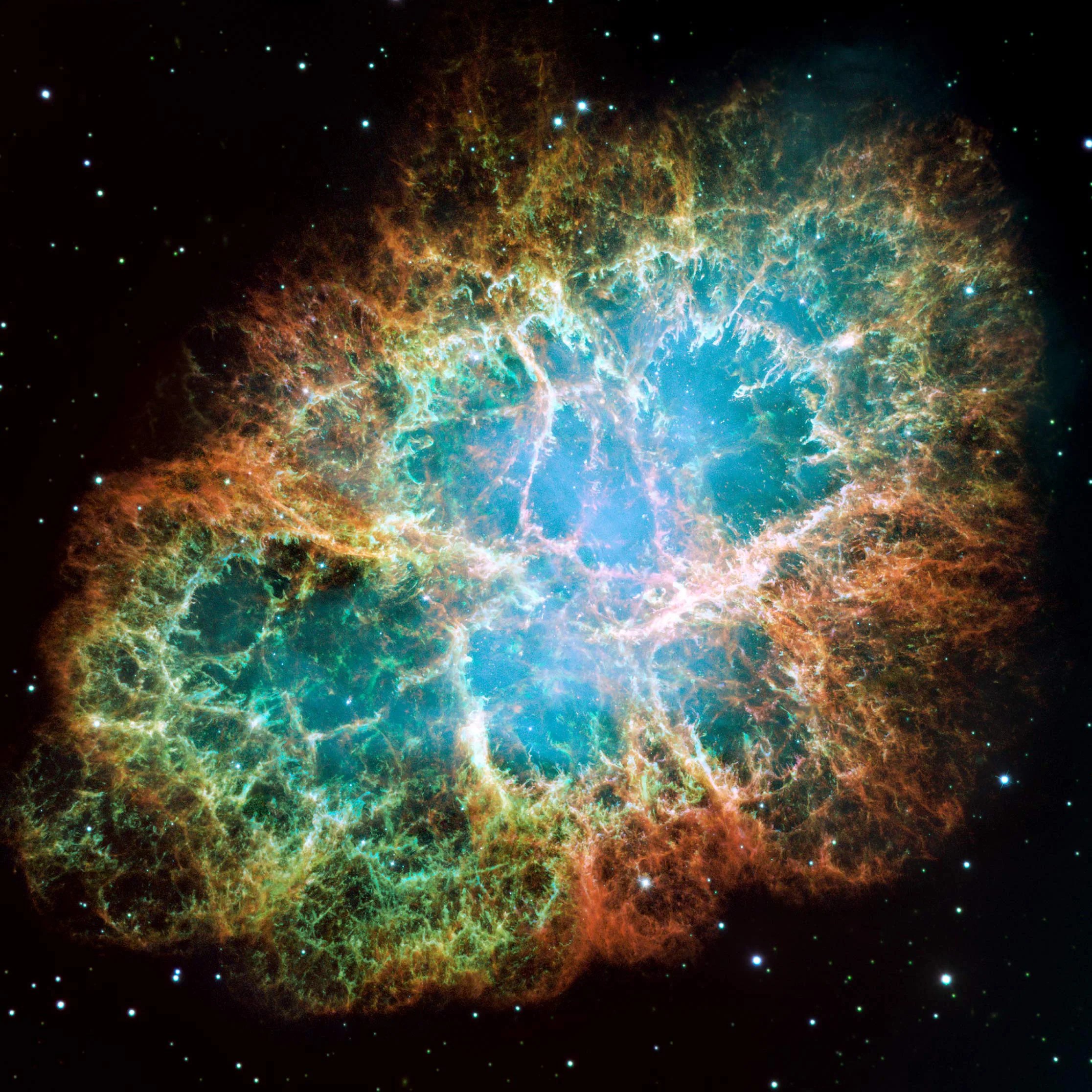
Approx. distance from Earth: about 6,500 light-years.
Approx. width of the object(s) in the image: about 6 light-years across.
Approximate sky region: the constellation Taurus, in the northern winter sky.
Source: NASA Science
8. Whirlpool Galaxy - Hubble Space Telescope - 2005
M51 is one of the clearest examples of a grand-design spiral galaxy. Its sweeping arms contain dust lanes, pink star-forming regions and brilliant young star clusters; interaction with its smaller companion helps drive this dramatic spiral structure and ongoing star formation. In NASA's description of the image, the red highlights hydrogen and infrared light from giant star-forming regions, blue marks hot young stars, and yellow comes from older stars. The smaller yellowish companion galaxy, NGC 5195, is tugging on one of the spiral arms, and those tidal forces help compress gas in the arms and trigger new waves of star birth.
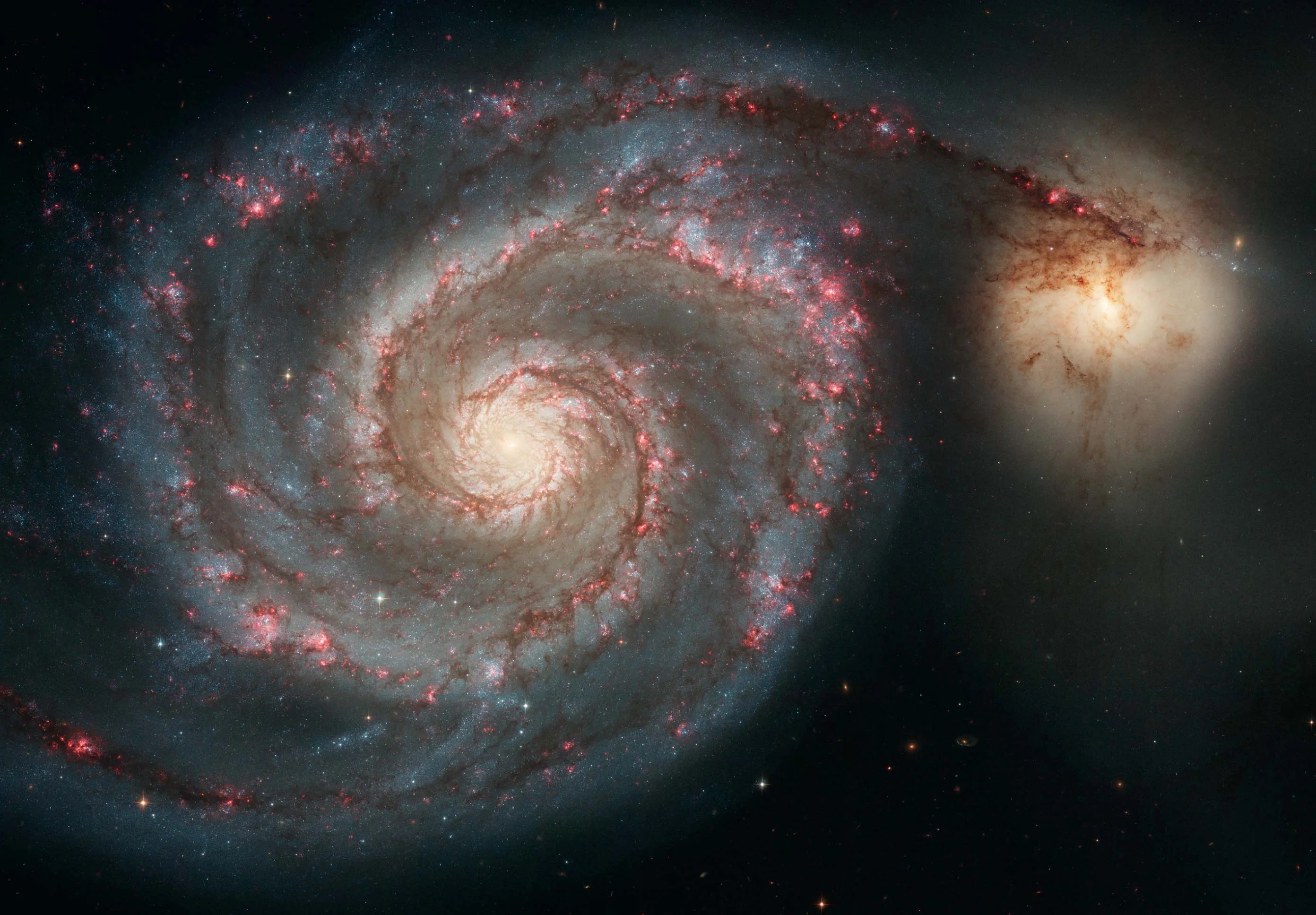
Approx. distance from Earth: about 31 million light-years.
Approx. width of the object(s) in the image: about 87,000 light-years across.
Approximate sky region: the constellation Canes Venatici, high in the northern spring sky.
Source: NASA Science
9. Horsehead Nebula in infrared - Hubble Space Telescope - 2013
In visible light, the Horsehead appears as a dark silhouette because its dust blocks background starlight. Hubble’s infrared image penetrated much of that dust, transforming it into a translucent landscape and revealing embedded young stars and finer cloud structure. NASA's infrared color assignment maps one wavelength band to cyan-blue and another to red-orange, helping separate structures within the cloud. The bright rim along the upper ridge is illuminated by Sigma Orionis just outside the frame, while the protruding pillar survives because it contains denser hydrogen, helium, and dust that shield material behind it from being photo-evaporated.
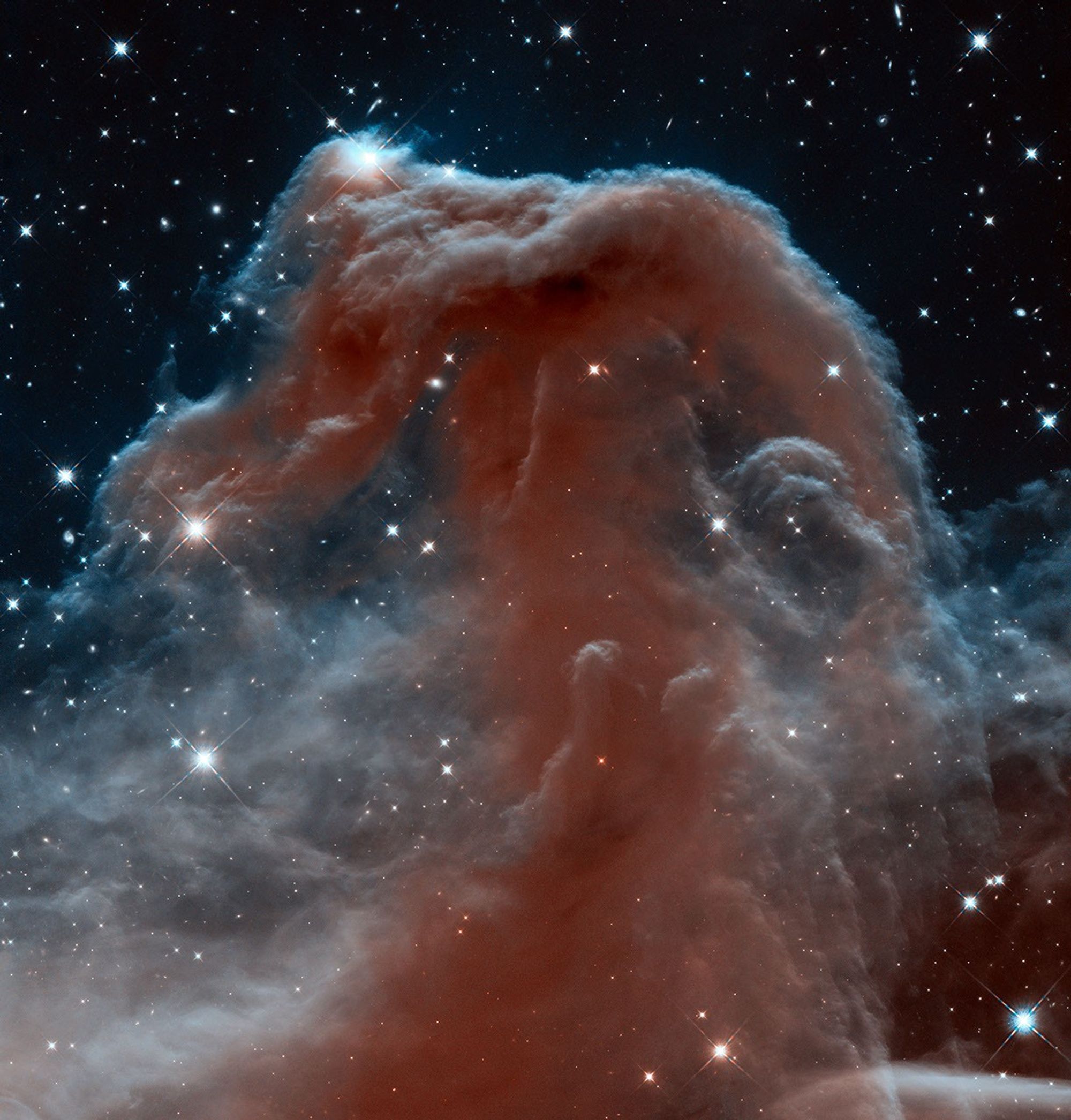
Approx. distance from Earth: about 1,600 light-years.
Approx. width of the object(s) in the image: about 2.5 light-years across.
Approximate sky region: the Orion Molecular Cloud in the constellation Orion, in the northern winter sky.
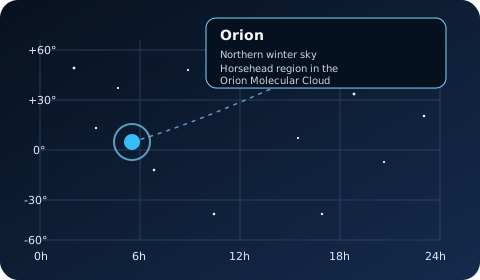
Source: NASA Science
10. Sombrero Galaxy - Hubble Space Telescope - 2003
The Sombrero Galaxy became famous for its bright central bulge and dark, sharply defined dust lane, which resembles the brim of a hat. Because the galaxy is viewed nearly edge-on, the image clearly exposes its thin stellar disk, central concentration of older stars and unusually extensive system of globular clusters. The dark band is dust in the galaxy's pancake-like disk, seen in silhouette because it cuts across the bright bulge behind it. Hubble also showed that the galaxy hosts nearly 2,000 globular clusters, with many of the metal-rich ones concentrated toward the bulge, reinforcing the impression that much of the galaxy's stellar mass is packed into its central regions.
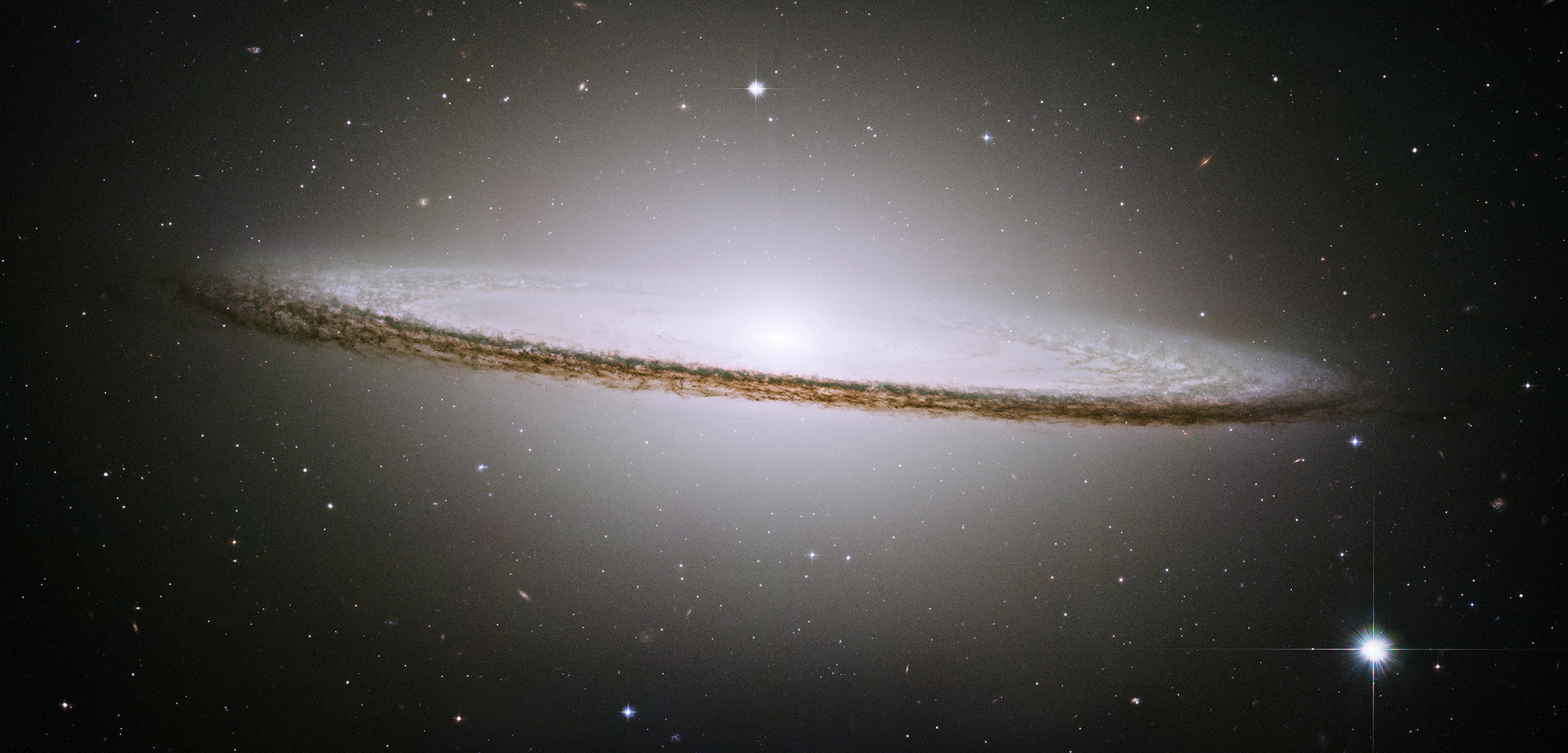
Approx. distance from Earth: about 28 million light-years.
Approx. width of the object(s) in the image: about 50,000 light-years across.
Approximate sky region: the constellation Virgo, in the northern spring sky.
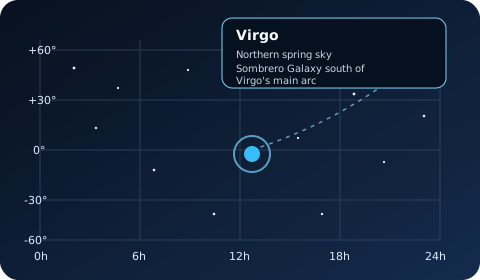
Source: NASA Science
Note: Many astronomical photographs are actually mosaics or composites assembled from multiple exposures and assigned colours corresponding to different wavelengths. That means the final published image is often both scientific data and a carefully composed visual interpretation.