Exploration Spacecrafts Launched
This page estimates how many robotic exploration spacecraft missions humans have launched beyond ordinary Earth orbit, how those counts change depending on the counting method, and which destinations and decades dominate the history of exploration.
Overview
Approximately 280 to 300 distinct robotic exploration missions or launch attempts
A reasonable single-number estimate is about 290 missions.
This estimate includes spacecraft launched, or intended to be launched, beyond ordinary Earth orbit to explore the Moon, the Sun and interplanetary space, Mercury, Venus and Mars, the outer planets and their moons, asteroids, dwarf planets, comets, Kuiper Belt objects, the heliosphere, and interstellar space.
It excludes Earth-observation satellites, communications satellites, most astronomical telescopes, military spacecraft, crewed lunar missions, and spacecraft that remained in ordinary Earth orbit.
Different ways of counting
| Counting method | Best estimate through August 5, 2026 |
|---|---|
| Distinct robotic launch missions or attempts | 280 to 300 |
| Missions that successfully departed Earth orbit | Approximately 210 to 240 |
| Individual exploration spacecraft and components | Approximately 340 to 400 |
| Best single estimate for individual spacecraft | Around 370 |
The totals differ because a single launch mission can contain several separately operating spacecraft.
- Cassini-Huygens: Cassini orbiter plus Huygens lander
- Galileo: Jupiter orbiter plus atmospheric probe
- Viking 1: orbiter plus lander
- Mars 2020: Perseverance rover plus Ingenuity helicopter
- Tianwen-1: orbiter, lander, Zhurong rover, and deployable cameras
- Pioneer Venus Multiprobe: carrier bus plus four atmospheric probes
- Chandrayaan-2: orbiter, Vikram lander, and Pragyan rover
- Chang'e 5: orbiter, lander, ascent vehicle, and Earth-return capsule
Therefore, counting missions produces about 290, while counting every independently operating probe, rover, lander, helicopter, or return capsule produces something closer to 370.
A more restrictive public summary sometimes uses roughly 200 craft sent to encounter celestial bodies, which is broadly consistent with excluding many failed launches and some secondary components.
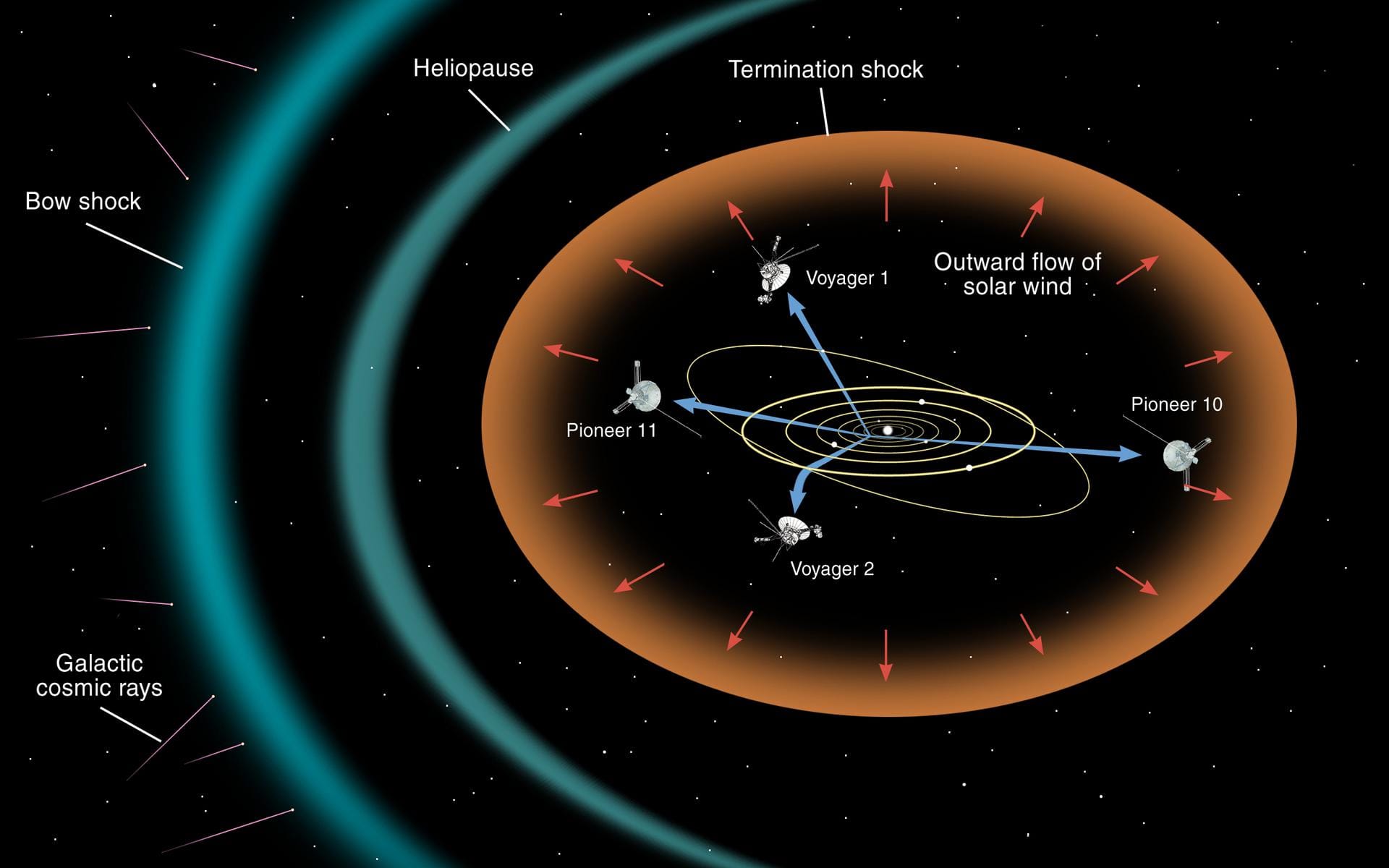
Credit: NASA/JPL.
How the estimate was constructed
The following are the largest categories. They cannot simply be added without adjustment because certain spacecraft explored more than one destination.
Moon: approximately 135 robotic missions
A current comprehensive lunar list through Artemis II implies roughly 135 robotic lunar launch missions after removing crewed Apollo Moon missions and Artemis II. The Moon alone therefore represents nearly half of all robotic deep-space exploration attempts.
Mars: 48 launch missions
The comprehensive Mars mission list reached 48 numbered launch missions with the twin ESCAPADE spacecraft launched in November 2025.
| Decade | Mars missions |
|---|---|
| 1960s | 12 |
| 1970s | 11 |
| 1980s | 2 |
| 1990s | 7 |
| 2000s | 6 |
| 2010s | 6 |
| 2020 to 2026 | 4 |
Several Mars missions carried multiple spacecraft, including Mars 2 and 3, Viking 1 and 2, Tianwen-1, and ESCAPADE.
Venus: 40 dedicated missions
There have been approximately 40 dedicated Venus missions, including failed launch attempts. The number rises to about 46 encounters when gravity-assist flybys by spacecraft travelling elsewhere are included.
Mars, Venus, and the Moon dominate
- Moon: approximately 135
- Mars: 48
- Venus: 40
Together these three destinations already account for about 223 launch missions, before adding Mercury, the outer planets, the Sun, asteroids, and comets.
Smaller destinations and mission classes
| Destination or class | Approximate distinct launches |
|---|---|
| Mercury | 3 |
| Outer planets | 11 |
| Asteroids, dwarf planets, and minor planets | Around 30 |
| Dedicated comet missions not already counted | Around 8 to 12 |
| Solar and interplanetary-space probes | Around 20 |
| Miscellaneous deep-space technology missions | Several |
After removing overlaps, such as New Horizons appearing in both outer-planet and minor-planet categories, the total converges on approximately 290 distinct robotic launch missions.
Estimated launches by decade
The following reconstruction counts robotic deep-space exploration launch missions or attempts, not every component carried by them. The figures should be treated as estimates rather than as an exact audited count.
| Decade | Estimated robotic exploration launches | Main activity |
|---|---|---|
| 1950s | 13 | First US and Soviet lunar attempts |
| 1960s | Approximately 95 to 100 | Moon race, early Venus, and Mars exploration |
| 1970s | Approximately 45 to 50 | Moon, Mars, Venus, and first outer-planet probes |
| 1980s | Approximately 10 to 15 | Venus, Halley's Comet, Phobos, and Galileo |
| 1990s | Approximately 20 to 25 | Return to the Moon and Mars; asteroid missions begin |
| 2000s | Approximately 23 to 28 | Mars expansion, comet, and asteroid missions |
| 2010s | Approximately 25 to 30 | Global participation, sample returns, and solar exploration |
| 2020 to August 2026 | Approximately 32 to 38 | Lunar resurgence, asteroid defence, and multi-spacecraft missions |
The midpoint of these ranges is approximately 285 to 290 launch missions.
Which decade had the most launches?
1. The 1960s, by a very large margin
Approximately one-third of all robotic exploration launch attempts in history occurred during the 1960s.
A reasonable reconstruction gives the decade roughly 98 robotic missions:
- Approximately 59 robotic lunar missions
- 12 Mars missions
- Approximately 21 Venus missions
- Approximately six solar or interplanetary probes
Early spacecraft and rockets were unreliable, so the United States and Soviet Union often launched repeated versions of nearly identical probes.
2. The 1970s
The 1970s probably produced approximately 47 robotic exploration launches.
- 18 robotic lunar missions
- 11 Mars missions
- Approximately 10 Venus missions
- Pioneer 10 and 11, Voyager 1 and 2, Mariner 10, Helios 1 and 2, and ISEE-3
The launch count was lower than in the 1960s, but the average scientific capability of each mission was far greater.
3. The current 2020s resurgence
By August 2026, the current decade has already produced approximately 34 robotic deep-space launches, despite being only about two-thirds complete.
- Commercial lunar landers
- Lunar CubeSats and relay satellites
- China's expanding lunar programme
- India, Japan, and South Korea expanding lunar exploration
- Asteroid missions such as Lucy, DART, Psyche, Hera, and Tianwen-2
- Juice and Europa Clipper heading to Jupiter
- More missions carrying multiple independent spacecraft
The 2020s will probably become the most active deep-space exploration decade since the 1970s, although it is still unlikely to surpass the roughly 100 attempts of the 1960s unless lunar launches accelerate dramatically.
Which individual year had the most launches?
Because of classification differences, particularly around unsuccessful Soviet launches, there is no universally maintained official annual ranking. Under the definition used here, the busiest robotic years appear to be the following.
1967: approximately 15 robotic exploration launches
Probable breakdown:
- Approximately 11 lunar missions
- Three Venus missions
- Pioneer 8 for interplanetary and solar observations
The lunar launches included Lunar Orbiter 3, 4, and 5; Surveyor 3, 4, 5, and 6; Explorer 35; Kosmos 159; and two unsuccessful Zond missions.
1965: approximately 14 launches
Probable breakdown:
- Nine lunar missions
- Four Venus missions
- Pioneer 6
1969: approximately 13 robotic launches
This rises to approximately 16 exploration missions if the crewed Apollo 10, Apollo 11, and Apollo 12 missions are included.
The robotic missions included several Soviet lunar spacecraft, Luna 15, Zond 7, two Soviet Mars attempts, Mariner 6 and 7, Venera 5 and 6, and Pioneer E.
Conclusion: 1967 is probably the busiest year for purely robotic exploration spacecraft launches, while 1969 may be the busiest year if crewed lunar exploration is included.
Most interesting historical patterns
The majority of launches targeted only three worlds
Approximately three-quarters of all robotic exploration launch missions targeted the Moon, Mars, or Venus.
- Only three mission systems have been launched specifically to Mercury
- Only one spacecraft has visited Uranus
- Only one spacecraft has visited Neptune
- Only one spacecraft has visited Pluto
- Only four spacecraft have reached Saturn
- A relatively small number have reached Jupiter
Early quantity reflected high failure rates
The extremely high 1960s launch rate does not mean that decade returned more science than all later decades.
- Many spacecraft exploded during launch
- Many failed to leave Earth orbit
- Many lost radio contact
- Some crashed during landing
- Some operated for only minutes
Modern agencies generally launch fewer but much more capable spacecraft.
Modern launches carry more explorers per rocket
One 1960s launch usually carried one probe. A modern launch may carry an orbiter, a lander, a rover, a helicopter, deployable cameras, several CubeSats, and sample-return or ascent vehicles.
This is why the number of individual spacecraft components is growing faster than the number of rockets or missions.
Mars became the sustained-exploration planet
The Moon received the most total launch attempts, but Mars became the destination with the most persistent long-duration robotic presence. Modern Mars missions form a connected infrastructure of orbiters, landers, rovers, and communications relays.
The centre of exploration is becoming international
The 1960s were almost entirely a US-Soviet competition. The modern exploration community includes the United States, China, European nations, India, Japan, Russia, the United Arab Emirates, South Korea, Israel, commercial American and Japanese companies, and smaller nations contributing CubeSats and instruments.
Useful final estimate
Humans have made roughly 290 robotic exploration launch attempts beyond normal Earth orbit. These missions carried approximately 370 independently identifiable spacecraft, probes, landers, rovers, helicopters, atmospheric vehicles, and return capsules. About 210 to 240 mission spacecraft probably succeeded in leaving Earth orbit.
The uncertainty is not primarily due to missing major missions. It comes from deciding whether to count multiprobe systems, deployable cameras, CubeSats, impactors, return capsules, failed launches, and spacecraft that merely used a planet for gravity assistance as separate exploration spacecraft.
Sources - public mission summaries and mission-list aggregations from National Geographic Education, Wikipedia mission lists, NASA Science lunar chronology, and The Planetary Society.